

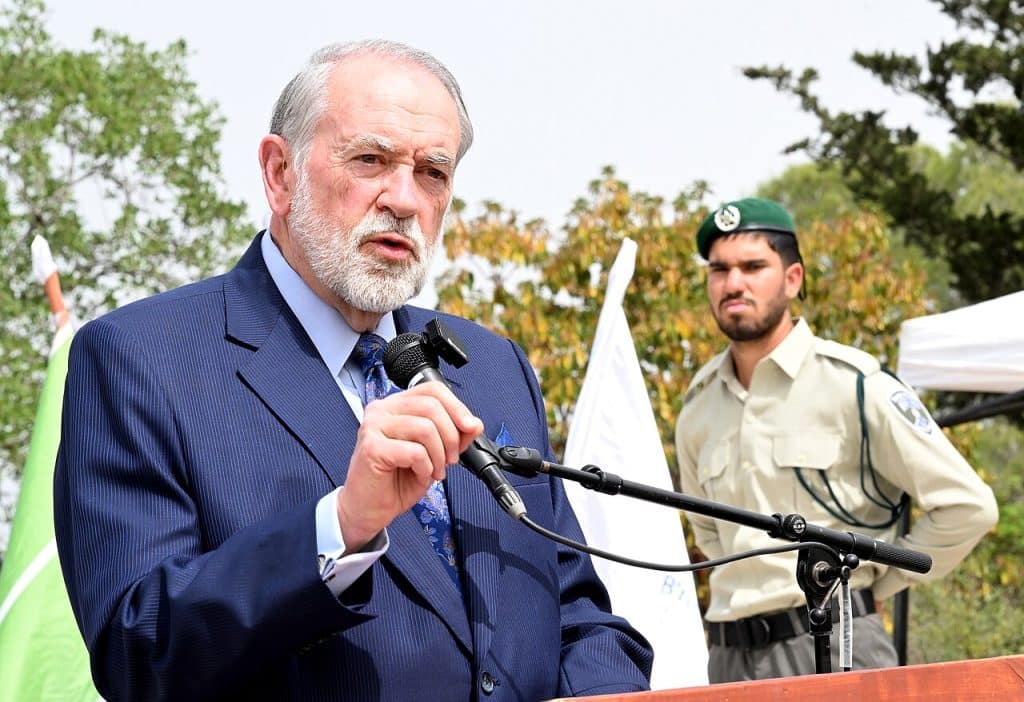
Last week, the Patriarchs and Heads of Churches in Jerusalem, the leaders of the historic churches in the Holy Land, issued a momentous statement clearly expressing their rejection of Christian Zionism. The statement was remarkable not only for its clarity but also for the moment of its release and the response it provoked from U.S. Ambassador to Israel Mike Huckabee, a vocal Christian Zionist. The episode highlights an emerging threat to the work and witness of the Palestinian church, as well as steps Christian Zionists are taking to erase our political voice.
The Patriarchs’ statement read, in part:
The Patriarchs and Heads of Churches in the Holy Land affirm before the faithful and before the world that the flock of Christ in this land is entrusted to the Apostolic Churches, which have borne their sacred ministry across centuries with steadfast devotion. Recent activities undertaken by local individuals who advance damaging ideologies, such as Christian Zionism, mislead the public, sow confusion, and harm the unity of our flock. These undertakings have found favor among certain political actors in Israel and beyond who seek to push a political agenda which may harm the Christian presence in the Holy Land and the wider Middle East.
What does this mean?
The statement is a response to disturbing developments taking place in Palestine that threaten the integrity, unity, and historical authority of the Christian Churches in the Holy Land. What specifically stirred the Patriarchs appears to be a growing pattern: the promotion of self-appointed local individuals or groups, welcomed at official political levels, who claim to represent Christians in Israel or the Holy Land while advancing Christian Zionist theology. Such initiatives have happened in the past and have gone unnoticed. But recently, such meetings have involved senior U.S. and Israeli officials, including Ambassador Huckabee, and increasingly pose a direct threat to the historic authority of the Heads of Churches and the integrity of the Christian faith. They undermine the centuries-old ecclesial structures (known as the Status Quo) that have maintained the unity of Christian communities in Palestine throughout a history of empire, colonialism, and occupation.
This is why Ambassador Huckabee felt compelled to publicly comment on the Patriarchs’ statement. He wrote in part, “It’s hard for me to understand why every one who takes on the moniker ‘Christian’ would not also be a Zionist.” The importance he gives the statement points to the serious stakes that issues of representation and power hold for Christians in the Holy Land and the degree of political interference Israel and its supporters are willing to exert to undermine anti-Zionist Christian voices.
It is worth asking why a U.S. representative would intervene at all in an internal matter of the Churches of Jerusalem. After all, the Patriarchs’ statement is not a political manifesto. It is a pastoral affirmation from those who legitimately represent Christian communities in the Holy Land. Huckabee’s response, therefore, reveals more about the political sensitivities exposed by the statement than about the statement itself. His reaction underscores precisely the concern the Patriarchs raise: certain political actors in Israel and abroad seek alternative Christian voices that are more aligned with their ideological and geopolitical agendas.
Huckabee’s interference cannot be separated from the broader political context. In recent years, we have witnessed systematic efforts by Israel and its allies, particularly the United States, to delegitimize official Palestinian representation. This process began with the weakening of the Palestinian Authority, criminalizing our resistance and our political parties. It continued with the designation of respected Palestinian NGOs as “terrorist organizations.”
It now appears this interference and repression is extending into the Christian sphere. Creating or empowering a local Palestinian Christian Zionist group provides a convenient alternative—a useful narrative—that allows political powers to bypass church leaders, silence prophetic Palestinian Christian witness (Kairos Palestine, Sabeel, Bethlehem Bible College, and others), and cast doubt on the legitimacy of long-established Palestinian institutions.
This is especially alarming at a moment when Palestinian Christians, alongside Muslims, have been among the most consistent and moral voices confronting genocide, mass displacement, and grave violations of international law in Gaza and beyond. Our advocacy has exposed not only Israeli policies but also the direct complicity of the United States. In this light, the emergence of a politically endorsed “Christian” voice that blesses occupation and its violence is not accidental. It serves a clear strategic purpose.
The Patriarchs’ language in their statement is also significant. Their critique of Christian Zionism and their emphasis on unity, representation, and pastoral responsibility closely echo the theological clarity of Kairos Palestine, particularly in its recently released document, Kairos II, A Moment of Truth: Faith in a Time of Genocide. Kairos II unambiguously names Zionism as a political ideology rooted in injustice and calls Christians worldwide to reject theological distortions that tolerate oppression.
For years, the Kairos movement has sought deeper alignment with church leadership, sometimes from the margins. In this statement, the Heads of Churches appear not only to defend the historical significance of their office but also to offer a practical and positive response to the Kairos call, affirming what is ultimately at stake: the future of Christian presence in Palestine. Their statement signals that the churches’ shepherds in Jerusalem increasingly recognize that neutrality in the face of political theology is impossible, and that safeguarding Christian unity today requires naming false theologies and resisting political manipulation. The Patriarchs are not merely protecting their institutional authority. They are defending the integrity of Christian witness in the land of Christ.
In this sense, Huckabee’s intervention confirms the urgency of the Patriarchs’ message. The struggle is no longer only about land or politics. It is also about who speaks for the Christian community, whose theology shapes—or helps to shape—global Christian understanding, and whether the churches of the Holy Land—and beyond—will be sidelined in favor of voices connected to Israel’s hegemonic and genocidal policies.
The Patriarchs’ statement is not defensive. The statement is prophetic. It draws a clear line between authentic church representation and politically manufactured alternatives. It reminds both the global church and the world that the Christian presence in Palestine cannot survive if it is severed from truth, justice, and the lived experience of its people, whose ancestors first claimed the faith and brought it to the world.
At this critical time, we are all encouraged to support our church leaders, helping to ensure that this clarity is preserved and strengthened, as the Patriarchs declare, “in the very land where our Lord lived, taught, suffered and rose from the dead.”

Huckabee: “It’s hard for me to understand why every one who takes on the moniker ‘Christian’ would not also be a Zionist.”
It’s hard for me to understand why any one can take on the moniker ‘Christian’ and is a Zionist only because he adheres to a satanic theology in which a Jewish Holocaust is treated as necessary, provided it happens in Israel. Christian Endtimes Neo‑Nazism is a theological system that normalizes the mass death of Jews as divinely necessary, treating human life as instrumental to salvation while cloaking eliminationist goals in pseudo “christian”piety and “love.”.The worst kind of structural antisemitism.
“Are ye not as children of the Ethiopians unto me, O children of Israel? saith the Lord. Have not I brought up Israel out of the land of Egypt? and the Philistines from Caphtor, and the Syrians from Kir? — Amos 9:7. Spinoza noted there was nothing special about Israel or Judah. They had all broken their Covenants and committed the same offenses alleged against the Canaanites, and forfeited their rights in the same fashion.
The biblical gathering of all nations to Mount Zion is a prophetic, eschatological vision found in Isaiah 2, Micah 4, Isaiah 25, Romans 11, and Hebrews 12. It describes a future time when all nations stream to Jerusalem to worship the Lord, learn His ways, and experience lasting peace, highlighted by a great banquet and the end of war. Even the Book of Revelation states that the “four beasts”, the “four and twenty elders”, and the great multitude are just resurrected people “from every nation, tribe, and tongue” (which includes Israel and Judea). You might have missed some of that if all you bothered to read is the Scoffield Bible or the Talmud. FYI, Abimelech and Abraham concluded a Covenant of Peace. The Kings Highway was an existing trade route that was goverened by more dangerous rulers than either man, long before Abraham or Abimelech ever arrived. The Prophets explained that Judah and Israel were Covanent breakers. Acceptance of both the blessings and curses were part and parcel the same deal (Deuteronomy 28:15-68, Leviticus 26:14-39).
I find it surprising that anyone considers remarks from a former State Governor or current U.S. Ambassador voicing approval of Trump’s plan that called for the forced displacement of approximately two million Palestinians to neighboring lands any kind of Christian at all. Dozens of verses about false prophets and corrupt rulers of the current age seem more applicable to fornicators, felons, and murderers. He just attended Netanyahu’s Jerusalem Summit on Antisemitism as a featured Speaker. He advocates for an unconstitutional religious test (the IHRA definition of Antisemitism) that a Federal Judge announced was part of a Trump Adminstration criminal conspiracy. The lawsuit was brought by the American Association of University Professors (AAUP) and the Middle East Studies Association (MESA), which include many public employees. They are faculty and staff who are targeted for persecution, arrest, and deportation.
Dear Phil, Adam, Mark Braverman, Rifat Kassis, Mondoweiss supporters, and the Holy Land’s churches and Christians,
Thank you very much for your continued work and courage in the face of adversity. These kinds of spiritually hard times have the positive side effect of bringing people together and spiritually closer. They test and try us, but they also show us our good sides and help us care more for each other.
Huckabee writes:
“It’s hard for me to understand why every one who takes on the moniker ‘Christian’ would not also be a Zionist.”
I don’t know if it’s actually hard for him to understand that or if it’s just polemics. Christian Zionism is basically a recent movement when compared to the expanse of Christian history and Tradition. Probably it stopped being just a marginal movement sometime in the early to mid 20th century. The Church Fathers, the traditional Churches, and the Founders of the Protestant Reformation weren’t Christian Zionists in the modern political sense.
To the extent that one can find any version of Christian Zionism in classic Christian writings, it just shows up in passing in the form of an expectation of an apocalyptic Messianic-era gathering of Jews to the land of Zion. The form mentioned doesn’t state political expectations about the religious or political institutions that would result there. Nor would it make sense for it to accord with the current state there, because in the classic Christian writings that expectation is put in terms of conversion.
The classic expectation in classical Judaism, including classic rabbinical tradition, has a somewhat similarly expected Messianic timeline for restoration of the people to the land: The people would become pious and observant, and then the Lord would restore them to Zion as a reward.
US white racist Christian Zionism is an evolution of white racist southern Christian redeemer ideology. Palestinians have no place in an ideology of racial hierarchy.
The Truth About US Christian Zionism
Grace rhymes with race
While Christian Zionism is commonly traced to 19th-century Anglo-American Restorationism, which envisioned Jewish return to Palestine as a prerequisite for Christ’s return, this narrative neglects the deep imprint of Southern white Redeemer ideology on the political and theological shape of American Zionism in the 20th century. After the Civil War, Redeemers sacralized the political reclamation of white supremacy in the South by deploying a religious vocabulary of redemption, divine election, and messianic victory.¹ This ideology reimagined the South as a “redeemed” land restored to its rightful Christian (white) stewards through suffering and eventual triumph—an eschatological narrative strikingly parallel to Christian Zionist portrayals of Israel’s national restoration. In both cases, divine favor is tied to territorial conquest, racial hierarchy, and prophetic destiny.
As Paul Harvey demonstrates, Southern Baptists and other evangelicals fused regional identity with a racialized theology of order, preparing a cultural soil in which the later political Zionism of Christian America could flourish.² Although Restorationist theology provided the scriptural scaffolding for Christian Zionism, Redeemer ideology supplied its political psychology: a belief in righteous domination, national exceptionalism, and sacred violence.³ This fusion is especially evident in the Cold War and post-1967 era, when U.S. evangelicals increasingly cast Israel’s geopolitical triumphs as divinely sanctioned and mirrored their own imagined Christian dominion.⁴ Thus, Christian Zionism in the U.S. is not merely a legacy of Restorationist prophecy, but also a rearticulation of the South’s white redemptive myth, projected onto a global stage.
Footnotes
Though borne first, Christian zionism is an arm of Zionism (which is not purely Jewish or Swiss etc). It is a global movement not only to create a Jewish state on top of an emptied Palestine, but to rule over the whole arab homeland. Any otherwise understanding is a diminished one.