
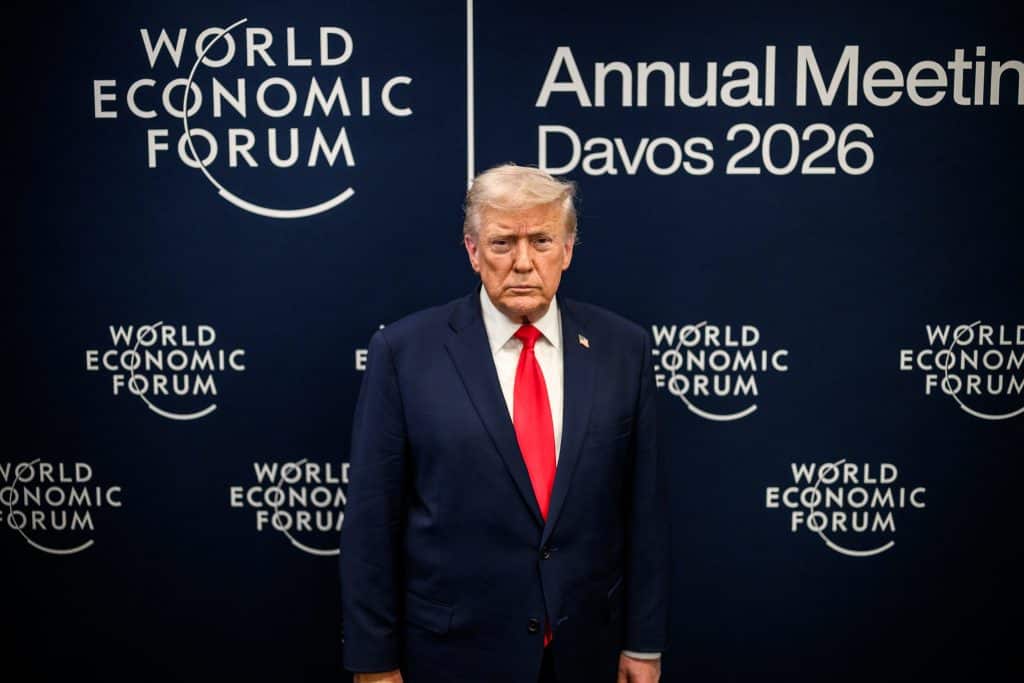
A lot of eyes were focused on the World Economic Forum in Davos this week, but while the world was riveted on Switzerland, scant attention was being paid to the Middle East where escalating tensions threaten to reach a boiling point.
In Palestine, Syria, Lebanon, Yemen, Sudan, Iraq, and Iran, long-standing crises have expanded and become more entangled with each other, and for all of Trump’s pretensions of isolationism or restricting American activity to the Western Hemisphere, the U.S. remains deeply entangled in the Middle East, always to the detriment of the people in the region.
With so many hot spots in the region, so much American clumsiness, and Israeli aggression aggravating an already tense situation, it is impossible to predict where the greatest rupture might be located. But it is worth looking at several particularly sensitive areas.
Palestine
Trump presided over the inauguration of the Orwellian-named “Board of Peace” in Davos. The charter of the Board makes no mention of Gaza, Palestine, or even Israel. Indeed, it has become clear that Gaza was merely a pretext for Trump to get the UN Security Council to endorse the Board, giving it some small, but unearned, legitimacy.
The Board, which is currently filled entirely with far-right and autocratic countries, is intended to challenge the United Nations as a semi-governing international body, and in Gaza, it is the so-called “Executive Board” that is intended to oversee the subjugation of the Palestinians and the theft of Gaza.
One of the Executive Board members—Trump’s son-in-law Jared Kushner—presented his plan for Gaza at Davos. It envisions a glittering playground for the wealthy, one that Palestinians would find unrecognizable. The vision does not include any specific plan for reducing the Palestinian population of Gaza, but it is hard to envision Palestinians being more than, at best, a servant class in their own land under this plan.
While that vision remains very much a vision at the moment, Israel still maintains readiness for a renewed military operation in Gaza. The attack is intended to expand Israel’s zone of control in the Strip and is scheduled for March, pending American approval.
Neither Israel nor the Trump administration has shown a willingness to negotiate with Hamas and other Palestinian factions in Gaza regarding the decommissioning of weaponry in Gaza, something Hamas has indicated they are willing to discuss, though complete disarmament is a non-starter for them.
The lack of motion on this issue will give Israel all the pretext it needs to launch a new wave of genocidal violence. It seems this is the direction we are heading in.
In the West Bank, with little attention in the West, Israel has launched its biggest assault on Hebron since the Second Intifada. The attack seems to have numerous purposes.
Combining these religious provocations with a large-scale attack in a fraught city, along with the ongoing killing in Gaza, gives a strong impression that Israel is trying to provoke a Palestinian response and generate an excuse for a massive increase in violence.
The obvious goal is to tighten the occupation in a key West Bank city. But there is more here. Israel is ratcheting up its rhetoric (though not its actions) against the settlers’ random violence. This is a reaction to the U.S., and it is geared not toward diminishing the violence against Palestinians but making that violence more “official” by transferring more of it from the settlers to the security forces.
Simultaneous developments indicate a strong ideological component to this attack as well. Israel has barred the top two Palestinian administrators at the Ibrahimi Mosque in Hebron from entering or praying at the Mosque for fifteen days. The mosque shares a compound with the Tomb of the Patriarchs, one of Judaism’s most revered sites in the region, and a key site for Jewish nationalism.
Last summer, Israel took over the administration of the Tomb of Patriarchs, part of the site, a significant shift in the status quo of the area. It is unclear precisely why Israel barred the administrators at this time.
But this action occurred around the same time as Israel decreed that Jewish pilgrims could bring prayer books and prayer pages to the Temple Mount in Jerusalem, a further and significant blow to the status quo at that site, which dictates that Jewish prayer on the site is not permitted.
Combining these religious provocations with a large-scale attack in a fraught city, along with the ongoing killing in Gaza, gives a strong impression that Israel is trying to provoke a Palestinian response and generate an excuse for a massive increase in violence throughout the areas under its control.
Iran
Meanwhile, both Israel and the United States appear poised to unleash chaos in Iran.
Recent protests there seem to have been crushed by the Islamic Republic, and the Iranian government now seeks to blame everything that happened on Israel and the U.S. With an internet blackout continuing to cover Iran, it’s impossible to be certain about the various narratives that have emerged. What seems to have happened is that the protests in Iran started and initially grew organically. They were, at first handled in a limited manner by the government, but that didn’t last, and intense violence emerged.
What is not clear is what role outsiders played in that escalating violence. There is no doubt that once the government in Iran set out to violently quell the protests, there was little restraint there. And, to be sure, when government spokespeople claim the violence was initiated by provocateurs from the U.S. and Israel, possibly working with Reza Pahlavi, the son of the last Shah of Iran, it is hard to escape the fact that it is a self-serving argument.
Self-serving doesn’t necessarily mean untrue, however, and the question of outside involvement must be investigated. We know for certain that the Mossad has an extensive network inside of Iran, one that proved extraordinarily effective in crippling Iran’s defense during Israel’s attack last June.
There are also testimonies that carry some weight, indicating that clandestine operatives of some kind were riling up crowds during the protest. Were these Israeli agents? Were they perhaps collaborators with Pahlavi, perhaps even paid by the United States?
It’s all possible, and at this stage, it’s all speculation, some of it informed, some less so.
The danger in Iran, however, is undeniable. While there may be a network of provocateurs, and even some growing, though still distinctly minority, support for Pahlavi in the country, there is no indication of any real political structures that could coalesce into a government if the Islamic Republic fell.
This is a very different situation from the one in 1979. At that time, numerous factions and movements organized and came together to overthrow the Shah. After his defeat, there was a struggle within Iran to determine where the country would go from there. The Islamic Revolutionary forces triumphed.
But today, there are no similar forces. The most likely outcome of an overthrow of the Islamic Republic is a power vacuum, which various forces, both from outside and inside Iran, will attempt to fill. Some see the potential for a Syria-like outcome similar to the civil war years. Libya is probably a better comparison. Either will be grim, would mean the factionalization of Iranian territory, and will involve upheaval that cannot be contained within Iran’s borders.
More than any other factor, that was probably the one that got Arab leaders to prevail upon Donald Trump to refrain from an attack on Iran that might have spurred the downfall of the current government.
Benjamin Netanyahu has been spoiling for a new attack on Iran for some time. His claim that he urged restraint from Trump came after Trump had already backed away from his threat to bomb Iran again, and was almost certainly a face-saving measure.
No one but Israel benefits from a shattered and war-torn Iran. In fact, in such a scenario, Israel would probably find itself in a far less secure position regionally. There would literally be dozens of militias and states clashing in and around Iran, and Israelis in Israel and abroad would certainly be targeted.
Moreover, any legitimate Iranian government, no matter how friendly to the West, will still support the Palestinian cause. There is little love for Israel in any sector of Iran.
Syria
Meanwhile, the new Syrian government under Ahmed al-Sharaa is continuing to make advances in recapturing territory that Bashar al-Asad lost control of since 2011.
The Damascus government has essentially defeated the Kurdish Syrian Democratic Forces (SDF), and was encouraged to do so by the Trump administration. This left the Kurds bewildered as to why their American partners abandoned them.
The SDF took control of large parts of northeastern Syria after the fall of ISIL, and had established some autonomy in the region. But the U.S., as well as its Saudi Arabian and Turkish allies, wants to see a reconstituted Syria under one government, realigned toward the U.S.-backed regional infrastructure, and reintegrated fully back into the Arab world.
Türkiye, of course, is also concerned about the precedent of a Kurdish autonomous region not just in Syria, but essentially on Türkiye’s own border. Such an accommodation has found some foothold in Iraq, although it remains very precarious there and is the source of internal tension.
The U.S. seemed to be largely oblivious to these complications as it backed al-Sharaa’s efforts to reunite Syria. The goal of a single Syrian authority is not a bad one, but neither is it simply a matter of drawing up a single constitution. Al-Sharaa seems to understand this, and he issued decrees aimed at protecting Kurds and specifically protecting their rights to teach their culture and making Kurdish an officially recognized Syrian language.
Still, the loss of the Rojava region is a blow to the long-term hopes of an autonomous Kurdistan that spans the borders of the four states it occupies, and it is making it tricky to sustain the current ceasefire in the north.
Al-Sharaa is already dealing with the Israeli occupation in southwestern Syria, an occupation that is perilously close to Damascus. Israel, unlike Türkiye and Saudi Arabia, does not wish to see a reunited Syria, but it has to be very careful about how it goes about opposing a policy that the U.S. is committed to.
Al-Sharaa needs to find ways to bring the Kurds in that keep them from fighting against Damascus. Right now, Kurds in and outside of Syria are feeling betrayed by the West and apprehensive about al-Sharaa. This is why Damascus is not pursuing anything on the touchy Israeli front for now. But Israel is in the dangerous position of spoiler; they can make life even more complicated for Damascus with military action to expand their influence, or even with political demands in Washington about “security concessions” they claim to need from Syria.
Other regional conflicts
The instability in both Syria and Iran has also put Iraq on high alert and raised serious concerns not only in the north of that country, where the Kurdish region is situated, but also around its relationship with Iran. Instability in the Islamic Republic inevitably reverberates in Iraq.
It is almost certain that increased conflict in Syria’s north will spill over into Iraq. Iraqi Kurds have mobilized to defend their borders against the Syrian army, should it advance that far.
There are also serious concerns over the fate of thousands of ISIL prisoners that have been held in northern Syrian camps under Kurdish guard. Much of the talk between Damascus and the SDF has centered around those camps, and the fear of the security there collapsing is a grave concern in Iraqi Kurdish areas.
Meanwhile, Saudi Arabia has largely eliminated the UAE’s control of southern Yemen and, simultaneously, pushed Dubai out of the Sudanese gold market, which it had mostly cornered. This is creating heightened tensions between two very close U.S. allies.
While that will not devolve into direct warfare, we have seen all too many examples—not least in Yemen and Sudan—of the devastation and regional upheaval that Gulf proxy wars can bring. The ongoing genocide in Sudan—a genocide which, as with Gaza, the United States has the power to stop by refusing to sell the UAE weapons if it is going to continue sending them to Sudan’s Rapid Support Forces—is a horrifying example.
These are just some of the situations that threaten the region. They’re all connected. A serious upheaval in Syria, a power vacuum in Iran, or a significant misstep by the United States or Israel could set any one of them off, and lead to a cascade effect of bloodshed throughout the region’s tangled alliances. The Middle East as a whole is on a precipice, and if it slides over it, the entire world will pay the price.


The adopted text of UN Security Council Resolution 2803 (2025) mentions further action by the UN in paragraph 8. This clause stipulates that the authority granted to the Board of Peace (BoP) and the imaginary International Stabilization Force (ISF) to manage Gaza through December 31, 2027, is expressly “subject to further action by the Council” regarding any potential reauthorization or changes. If Israel fires on ISF NATO member states, or OIC, etc., that will trigger mutual defense obligations that the BoP Chair can’t veto..
FYI, you may have noticed that Putin is still the subject of an ICC arrest warrant, because he is the head of a state accused of crimes committed in Ukraine. Nothing in the UN Security Council resolution alters Netanyahu’s status as an international fugitive or Israel as an illegal occupying power.
With reference to the status quo in Al Aqsa compound, it is worth pointing out that the traditional Orthodox rabbinate has long forbidden Jewish entry to the Temple Mount on the grounds that Jewish visitors may violate the sacred ground of the original temple. There used to be a sign indicating that at the entrance to the Mount from near the Western Wall, but I believe that notice has been removed in recent years.
The Kurds are bewildered? The US abandoned them after the Iraq war. Why shouldn’t it do the same again?
Protesting Iranians believed Trump when he promised to protect them. Called him “a man of his word.” (WHAT????) That doesn’t mean that the US is fomenting the protests, but it does give the Iranian regime an excuse to say that it is.