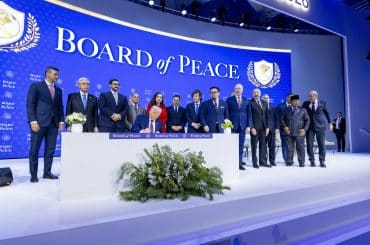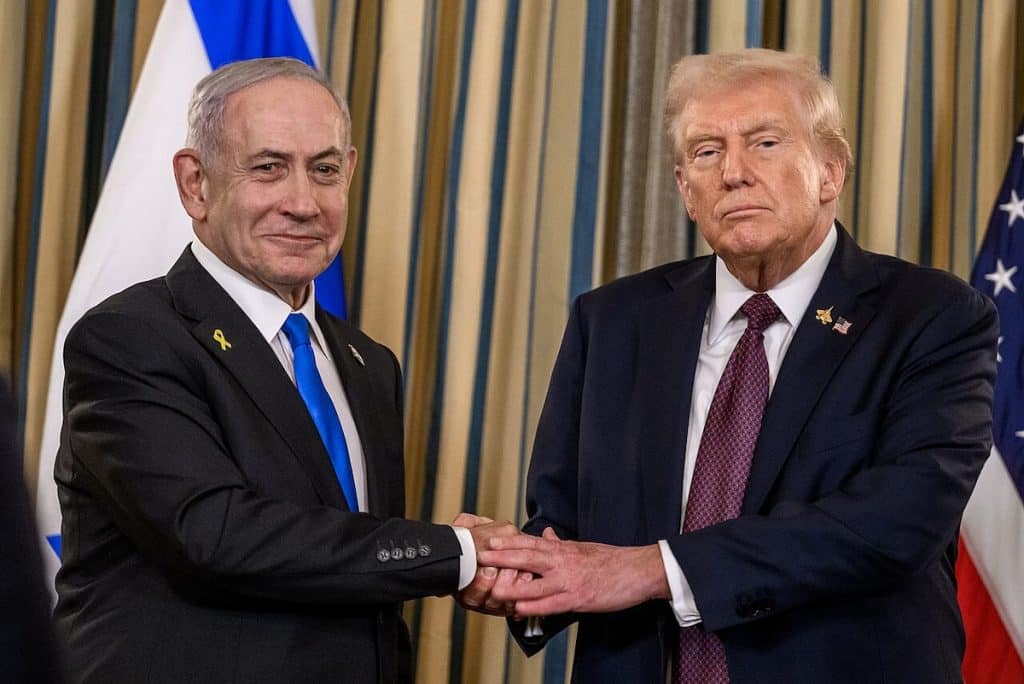
This week, Drop Site News revealed a draft resolution from Trump’s newly christened “Board of Peace.” The resolution outlines what is, in essence, Phase Two of Trump’s unrealistic peace plan that ushered in a new phase of horror in Gaza under the guise of a ceasefire.
The actions outlined in the resolution ignore realities on the ground and paint a very grim picture of what the United States is planning for Gaza. Far from abandoning the ludicrous and offensive imagery Trump shared in that AI video from last year of himself and Elon Musk on a beach in an unrecognizable Gaza, this resolution is the battle plan to turn Gaza into the playground for the wealthy that Jared Kushner presented to the World Economic Forum at Davos last week. It’s a Gaza where the only Palestinians remaining are those chosen to be the servants in the new regime.
It’s a Gaza under permanent American occupation.
The “Executive Board” that would control Gaza
The Board of Peace (BoP) itself has drawn the most attention, but it is not the focal point for Gaza. The BoP is being set up as an international force to challenge the United Nations. It is currently populated entirely by far-right and autocratic figures, and will likely stay that way.
The BoP will be headed by Donald Trump and his role as Board Chair is personal, disconnected from his role as President of the United States. He has full power over the Board’s composition and full veto power over all of its actions. Trump will remain in control of the BoP until he decides to leave or he dies, and he has the sole authority to name his successor. You couldn’t build a clearer autocracy.
The BoP can delegate its authority as it wishes, and that is what it has done regarding Gaza. The “Executive Board” (EB) is the body that will govern Gaza. The EB itself will also have other areas within its portfolio, so it, too, has delegated its power to yet another group, dubbed the Gaza Executive Board (GEB). There is considerable overlap between the members of the EB and GEB.
The members of the GEB include some very familiar names like Steve Witkoff, Trump’s lead negotiator; Susan Wiles, his Chief of Staff; Jared Kushner, his son-in-law; and Tony Blair the former PM of the UK and a war criminal in the 2003 invasion of Iraq.
The rest of the names may be less familiar, but they are all important and, together, they draw a very worrisome picture of how this Board will behave.
Minister Hakan Fidan Ali Al-Thawadi is the Minister for Strategic Affairs of Qatar. He’s been a key figure in the negotiations between the U.S. and Hamas for the past year. Israel objected to his inclusion, but not too loudly. Al-Thawadi has cultivated a strong relationship with Trump.
General Hassan Rashad is the head of Egyptian intelligence.
Marc Rowan is an American billionaire and a major donor to Donald Trump’s presidential campaign. He is the chair of the United Jewish Appeal-Federation of New York, and a major figure in the American Jewish pro-Israel community. Rowan was a leader in the effort to silence academic and student activist criticism of Israel’s genocideandled the charge for the removal of University of Pennsylvania president Liz Magill in 2024.
Minister Reem Al-Hashimy is the Minister of State for International Cooperation in the United Arab Emirates. She was a leading spokesperson in support of the Abraham Accords.
Nickolay Mladenov is a long-time Bulgarian diplomat who has served as both a member of the European Parliament and a top United Nations official. He worked closely with Blair in the Quartet—an international body ostensibly charged with promoting a two-state solution in Israel and Palestine, but which failed utterly—and supported the Abraham Accords when they were agreed upon. Mladenov was enough of a diplomat that he was able to garner public praise from Israel, the U.S., the Palestinian Authority, as well as Hamas leaders. He has also been named by Trump as the “High Representative for Gaza,” so he will have a central role beyond just GEB membership in implementing the Trump plan. Mladenov expressed skepticism about Trump’s first-term “deal of the century,” so it will be worth looking into how Mladenov won Trump over.
Yakir Gabay is an Israeli who is also a citizen of Cyprus. A billionaire real estate tycoon, Gabay made some headlines with his involvement in pressing then-New York City Mayor Eric Adams to deploy police to violently crush the anti-genocide protests at Columbia University.
Sigrid Kaag is a long-time UN diplomat and former Foreign Minister of the Netherlands. She was most recently UN Special Coordinator for the Middle East Peace Process, although she resigned from that role last June. Kaag has not commented on her supposed appointment to the GEB, and it is questionable whether she has or will actually accept this role.
Not only are there no Palestinians on the Gaza Executive Board, but there is also no one with any history of advocating for Palestinian concerns and interests. The EB, to which the GEB will serve as “advisors,” includes much of the GEB: Witkoff, Wiles, Kushner, Blair, and Rowan are also on the EB, along with U.S. Secretary of State Marco Rubio and Deputy NSA Robert Gabriel.
Trump also appointed the head of the World Bank, Ajay Banga, and lawyer Martin Edelman, who has very close ties to both Trump and the UAE, to the EB. Aryeh Lightstone, a former adviser to Trump’s first-term Ambassador to Israel, David Friedman, and Josh Gruenbaum, a bureaucrat who has worked closely with Witkoff and Kushner, were appointed as advisers to the EB.
Palestinians not included in planning Gaza’s future
While there are no Israelis on the Executive Board, it is stacked with extreme supporters of the Israeli right and of Netanyahu. This makes the vague mandate of the entire enterprise much more concerning.
The proposal published by Drop Site states that “the reconstruction and rehabilitation activities of the Board shall be dedicated solely to those who regard Gaza as their home and place of residence.”
But the proposal offers no opportunity for the people of Gaza to have any say at all in their present situation, let alone their future. The EB governs all of the laws. An American-led International Stabilization Force (ISF) controls all security.
The ISF is to be under the command of American Major General Jasper Jeffers. Trump, and Trump alone, has the power to remove the commander of the ISF and must personally approve any nominee to replace him.
The plan further states that “only those persons who support and act consistently [with Trump’s Comprehensive Plan for Gaza] will be eligible to participate in governance, reconstruction, economic development, or humanitarian assistance activities in Gaza.”
The only role currently envisioned for Palestinians in Gaza is to carry out the decisions made for them by others.
In other words, Palestinians who wish to be part of Gaza in any way must meet Trump’s litmus test of support for the external American control of the Gaza Strip. The same will be true for any business, NGO, or even individual who wants to participate in any way in rebuilding Gaza, physically, politically, or economically.
Ideally, for Trump and Jared Kushner, Gaza would be transformed into a giant “company town.” Most of the coastline would be dedicated to tourism. The bulk of Gaza’s eastern border with Israel would be dedicated to industrial zones and huge data centers, doubtless reflecting the massive investments Trump and his Emirati friends are making in AI.
In between would be residential areas separated by parks, agricultural, and sporting sites. In the West Bank, such parks and agricultural areas are frequently declared closed military zones and used for other purposes by the occupying force.
As has been apparent from the beginning, the only role currently envisioned for Palestinians is in the administration of the Executive Board’s decisions. In other words, Palestinian technocrats, laborers, and office workers would be “permitted” to carry out the decisions made for them by others.
The U.S. occupation of Gaza
This resolution provides only a bit more substance to the half-baked ideas Trump has been putting forward since October. And it continues to envision a near-future where Hamas has voluntarily disarmed, Israel has pulled out of Gaza, and the ISF has assumed security control that is welcomed by whatever Palestinians remain in Gaza.
All of that remains fully in the realm of fantasy.
Hamas has repeatedly made it clear that it is willing to discuss decommissioning its weapons, but would not disarm. Given that Israel is, once again, funding rogue Palestinian gangs in Gaza, complete disarmament is suicide for many members of Hamas, Islamic Jihad, and other factions.
The United States is discussing offering amnesty and even a buy-back program for the weapons, but these offers are hardly useful if the lives of Hamas members are put at grave risk by disarmament, even if we assume that the U.S. keeps to its word and that Israel does not itself hunt these fighters down.
Moreover, Israel is bristling at this entire plan. They prefer to bring the hammer down again on Gaza, especially now that there are no hostages, dead or alive, to be concerned with.
Netanyahu is openly stating that Israel will allow no rebuilding in Gaza—where it is killing people, including infants, not only with its weapons but by denying Palestinians the materials to shelter from the winter elements—until Hamas is “disarmed.”
What is taking shape in Gaza is a new kind of foreign occupation. This time, the U.S. would be the leading force on the ground and an American-led occupation will face resistance just as the Israeli one does.
He is also declaring that Israel will maintain “security control” over Gaza in perpetuity. Israel has informed the U.S. that it wants to expand the zone of Israeli control in Gaza—which already encompasses well over half the Strip—rather than shrink it, as called for by Trump’s plan.
Israel has already reportedly drawn up a plan for a major military operation, a return to the full-blown genocide of last year, which it plans to launch in March unless the U.S. refuses to allow it to do so.
And, finally, a great deal of ambiguity remains about the potential makeup of the ISF. While numerous states have pledged to support the disarmament of Gaza, many have also expressed reluctance to be part of the force if it means having to confront armed Palestinian resistance groups.
There is a good reason for their reluctance. What is taking shape in Gaza is a new kind of foreign occupation. This time, the U.S. would be the leading force on the ground unless it allows Israel to renew its aggression, something Trump doesn’t want. It would mark the greatest failure of his long list of failures, undermining his claim to have “ended wars all over the world.”
But foreign troops are foreign troops. It is possible that the Trump administration has bought into its and Israel’s own nonsense so thoroughly that they really believe that as long as the boot on Palestinians’ necks is not Jewish, the Palestinians can be controlled and will not fight for their freedom. Because, in their telling, the entire Palestinian struggle is only about fighting “the Jews.”
But an American-led occupation will face resistance just as the Israeli one does. That will manifest even if Hamas is disarmed.
An American occupation of Gaza on Israel’s behalf will be just as unwelcome by Palestinians as an Israeli one backed by the United States. It may take some time for the people of Gaza to regroup from the past two and a half years to organize impactful resistance, but it will come, as it always has.
The solution is simple: allow Palestinians their freedom and their rights. But that solution is beyond the imagination of Washington and Tel Aviv. So, meet the new occupation. It will be no more pleasant than the old one.