

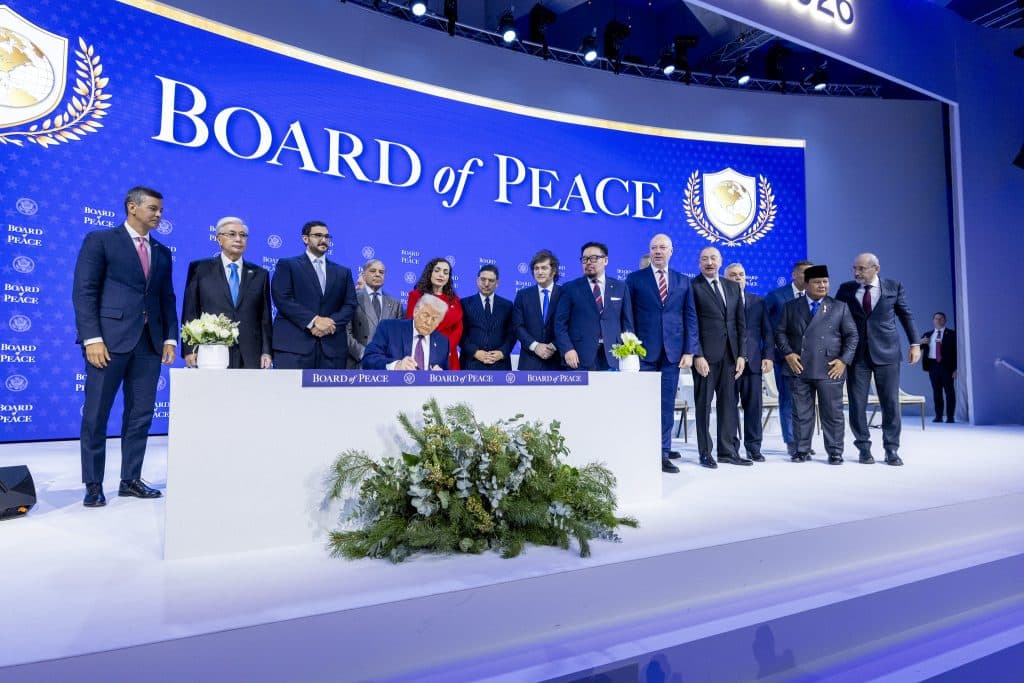
The latest iteration of the future U.S. plan for Gaza was revealed last week by U.S. President Trump’s son-in-law, Jared Kushner, at the inaugural ceremony of the so-called “Board of Peace,” which is tasked with overseeing the reconstruction and administration of the Strip. Kushner’s presentation included a map of what Gaza would look like after reconstruction, including industrial zones, residential blocks, and tourism beaches. The plan advertises a new Rafah and a new Gaza City, completely separate from one another. Meanwhile, the edges of the Strip — which once served as Gaza’s farmland and bread basket — would now be home to industrial complexes. Kushner’s plan doesn’t foresee any restoration of Palestinian neighborhoods or villages, and offers no place for natural Palestinian life to exist. Only fixed residential blocks, surrounded by investments.
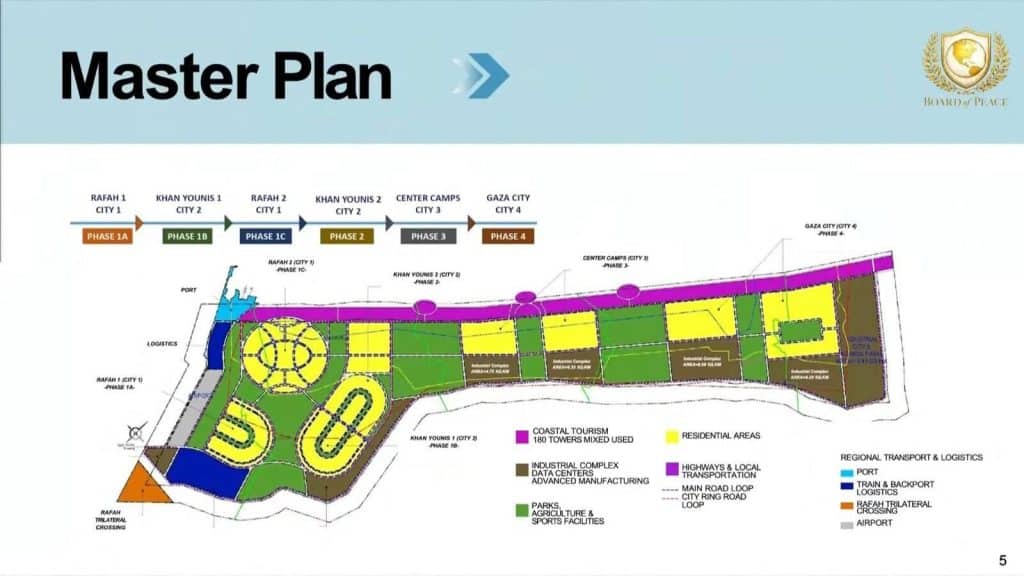
After two years of genocide, the outcome that is being laid out for the people of Gaza — and the Palestinian people as a whole — is the creation of a dystopian reality that sees the building of luxury resorts on top of their destroyed homes and communities.
The only role for Palestinians in this vision is to be managed — controlled, “concentrated” in confined zones, and later possibly expelled. All of this is masked as a “historic” humanitarian effort.
A Gaza without Palestinians
Soon, it will be four months since the ceasefire in Gaza went into effect. On Monday, the first phase of the agreement officially ended after the Israeli government announced that Israeli forces had found the body of the last dead Israeli soldier held captive in Gaza. Israel had refused to move to the second phase of the ceasefire before Hamas handed over the remaining body, which the Israeli army reportedly found on the Israeli-controlled side of the Strip.
Coincidentally, in the past few days, U.S. President Trump announced the formation of the Board of Peace, initially planned to oversee the transition in Gaza during the second phase of the ceasefire. Simultaneously, the Israeli government agreed to reopen the Rafah crossing, a crucial step for the second phase. A week earlier, the Palestinian technocratic committee for the administration of Gaza was also announced.

But what’s actually happening on the ground started well before the technocratic committee was formed. Israel’s longstanding plans for Gaza — to corral its population into concentrated zones ahead of their possible expulsion — have been silently unfolding on the ground. Last week, Drop Site News revealed documents obtained from the U.S.-Israeli military and civil command center in Israel showing preparations for a residential area to be built in Rafah. According to Drop Site, if developed, the “planned community” in Rafah “would contain and control its residents through biometric surveillance, checkpoints, monitoring of purchases, and educational programs promoting normalization with Israel,” comparing it to a panopticon. Rafah was completely leveled by the Israeli army earlier in 2025.
Based on an analysis of satellite imagery conducted by Forensic Architecture, the Drop Site report indicates that the new “community” is being prepared on a 1-square-kilometer plot of land in Rafah at the intersection of two military corridors.
Jonathan Whittall, a senior UN official in Palestine between 2022 and 2025, said that “this is the next phase in the weaponization of aid,” after reviewing the materials obtained by Drop Site
This idea to “concentrate” Palestinians into a highly surveilled area is in line with previous statements made by Israeli Defense Minister, Israel Katz, who said last July that Palestinians who would be allowed into the so-called “humanitarian city” — proposed to be built over Rafah’s ruins — would not be allowed to leave it. The scheme was widely decried by human rights groups as a thinly-disguised plan to build a “concentration camp,” and was seen as a first step toward pushing Palestinians to leave Gaza entirely. Israeli Prime Minister Benjamin Netanyahu explicitly told his cabinet as much in September, under the label of “voluntary emigration.”
Meanwhile, the National Committee for the Administration of Gaza (NCAG), the body of Palestinian technocrats set to oversee day-to-day governance in the Strip, is about to enter Gaza. It has so far garnered the support of all Palestinian factions, yet remains subordinate to Trump’s Board of Peace, with only limited executive powers. The Board of Peace, on the other hand, plays a political role in drafting plans for Gaza.
The NCAG is the first-ever Palestinian governing body in Palestine that is not part of the PLO’s institutional structure, which effectively splits Gaza politically from the rest of Palestine. Instead, its ultimate political reference now lies in a Board of Peace headed by Trump and, among others, Israel. The vision it is advancing for Gaza is one without Palestinians.
In fact, all the unfolding information about the U.S. plan for Gaza shows that it treats the Palestinian question as a purely humanitarian issue shorn of any political content. It completely ignores the centrality of Gaza to the Palestinian cause as a political question and fails to address the basic element of the “conflict” — Palestinian self-determination.
This should not be surprising, given that decision-making is dominated by U.S. business interests, ambitions of regional control and power, and Israel’s ideological drive to push Palestinians out. In the midst of all this, no Palestinian voice is present.


Trump’s Board of Peace Charter has several legal flaws and shortcomings. It has its own “international legal personality”. Piracy and pillage are still illegal and they are crimes with fines and prison penalties for joint criminal enterprises that Nazis, Judges, I.G. Farben, et. al. could not escape. There are already many jurisdictions eager to file claims and freeze its assets, based upon ongoing complaints from two ICJ cases for reparations due to Palestinians, genocide, apartheid, ecocide, and global warming, See for example: Existing & Proposed Ecocide Laws – Ecocide Law
The World + Dog have already started work on lawsuits that will point to clauses in the Constitution that prohibit Presidents and Executive branch officials from accepting employment, job Titles, salaries, or any emolument from any foreign government in their personal capacity. Long story short, Trump just hasn’t noticed the forest for the trees, but he isn’t out of the woods.
I remember listening to hours of testimony from Lt.Col Oliver North inventing feeble excuses for misappropriating revenues from US government arms sales to Iran to use in violation of the Boland Amendments (enacted between 1982 and 1984), which strictly prohibited the CIA, Pentagon, or any US agency from providing military support to the Nicaraguan Contras. As if that wasn’t bad enough, he tried to tap dance around the issue of stealing the funds for his own automobile parts and service and a home security and surveillance system.
So, you can rest assured Trump, Rubio, Hegseth, and Noem will need a better cover story than the contradictory whoppers they have floated as trial balloons to Congress so far : See: TOP Trump Official SPILLS BEANS on SECRET BANK ACCOUNT and Rand Paul DESTROYS Rubio On Venezuela
I believe that, short of lining their pockets and keeping Bibi out of prison, Bibi and the right wing extremists (primarily Ben Gvir and Smotrich) running the show in Israel, are not pleased with this plan. It is inconsistent with the Greater Israel wet dreamthat these extremists envisioned all along.
Then again, everyone has his/her price – and that, I’m sure, includes Messrs Ben Gvir and Smotrich!
Nothing but peace and an end to Hamas inspired warfare. And $25 billion worth of infrastructure and development. And an airport and seaport. And housing and clean water. And jobs and an economy.
All that plus the absolute horror or permitting anyone with means and desire to actually leave the place.