
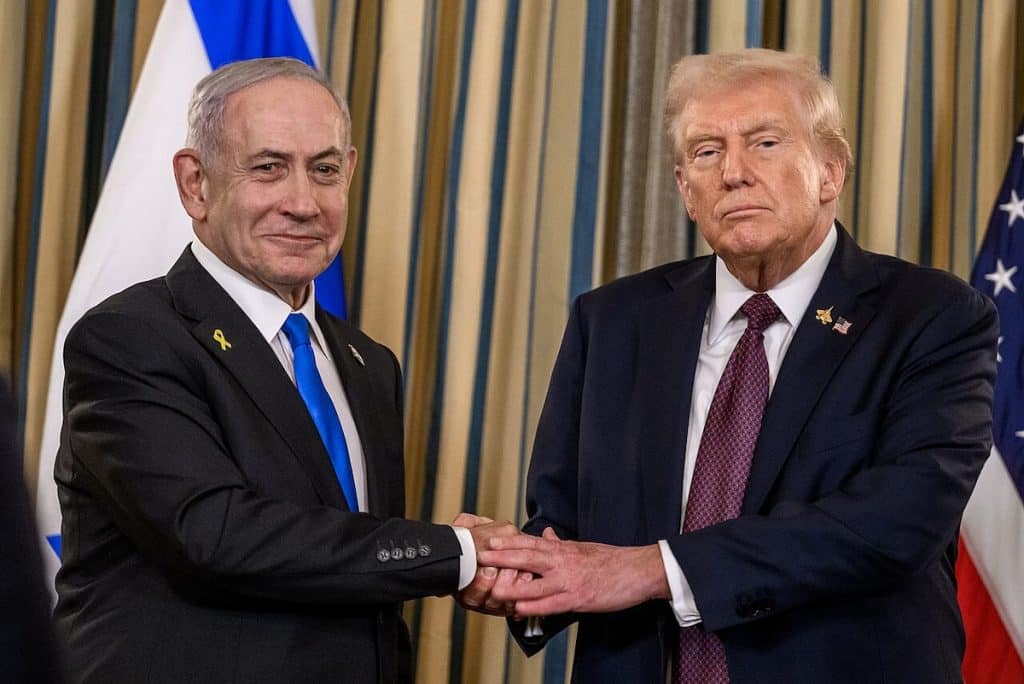
In a surprising turn of events, Israeli Prime Minister Benjamin Netanyahu told The Economist that he intended to wean Israel off of United States military aid over the next ten years.
This intention represents a 180-degree turn from what Israel was reportedly seeking just two months ago, so why is Netanyahu making this sharp shift? And why is pro-Israel uber-hawk Senator Lindsey Graham (R-SC) so enthusiastically supporting this decision, even stating that he would soon introduce legislation to expedite the process Netanyahu seems to be starting?
It is entirely possible that Netanyahu is bluffing to deflect a difficult political conversation and will reverse this decision in due course. While it hasn’t made U.S. headlines, Israelis have noticed that military aid is becoming increasingly controversial among Republicans as well as Democrats. This might be a strategy to quell some of that controversy and then come back to request more aid later.
However, it is at least as likely that this is a genuine move on Netanyahu’s part. And there are some very good reasons that he would want to pursue this course.
Strategic benefits for Israel
Conservative Israelis and supporters have Israel have been recommending reducing Israel’s dependence on the United States for many years. Indeed, this was a basic precept of the neoconservative plans around the turn of the century for subcontracting U.S. dominance of the Mideast to Israel. Granting Israel freedom to dominate the Middle East without concern for the vagaries of American politics was always attractive.
Beyond the ideological point, Israel could also benefit economically, as ironic as that seems. Because American aid must be overwhelmingly spent in the United States, Israel’s military spending doesn’t maximize its potential for stimulating the Israeli economy. That has been mitigated in the past by the U.S. allowing a certain amount of aid to be spent outside the U.S., and that exception has contributed to Israel’s belief that it can soon use its military spending to augment its own economy.
“Arms sales to Israel would not only be unaffected…but, once Israel is picking up the tab, [it] will actually be less subject to some of the constraints and conditions in U.S. law.”
Analyst Josh Paul
Moreover, Israel would, of course, continue to purchase top-of-the-line equipment from the U.S. and might well be able to acquire upgrades through sales that it could not have achieved through the Foreign Military Financing program, which is where the bulk of the annual aid originates.
As former State Department official Josh Paul noted in a policy paper for his group, A New Policy, “Presuming that Israel picks up the slack with its own funding, arms sales to Israel would not only be unaffected…but, once Israel is picking up the tab, [it] will actually be less subject to some of the constraints and conditions in U.S. law which apply to U.S. grant funding, such as the Leahy Laws.”
All of these are good reasons for Netanyahu to want to shift away from the model of annual aid to Israel. The benefits outweigh the costs, especially if Netanyahu is less concerned about issues such as education, healthcare, and the social safety net in Israel, which is the case.
Avoiding political defeat in Washington
Politically, the reason Netanyahu would want to pursue this course—and the reason Graham would so enthusiastically support it—is that the current ten-year agreement signed by Netanyahu and Barack Obama just before Obama left office is going to expire in two years. The prospect of a new one is far from the sure thing it once was.
The concern over a new Memorandum of Understanding (MOU) is bipartisan, and the recent controversy around Israel among Republicans surely concerned Netanyahu.
But an even greater concern was that, unlike any time in recent memory, Israel and its supporters could not be sure of support from the White House for aid to Israel.
Despite Netanyahu repeatedly praising Donald Trump as “the best friend Israel ever had in the White House,” Trump has shown that he follows his own agenda. That agenda has been largely favorable to Israel and entirely hostile to the Palestinian people, but it is far from certain that Trump would be more sympathetic to Israel’s concerns than to those of his base on this issue. Aid to a wealthy country, or any country, sits poorly with Trump, as it does with many of his supporters.
Netanyahu and pro-Israel forces in Washington have likely recognized that the fight over aid to Israel is one they can’t win in the long run.
Until recently, Trump had more interest in avoiding a fight over Israel that might split the Republicans. The safest route, then, was to simply maintain the status quo of support for Israel.
However, now he or his team has likely decided to get out in front of a potential conflict over Israel and try to avert it before it escalates.
Beyond the intra-party issues, Netanyahu and pro-Israel forces both in and outside of the Republican party have likely recognized that the fight over aid to Israel is one they can’t win in the long run.
If Israel, AIPAC, and their fellow travelers pushed for a new MOU now—something they are still leaving the option open for—they would probably win. But that victory is not a certainty as it was in the past, when annual aid, with or without such a memorandum, was almost as certain to pass as the annual defense bill.
Worse for them, the fight would be a difficult one and would spotlight all the objections to Israel’s behavior from the left, and the argument that a country as wealthy as Israel doesn’t need free money from the right. The political beating pro-Israel forces would take from that fight would not just spell doom for future aid, but could further jeopardize Israel’s already weakening political status in the near term.
So Netanyahu, Graham, and their friends decided to preempt the fight. The move can be viewed as a retreat, but certainly not an admission of defeat. Rather, it is a strategic pivot given a new political landscape.
That decision has the added benefit of cutting off a key point for Democrats scrambling to get their stance on Israel more in line with their base. Republicans will be able to claim, however disingenuously, that they “normalized” the relationship between the U.S. and Israel, to the benefit of both countries. Democrats, whose constituents view Israel more negatively than Republicans, would look weak and foolish on the issue again.
Adjusting to the new Israel lobby
While the Senate still approves arms sales to foreign countries, it is a much easier lift in Congress for lobbyists to argue for a sale than for a gift of taxpayer money. Saudi Arabia, the United Arab Emirates, and many other countries that are seen far less positively than Israel are, even today, may get some pushback over arms sales, but they get what they want from American administrations, for the most part. Israel will surely do better.
For groups like AIPAC, the idea that Israel will no longer receive an annual grant of billions of dollars represents a change in the game.
For decades, AIPAC’s bottom line has been aid to Israel. But that has been changing in recent years. The lobby and similar groups have veered much more strongly toward a general defense of Israel, complete with phony charges of antisemitism in their direct communications, and less of a focus on the annual aid, which, until recently, was regarded as invulnerable.
Meanwhile, their political campaigning has gone in a very different direction, avoiding any mention of Israel and going after their opponents with advertising focused on domestic issues or in lobbying for redistricting that works against their targets.
Increasingly, pro-Israel lobbying has been at a disadvantage with Democrats, largely because Israel’s behavior has become so much more outrageous and brazen. But they still have certain strengths, despite Israel’s cratering image.
Arms sales to Israel, just as much as U.S. aid, create jobs and generate profits for U.S. corporations. That will continue to influence Democrats whose constituents are affected by military contracts and who have a lot invested in the military-industrial complex in general. Israel, even if it’s not bolstered by American taxpayer dollars, is likely to continue to buy a great deal of American weaponry. It will purchase what it doesn’t have the capacity to manufacture—which will still be a lot—and Israel will continue to require basic materials from the U.S., as a lot of its own military spending will go toward manufacturing for export, an arena Israel is already a major player in and will certainly expand significantly.
In addition, Israel is likely to significantly expand its joint military projects with the U.S. It would be a surprise if Graham’s proposed bill doesn’t include substantial boosts to U.S.-Israeli joint projects and cooperation, which have already seen substantial growth.
U.S. weapons to Israel will continue to be a political issue, but a switch from military aid to direct sales will greatly blunt some of the momentum against arming Israel.
That means that arms to Israel will continue to be a major political pressure point. A switch to sales instead of aid will greatly blunt at least some of the momentum against arming Israel, so Palestine support lobbyists and activists will have a harder time taking advantage of this argument.
In the Republican Party, the main argument against arming Israel has nothing to do with justice, peace, or human rights, but is simply a matter of not wanting tax dollars going to another country. This shift renders that argument entirely moot.
For Democrats, the picture is more muddled. Objections to Israeli crimes motivate much of the political push against arming Israel, but the argument is given considerably greater weight by the fact that we as taxpayers are the ones arming Israel. The issue of aid to Israel isn’t the sole basis of Americans feeling responsible for what Israel does with American support, but it’s a primary impetus for it. Without that piece, the argument of why Israel is singled out, disingenuous though it may be, gains strength.
This won’t be a comfortable shift for the pro-Israel lobby. The Israeli daily news website, Ynet, detailed a lengthy argument for the benefits of aid to Israel from the United States. The idea of that aid disappearing, even gradually over the course of the next decade, clearly scares them.
But Israel is much more dependent on the U.S.’ diplomatic cover and its political intervention with other countries to enable its impunity and freedom to attack both Palestinians and other countries than it is on the $4 billion or so it gets in annual aid. Saving that diplomatic support is the goal. And if the cost is not covered by gains in exports and in increased corporate partnerships in the U.S., they will cut back on social services, as has been their tendency in recent years, to cover the military and settlement budgets.
For Netanyahu and Trump, that’s a win with minimal downside.

Smoke and mirrors. What about the self-declared Zionist billionaires, like Ackman, who will never cease sending hundreds of millions to the IDF, settlers and other thugs? Of course, if the Apartheid state continues to steal more Palestinian, Syrian, Lebanese and even Jordanian lands and resources, they’ll have the means to continue slaughtering Arabs without the need for US taxpayer money.
With sufficient resources, arms sales to Israel can be stopped by means of a qui tam (False Claims Act) litigation against a US manufacturer. A qui tam litigation is complex in normal circumstances, and the US government might create some not always insurmountable problems for the relator in a scenario of systemic corruption.
[In my opinion, the Zionist movement has created a scenario of systemic corruption to the point at which we Americans are in dire peril of losing the USA to an oligarchy of Zionist plutocrats.]
If the government acts in bad faith (as it always does for the sake of Zionism), the relator would have to resort to
Parallel ATS (Alien Tort Statute) and civil RICO (Racketeer-Influenced Corrupt Organization) litigation would be advisable.
Realistically, neither country is economically viable long term. Neither Israel nor the USA has the wherewithal to produce the arms it needs to conduct a battle longer than a few weeks without exhausting supplies of stockpiles.
The USA is 38 trillion in debt and former top lenders are cutting their US Treasury buying because Trump is sanctioning them, illegally deporting immigrants, and they have established interlocking free market trade zones between the EU, Mercosur bloc, BRICS, and many of the Commonwealth of Nations Countries to replace the USA as a partner. There are 340 million Americans and we’ve elected a felony twice that no one would trust to buy a used car from.
Trump can’t punish Americans with enough Tariffs to buy Greenland or beg borrow, and steal enough to maintain the dollar as a credible reserve currency for trade, with his hands on the scales and down the cookie jar at the same time..He has fired IGs, Prosecutors, Special Counsel for Whistleblowers, and started destroying the Union with ICE invasions and mass deportations, firings of FTC, Consumer Financial Protection Bureau, and indictments of regulators at the Federal Reserve. When this house of cards collapses it will not be missed and make a full recovery impossible for us and Israel. They need to rely on new trading partners or will collapse with us.
I had never given this much thought before — the difference between selling weapons to a country which will use them to commit war crimes, and actually giving them the weapons. Morally I don’t think there is a difference, but it might change the rhetoric.
Not having thought about it, I don’t know if we sold or gave the weapons to some of our other blood- soaked pals. Saudi Arabia, for instance, when bombing and starving Yemen, or Indonesia when slaughtering the Timorese, or Guatemala or El Salvador in the 80’s.