
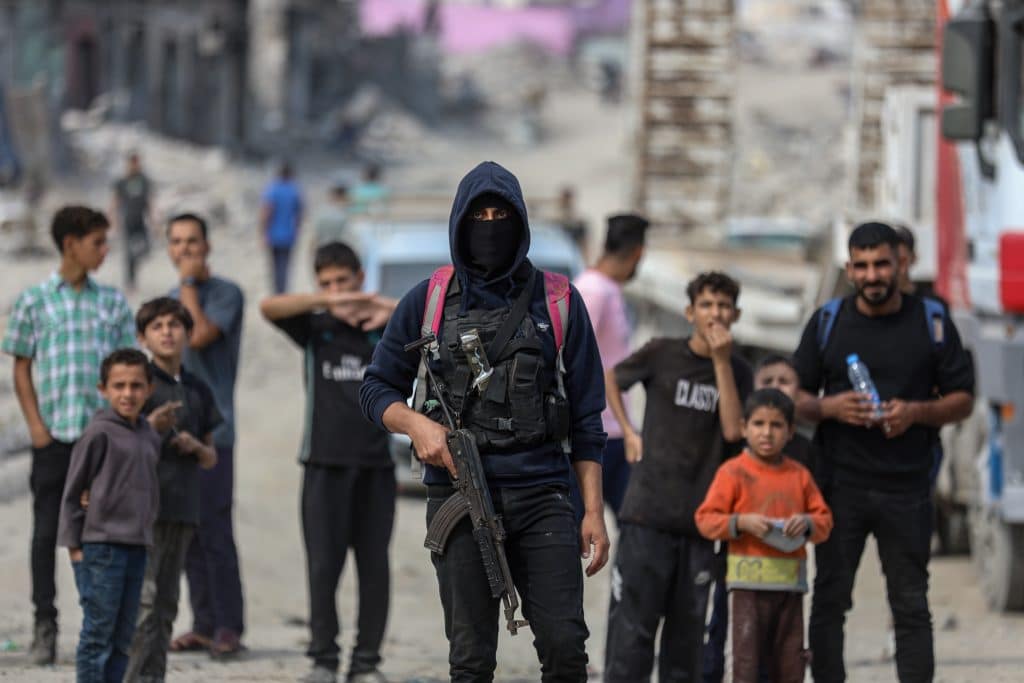
The first meeting of Trump’s so-called “Board of Peace” is scheduled for later this week. Palestinian resistance factions face a defining predicament in how to respond: reject the Board outright and risk annihilation and the stalling of reconstruction, or engage with it and risk the slow erosion of their nature as resistance organizations.
Although it has been billed as a postwar administrative mechanism, the Board’s ultimate goal is to reorganize Palestinian political life in Gaza — under direct colonial oversight — into a permanent state of political submission. While presented as a pragmatic multilateral framework for ending the war and rebuilding the territory, its deeper logic is to transform Gaza from a wellspring of anti-colonial confrontation into a domesticated political space that could be managed and subdued. In this “new Gaza,” the ultimate objective of the U.S. is to synchronize governance, security, and reconstruction under external supervision.
This is not merely an external imposition on passive recipients; it is a structure designed to force Palestinian actors to choose between catastrophic refusal and compliant incorporation. This forced choice is what defines the predicament at the heart of what follows.
The postwar arrangement in Gaza under the Board of Peace also seeks to sustain the possibility of large-scale ethnic cleansing — deferred, yet constantly present as a specter and a possibility. In doing so, it reframes the Palestinian question in Gaza — not as a struggle over sovereignty and liberation, but as a problem of administration, compliance, and institutional reform.
In many ways, this is neither new nor novel, echoing old forms of colonial domination through the Board’s business-focused nature, as if resurrecting a new East India Company. It also isn’t new to Palestinian politics, which has grown accustomed to a managed life and deferred statehood. The Oslo Accords were one such framework. The post-Second Intifada arrangements of “economic peace” were another. If Palestinians disarm, condemn resistance, build institutions, and focus on economic prosperity, they are told they will arrive at statehood.
But this strategy, at its best, is a politics of deferral. At its worst, it is a preparation for the end of Palestinian life in Gaza.
The architecture of the Board consolidates financial leverage, security restructuring, and political conditionality into a single transitional regime. Reconstruction funds are tied to benchmarks. Civil administration is overseen by an international body. Security stabilization is implicitly or explicitly linked to the restructuring or neutralization of armed resistance. The time horizon of the arrangement — which extends to 2027 and potentially beyond — introduces a dangerous elasticity into the concept of transition. What is framed as temporary governance risks solidifying into a normalized state of suspended wreckage.
This produces a deeply constrained field of Palestinian action. The asymmetry of power is not only military; it is institutional and financial. External actors command the instruments of reconstruction, diplomatic legitimacy, and border regulation. And of course, everything moves through Israel. Palestinians are positioned as recipients within a system designed elsewhere and told they must submit to avert further massacres.
Yet the Palestinian political arena is not a passive terrain. It is fractured, fatigued, contested — and precisely because of that, also unpredictable. The Board’s success or failure will also depend on how Palestinians navigate this compressed political space — from Hamas, to the other resistance factions and political actors, to the Palestinian Authority (PA).
Contrasting predicaments: how are Hamas and the PA relating to the Board of Peace?
Palestinian resistance enters this moment thick with contradiction. It has endured militarily, yet Gaza is pulverized. Survival sustains its symbolic and material authority as a force of resistance, but the immensity of destruction bears down on the very social body from which that endurance is drawn.
A population can’t be asked to endure hunger, displacement, and ruin indefinitely in the name of freedom alone.
Hamas’s signing of the ceasefire and its guarded openness to technocratic governance aren’t so much a sign of surrender as they are a recognition: a population can’t be asked to endure hunger, displacement, and ruin indefinitely in the name of freedom alone. Shelter, electricity, water — these are not abstractions. They reorder priorities.
And yet, disarmament is not a technical adjustment. It is existential. For Palestinians, the weapon exceeds its material function. It is a declaration of political being, a claim to a disruptive agency, a refusal of permanent vulnerability. It signifies the capacity not only to confront occupation, but to insist upon Palestinian presence on Palestinian land, and one that is able to deform the colonial order. To relinquish it under externally scripted conditions would not merely recalibrate tactics but mark a transition from a resistance movement contesting domination to a domesticated actor folded into a highly managed order.
Hamas and the rest of the Palestinian factions comprising the resistance networks operate within a narrowing corridor. To reject the Board outright risks isolation and the throttling of reconstruction. To comply fully risks a slower erosion of their commitment to resistance and their slide into permanent subordination. So Hamas’s posture becomes one of calibrated flexibility: accommodate transitional arrangements while resisting the quiet conversion of reconstruction into disarmament by other means. It seeks to hold deterrence alongside social obligation, to preserve arms while averting another round of bloody massacres.
Whether such a balance can endure will hinge not only on external coercion, but also on internal cohesion. Put differently, it depends on how long Palestinian society can withstand the pressure when both Israel and the United States have made survival conditional on the abdication of resistance.
The Palestinian Authority in the West Bank, by contrast, confronts a different paradox. The Board offers it recognition, financial engagement, and the possibility of re-entering Gaza’s administrative sphere. For a leadership long invested in international diplomacy and institutional reform, this framework appears compatible with its strategic orientation toward collaboration with Israel, and its entrenchment as managers of Palestinians at the behest of international centers of power.
Yet the PA’s problem is not access to diplomatic endorsement, but the erosion of domestic legitimacy. Palestinian political culture has been shaped by siege, confrontation, and mistrust of externally brokered arrangements. Should the PA align too closely with the Board’s security conditions — particularly on the issue of resistance weapons — it risks further entrenching itself as a collaborationist, technocratic, and authoritarian regime.
The PA has proven useful as a Palestinian rubber stamp…but rubber stamps are disposable instruments.
At the same time, distancing itself from the process would risk marginalization within a framework already structured around U.S. initiative. This risk is felt even more acutely as Israel’s right-wing coalition moves deliberately to sideline and diminish the PA’s role, going so far as to reject its participation in the proposed Board of Peace in any form.
The PA’s maneuvering space, therefore, narrows to partial alignment: endorsing reconstruction and international involvement while rhetorically invoking unity and national sovereignty.
This posture reveals a deeper vulnerability. For international centers of power, the PA has proven useful as a Palestinian rubber stamp — a source of nominal legitimacy for arrangements that serve external interests while providing a veneer of Palestinian consent to demands that would otherwise appear purely coercive.
But rubber stamps are disposable instruments. Once they have served their function, they become expendable. The PA risks becoming a vanishing mediator: essential to the transition, irrelevant to what follows.
This impasse — between resistance that cannot fully yield and an Authority that will not rise to the occasion — captures what Ghaleb Halsa termed the condition of “choosing the tragic end.” Palestinian politics today appears caught in a structural limbo, not because both paths are equally constrained, but because the PA has actively chosen subordination over confrontation, management over mobilization, and institutional preservation over national liberation. The tragedy is not merely that the Authority operates within externally imposed constraints, but that it has internalized them as a political strategy.
Where resistance factions navigate impossibilities forced upon them, the Authority has embraced impossibility as a mode of governance. It does not simply collaborate with the occupation under duress, but builds its entire institutional existence around collaboration, transforming what should be a temporary tactical accommodation into a permanent political orientation. It governs without sovereignty not because sovereignty is unattainable, but because attaining it would require risking the institutional privileges, financial flows, and international recognition upon which its leadership depends.
The limbo, then, is not structural inevitability, but political failure. The PA has proven incapable of transforming its institutional presence into genuine leverage, nor of turning its international recognition into meaningful concessions. It provides legitimacy to processes designed to defer rather than deliver statehood. In doing so, it does not navigate tragedy but produces it.
The Board of Peace is merely the latest iteration of a dynamic the PA has enabled for decades: the conversion of Palestinian political aspirations into administrative compliance.
The paradox of survival
Beyond factional calculations lies the Palestinian public, whose position is neither ideologically uniform nor politically apathetic. The devastation of Gaza has intensified material urgency. Reconstruction is not abstract; it is immediate and visceral.
Yet humanitarian need does not erase political consciousness. The language of trusteeship, supervision, and reform is received with suspicion by a population historically accustomed to externally imposed deferrals disguised as solutions. Even more than suspicion, it is met with an ingrained knowledge — the type that becomes second nature — of how this language means nothing for Palestinians, and everything for the Israelis.
The paradox is clear: survival is both the precondition for resistance and the mechanism through which resistance can be neutralized.
This produces a dual dynamic: an acute desire for stability and rebuilding, coupled with resistance to arrangements that appear to normalize subordination. Any Palestinian actor that fails to grasp this duality risks rapid loss of power and legitimacy. Armed resistance cannot disregard the social cost of prolonged devastation. Active cooperation with colonial and imperial powers cannot disregard the cost of capitulation. But more interestingly, something else emerges from this scene: a politics of survival that is itself invested in deferral.
Perhaps more than ever, resistance forces — whether in Lebanon or Palestine — are navigating the paradox of survival itself. To survive is necessary for the preservation of the capacity to resist over time, but to survive indefinitely within frameworks designed to convert survival into submission is to risk becoming what one resists. The paradox is clear: survival is both the precondition for resistance and the mechanism through which resistance can be neutralized. To refuse survival is to risk another round of elimination; to accept survival on available terms is to risk incorporation into the very structures one opposes.
What emerges here is a double logic of postponement, where two distinct forms of deferral operate simultaneously yet serve fundamentally different purposes. Understanding this distinction is critical, for while one is imposed from above as a mechanism of control, the other emerges from below as a strategy of preservation, though both risk producing the same political outcome.
Colonial deferral is architectural and intentional. It does not outright deny Palestinian sovereignty but makes it conditional on meeting an ever-expanding list of requirements: institutional reform, security coordination, economic viability, and good governance. Each condition generates its own timeline, its own monitoring mechanisms, its own cadre of international experts. The genius of this system is that it transforms a binary political question — freedom or subjugation — into a graduated administrative process. Sovereignty becomes not a right to be recognized but a prize to be earned through demonstrated competence.
The Board of Peace exemplifies this perfectly: it does not reject Palestinian statehood but defers it indefinitely through staged sequences where each phase must be completed before the next can begin. It is also how the Mandate system worked.
But colonial deferral does more than postpone sovereignty. It actively reorganizes space and population while appearing focused solely on process and timelines. The temporal language of phased implementation, conditional progress, and graduated autonomy masks a deeper spatial project. Gaza’s reconstruction becomes the pretext for permanent transformation: who returns, where they settle, under what authority they live.
This is deferral’s doubled function: it postpones Palestinian political demands while accelerating Israeli territorial ambitions, managing international legitimacy concerns through the performance of process — while the substance of dispossession proceeds. The framework talks about tomorrow’s governance while ensuring that today’s geography becomes irreversible.
How resistance movements navigate deferral
But there is another form of deferral that resistance movements can practice themselves as part of their political maneuvering. This kind of resistant deferral operates from an entirely different necessity, emerging from the material reality that Palestinian resistance faces impossible choices: armed confrontation that produces catastrophic social devastation, or cooperation with colonial frameworks that produces political capitulation. Neither is sustainable.
The former destroys the social fabric on which resistance depends; the latter destroys the legitimacy that gives resistance meaning. Resistant deferral is the attempt to navigate between these twin impossibilities. It isn’t postponing sovereignty — which remains the stated goal — but the decisive confrontation that would force an immediate choice between annihilation and submission.
Where colonial deferral aims to prevent the arrival of sovereignty, survival’s deferral aims to prevent the closure of political possibility itself. Its purpose is not to reach some predetermined endpoint but to keep the future open, to ensure that catastrophe does not foreclose all alternatives.
The temporal logics differ fundamentally. Colonial deferral operates through false progress — constant activity, negotiations, reforms, benchmarks — that creates the appearance of movement toward a future, while structurally ensuring that arrival remains perpetually out of reach. It measures time in milestones deliberately designed never to be completed.
Resistant deferral, by contrast, does not measure progress at all. It measures endurance. Its temporality is not forward motion but lateral persistence: not “we are getting closer to liberation,” but “we have not yet been eliminated.” This is why resistant deferral lacks a conventional teleology. It aims not for a specific future state but to prevent a specific outcome — the final erasure of Palestinian political subjectivity.
The double-edged sword of survival
There is a danger in transforming endurance from a temporary necessity into a permanent condition. When survival becomes its own justification — when the goal of preserving the capacity to resist effectively postpones resistance itself — resistant deferral begins to mirror colonial deferral in its effects.
The colonial framework anticipates precisely this convergence. It creates conditions designed to force resistance movements into survival mode, knowing that indefinite survival within structures of domination eventually normalizes those structures. The PA embodies this trap: born from resistance, it now exists primarily to manage the occupation it was meant to end, justifying this management through the language of preserving institutional capacity and preventing social collapse. What began as resistant deferral has calcified into participation in colonial deferral.
This, then, is the condition: resistant deferral preserves political possibility only by postponing its realization, while colonial deferral forecloses possibility precisely by keeping it perpetually in play. Both produce waiting, both generate exhaustion, and both risk converting the temporary into the permanent.
Yet they are not symmetrical. One is imposed by overwhelming force and institutional architecture; the other is chosen from within impossible constraints. One aims to prevent arrival; the other to prevent annihilation.
The difference matters — not because it guarantees victory, but because it identifies where agency, however compressed, still operates. The Board of Peace represents colonial governance’s latest iteration, but also its persistent vulnerability: it must constantly reproduce Palestinian consent, manage Palestinian compliance, and respond to Palestinian refusal.
Structures designed to eliminate politics never fully succeed; they only displace it, defer it, force it into new forms. Whether those forms constitute resistance or merely its prolonged decomposition cannot be known in advance. It can only be practiced, endured, and perhaps transformed through the struggle itself — through the daily navigation of impossible constraints, in real time, with no guarantee of arrival.
Abdaljawad Omar
Abdaljawad Omar is a writer and Assistant Professor at Birzeit University, Palestine. Follow him on X @HHamayel2.


Thank you, Abdaljawad. A very good analysis of the dilemmas facing the Palestinians as a result of this dreadful plan. Shame on the UN for not rejecting it out of hand.
Relevant news:
Mexico’s president, Claudia Sheinbaum, reaffirmed this week her long-standing position with Gaza and Palestine as she declined an invitation from US President Donald Trump to join his newly established Board of Peace, while reinforcing Mexico’s economic strategy with Canada and its commitment to key trade agreements….Speaking at her regular morning press conference, Sheinbaum confirmed that Mexico would not become a member of the Board of Peace, an initiative launched by Trump to oversee reconstruction and stabilisation efforts in Gaza. She explained that Mexico’s decision is rooted in its longstanding recognition of Palestine as a state. In her view, any credible peace effort in the Middle East must include representation from both Israel and Palestine.
Mexico declines Trump’s Gaza Peace Board and reaffirms support for Palestine – Middle East Monitor
That “wellspring of anti-colonial confrontation” is nothing more than an endorsement of Hamas and continuing rounds of violence and despair. What decent person would wish that on Gaza?
End the Hamas inspired violence, concrete for homes instead of tunnels. Pipes for water and sewer instead of their crude rockets. Hospitals for health instead of hiding.
As for fear-mongering with “permanent occupation”, that’s despicable. Let Gaza be ruled by families and peace seekers instead of fanatics who dream of destroying Israel.