

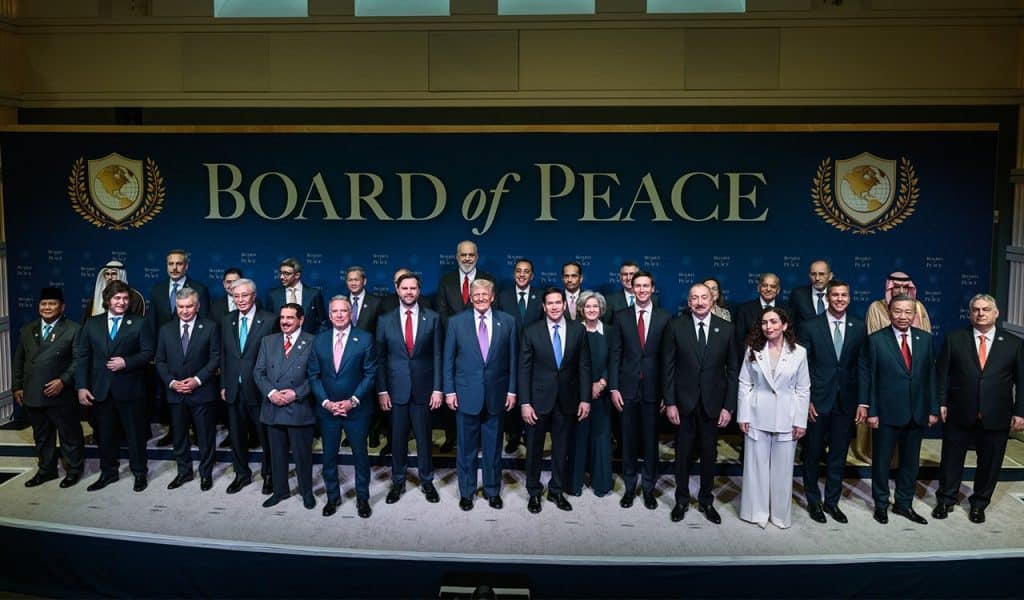
A sweeping investment and reconstruction plan to transform the ruins of Gaza into a playground for investors was unveiled at the first meeting of U.S. President Donald Trump’s “Board of Peace” in Washington, D.C, on Thursday.
The plan to reconstruct Gaza, framed as the transformation of the Strip into a beachfront economic hub, would see the Strip become “an investment center,” while Palestinian political aspirations were left unaddressed. The reconstruction plan mirrors longstanding Israeli schemes for the gradual ethnic cleansing of Gaza under the guise of building temporary “humanitarian cities” for Palestinians in Rafah. As a U.S.-led body with Trump as its ultimate decision-maker, the Board has been described by most Palestinian factions as a colonial instrument reminiscent of the British Mandate.
Joining the meeting on Thursday from the Trump administration were Secretary of State Marco Rubio, Vice President JD Vance, Middle East envoy Steve Witkoff, and Trump himself. Participating countries included all the mediators in the Gaza ceasefire deal — Egypt, Qatar, and Turkey — as well as other Arab and Islamic states that took part in early consultations on Trump’s so-called “peace plan,” including Jordan, the United Arab Emirates, Kuwait, Morocco, and Saudi Arabia. Indonesia, Albania, Argentina, and El Salvador also attended. Israel, through its Prime Minister, Benjamin Netanyahu, officially joined the Board earlier in February but did not participate in its first meeting.
Recent reports also indicate that the Board of Peace and its role in Gaza will facilitate the United States’ broader military and political positioning in the region. According to The Guardian, the United States has begun planning a new military base in the southern part of the Strip that would host 5,000 personnel. The compound would cover approximately 1,400 square meters, including a shooting range and warehouses, and would be surrounded by barbed wire and 26 watchtowers.
Who runs Gaza on paper?
The ceasefire between Israel and Hamas, signed last October, previewed the formation of the Board of Peace as the ultimate political authority overseeing the reconstruction of the Strip. It also outlined two additional bodies: an “Executive Committee” to make decisions on Gaza, and the National Committee for the Administration of Gaza, a Palestinian-led committee of ostensibly politically unaffiliated technocrats tasked with administering day-to-day affairs in the Strip. The technocratic committee represents the only formal Palestinian participation in Trump’s postwar plan.
The technocratic committee was formed with the approval of all the Palestinian factions, including Hamas. Ali Shaath, head of the technocratic committee, attended the meeting on Thursday, but neither the Palestinian Authority (PA) nor the Palestine Liberation Organization (PLO) attended.
Buck after bang
When announcing the board last October, Trump made membership contingent on participating countries contributing $1 billion. At Thursday’s meeting, billionaire Marc Rowan, Apollo Global Management’s CEO and a member of the board, presented elements of a reconstruction plan.
According to Rowan, the first phase would include building 100,000 housing units to accommodate half a million people, along with $5 billion in infrastructure projects. The long-term vision, according to Rowan, would include the construction of 400,000 housing units and $30 billion in civilian infrastructure.
Rowan’s proposal is part of his role on the Board’s Executive Committee, which also includes Trump’s son-in-law, Jared Kushner. Kushner outlined what he described as a “master plan” to transform Gaza into an investment opportunity earlier in January at Davos. The proposal envisions tourism, beach resorts, industrial zones, and corporate facilities, with limited residential areas — a vision critics say erases Gaza’s Palestinian identity.
An investment-driven approach also featured prominently in Rowan’s presentation. He described Gaza’s beachfront as “worth $50 billion,” arguing that transforming the territory from a “destruction zone” into an “investment center” is the Board’s greatest challenge.
The vision echoes Trump’s earlier plans, first presented in February 2025, of establishing a “Riviera of the Middle East” on top of Gaza’s ruins.
What Israel wants: ethnic cleansing
The plan to reconstruct Gaza in areas such as Rafah is in line with previous Israeli proposals to reduce Gaza’s Palestinian population through what officials have termed “voluntary migration” after having “concentrated” them in so-called “humanitarian cities.”
On the ground, that vision appears to be gaining traction. Israel has sought to allow more Palestinians to exit through the Rafah crossing than to return, prompting Egyptian pushback, while Israel also continues to use the crossing to harshly interrogate Palestinians and pressure them to leave the Strip.
Within Gaza, Israel continues to make life unbearable for Palestinians. Israeli forces have continued targeting Palestinians who approach the “Yellow Line,” which splits Gaza in half.
According to international organizations, aid entering the Strip remains far below required levels, let alone the agreed-upon conditions set out in the ceasefire terms. According to local authorities, Gaza continues to face acute shortages of fuel, medicine, and basic food supplies. Meanwhile, Israel continues its assassination and airstrike campaign across Gaza, killing over 600 Palestinians since the ceasefire began last October, according to local authorities.
But the main way in which Israel seeks to exacerbate living conditions in the Strip is by continuing to stall reconstruction. The Board’s inaugural meeting was expected to trigger the reconstruction process, particularly through financial commitments from member states, but Israel continues to cite Hamas disarmament as a precondition.
While several countries made financial pledges at the meeting, with Saudi Arabia, Kuwait, and Qatar each pledging $1 billion toward reconstruction in the coming years, and the United Arab Emirates pledging $2.5 billion, reconstruction remains theoretical. Construction materials are still awaiting Israeli approval to cross into Gaza.
The Palestine question deferred
Speeches at the Thursday meeting focused on “early recovery” and ending the “humanitarian crisis” in Gaza. A two-state solution and Palestinian rights were mentioned in brief remarks by representatives of Egypt, Jordan, Qatar, and Kuwait. Shaath said the technocratic committee would establish a new police force, for which 2,000 Palestinians in Gaza have already applied, stressing that there should be a single authority responsible for security and reconstruction.
Yet the pledged funds and initiatives remain contingent on political arrangements determined by Trump and coordinated with Israel. Israel has not permitted Shaath’s committee to enter Gaza and continues to oppose Turkish and Qatari participation in a proposed stability force, which has yet to be formed.
In his speech, Trump framed Gaza primarily through Israel’s security concerns, stating that Hamas must disarm or face severe consequences. Rubio said the only alternative to Trump’s peace plan was a return to war, a scenario that would mean a resumption of the genocide.
The vision taking shape between Washington and Israel appears detached from the multibillion-dollar pledges announced at the board’s meeting, where funding dominated discussions and the political framework remained secondary.
For many in Gaza, the dominant reality remains a lower-intensity continuation of the genocide — and reconstruction promises that have so far failed to materialize.
The redevelopment plan seem the creation of a less exclusive version of Epstein’s Island. The remnant of Palestinians in Gaza would be slaves or helots as the underage girls were slaves on Epstein’s Island.
Pressuring Palestinians to leave “voluntarily” is the pre-Holocaust genocide that the Nazi regime perpetrated against German Jews before the start of the Holocaust in 1941.
Jared Kushner and Marc Rowan do not have presidential official function immunity. If an administration with integrity and commitment to enforcing US law succeeded Trump, the new President could put Kushner and Rowan into the category of Specially Designated National and try them for genocide, which is a US federal capital crime.
Obviously Zionist billionaires will do everything possible to prevent such a development. Because of the pervasiveness of the SWIFT network, there is practically no place on the planet where a Zionist plutocrat, who is complicit in genocide, can hide. Zionist plutocrats will do everything possible to destroy democracy throughout world and to impose tyranny on the human race.
Hamas sowed the wind on October 7, 2023, and now it’s reaping the whirlwind. I hope they’re satisfied.