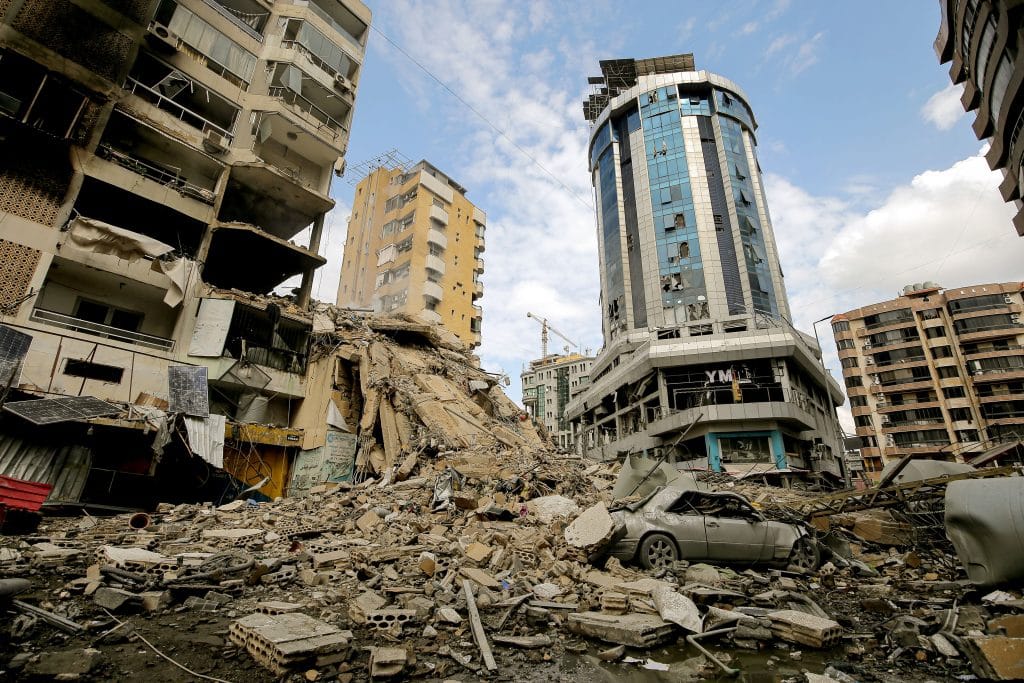
“Save your lives and evacuate your homes immediately,” read one of the leaflets dropped by the Israeli army over Beirut at the onset of Israel’s 2026 war on Lebanon.
The blanket evacuation order, first targeting southern Lebanon in early March and then extending to encompass entire parts of Beirut, caused widespread panic in the city, effectively displacing about one million Lebanese in under two weeks. This means one in every four Lebanese is now displaced, and the number continues to rise.
Local media described the warning as unprecedented for such large areas of Beirut, and unlike previous statements, the Israeli order did not simply urge residents to leave, but also where to go: east toward Mount Lebanon, north toward Tripoli. Do not go south, or you will put your lives at risk. A joke started going around: the Israeli army is now our traffic control!
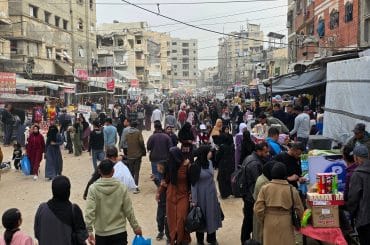
Images circulating on social media showed seas of people leaving Beirut’s southern Dahiya suburb on foot, by bus, or by car, settling wherever they could — in downtown Beirut, along the seafront, or in other neighbourhoods, particularly in West Beirut.
Residents spoke of leaving everything behind. Many had been preparing to break their fast when the evacuation warning arrived. “I left the food on the stove,” one woman said. “And now look at us, we have nothing to break our fast with.”
Leaving food on the stove, evacuation orders, a trail of people leaving their homes behind. The parallels with past historical traumas were evident. “This looks exactly like 1948,” one user wrote. “It is our Lebanese Nakba.”
As if to reaffirm it, Israeli Finance Minister Bezalel Smotrich posted a video on social media stating that Beirut’s southern suburb, Dahiya, would “soon resemble Khan Younis,” referring to the city in southern Gaza that was heavily destroyed during Israel’s military campaign.
“Why are we alive? Maybe it’s best if they just drop a nuclear bomb and kill us once and for all,” a message from a friend reads. “It would be easier than this death-like life.”
It would seem that the messages dropped from above, compelling people to make the choice of death or life, had now formed a continuity between past and present. Similar leaflets were dropped during the 1948 war over the Palestinian cities of Lydd and Ramla:
“The Israeli Army has surrounded the area.”
“Residents must leave immediately toward the east.”
“Anyone remaining may face military attack.”
The messages accompanied a military campaign that resulted in the mass displacement of thousands of civilians from both cities.
Similar warnings appeared elsewhere. In the village of al-Tira, leaflets declared:
“The next few hours are crucial… your destiny is in your hands.”
“Turn in the fighters and weapons.”
“Our airplanes, tanks, and mortars will crush your village.”
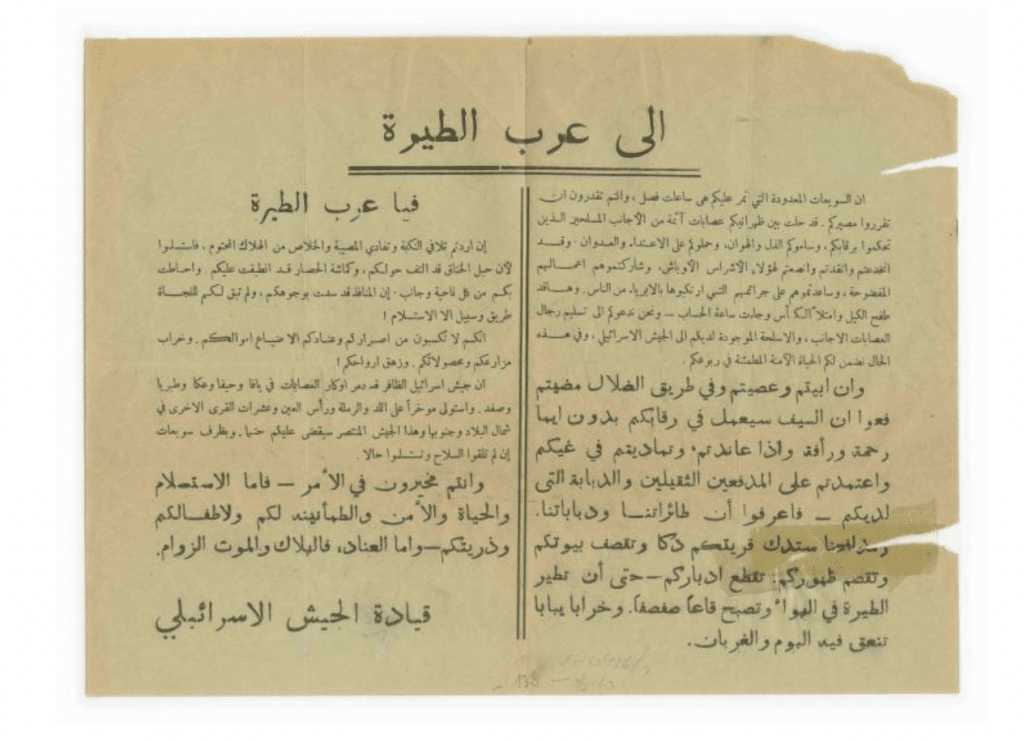
Over Haifa, residents were warned:
“The day of judgment has arrived.”
“Evacuate the women, children, and the elderly immediately.”
“Move away from neighborhoods where fighters are operating.”
The text inscribed on leaflets read like verses from holy books: you must follow these directives or suffer the consequences.
The waiting itself — the space between threat and action — becomes far more potent than any physical weapon. Civilians linger in uncertainty, trapped between anticipating salvation and dreading devastation, all while paralyzed by the divine threats descending from above.
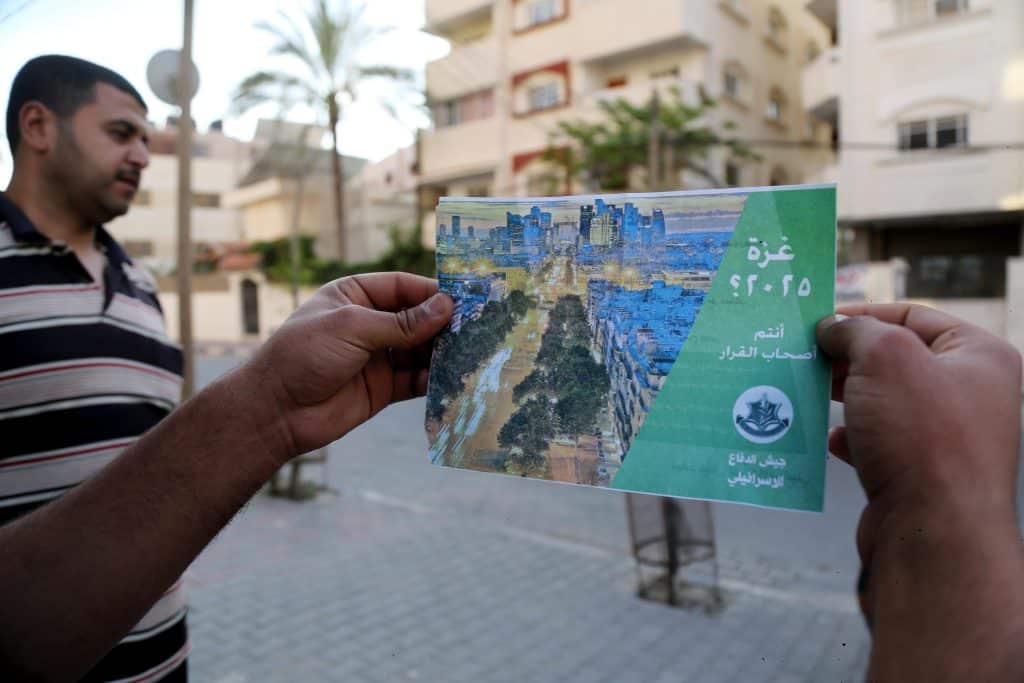
Dawoud Abo Alkas/APA Images)
The gods in the sky
A week into the war, the Israeli army felt the need to address the greater Beirut population. Leaflets were dropped from the sky alongside two huge sonic bombs.
“Take matters into your own hands,” the leaflets read. “Disarm Hezbollah, and do not let others decide your future.”
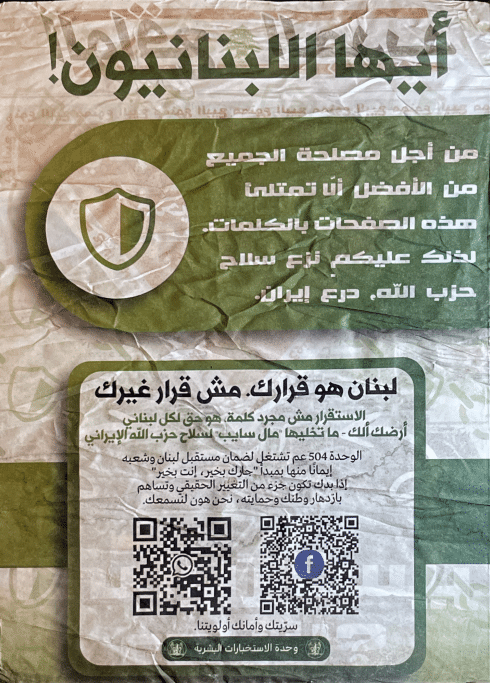
“Act, or live with the consequences.”
This was echoed by Israel’s Defense Minister, Israel Katz. “If Lebanon doesn’t stop Hezbollah, Israel will take matters into its own hands,” he said.
The leaflets came with a QR code, which, when scanned, took you to direct chats on Facebook and WhatsApp — forums for recruiting collaborators.
Other leaflets dropped by the Israelis described Gaza as a great success story, warning the Lebanese of a similar fate if they did not revolt against Hezbollah.
If you do not obey me — I, the all-powerful, the unreachable — you will suffer the consequences. The orders resembled divine instruction, a perception reinforced by their falling from the sky.
But counter-messages also began to circulate, warning of the blatant psychological tactics and urging members of the public not to scan the codes to prevent their phones from being compromised. This, too, was drawn from past experiences of mitigating the effects of psychological warfare; in the 1982 Israeli invasion of Beirut, Lebanese groups fighting Israel warned people not to touch the leaflets because they were “poisoned.”
In Gaza in 2014, leaflets dropped by the Israeli army urged residents to evacuate entire districts, signalling knowledge of their movements: “You are always seen, always known.”
The effect mirrors cinematic portrayals of divine oversight: humans scurry below, aware of an invisible gaze that shapes their every choice. The technology becomes the godlike instrument, the human recipients its audience. As for the drone operators, they are the deities who can see without being seen.
This is also the objective of psychological warfare, employing leaflets, drones, and mass propaganda to convey the impression of omnipresence. Civilians experience the state’s reach as unavoidable, much like a god’s presence in everyday life.
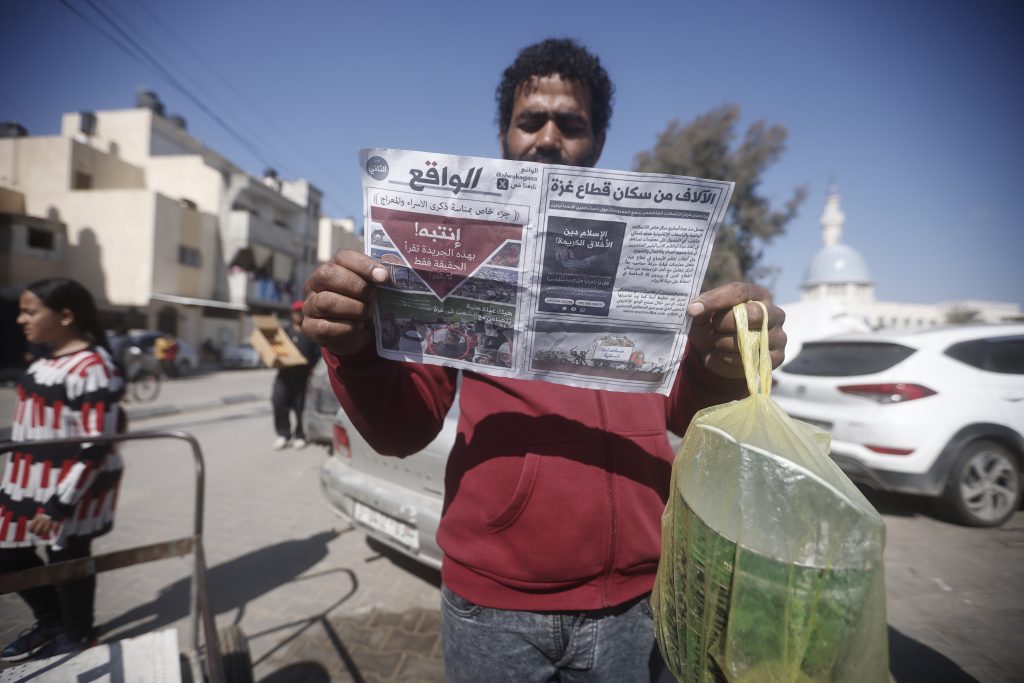
During the Gaza genocide, the Israeli army dropped leaflets threatening residents with divine conquest, citing verses from the Quran about Moses parting the sea and a flood overtaking the wrongdoers, accompanied by the message, “People of Gaza, the IDF is coming.”
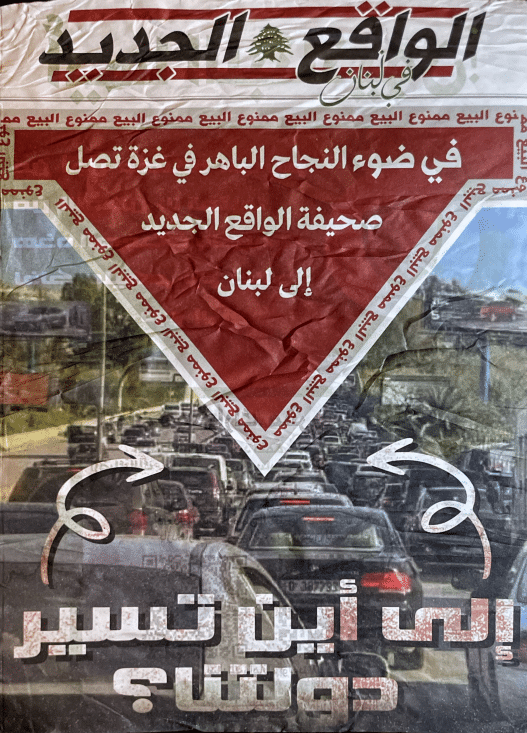
In Beirut, some leaflets were designed to resemble the front page of a newspaper called “The New Reality.” It carried the headline: “In light of the great success in Gaza, ‘The New Reality’ newspaper arrives in Lebanon…Where is our state heading?”
The same “newspaper” was dropped over Gaza in 2024, containing propaganda purporting to “reveal the truth,” including propaganda about Hamas looting aid and messages urging residents to provide information on the whereabouts of Israeli captives.
During a live broadcast in the early days of the bombing of Dahiya, one displaced person shouted on TV. “Who is going to stop Israel? No one will. They are gods on earth,” he said. “They decide when we live, when we die, where we go, which route we take. They decide our future. Who is going to stop this insanity?”
Another person responded: “No one will. There aren’t even pretenses of UN meetings like with Gaza. No ‘diplomatic movement’ [haraka diplomasiyya],” she says, invoking a term that has become so commonplace in previous wars. “The only ‘movement’ is of fighter jets above our heads. The movement of the displaced. Movement in the direction of hell.”
Unlike gods, mythical or otherwise, political and military leaders are supposedly subject to the restrictions of international law. But the Gaza genocide saw the death of international law and the world order as we knew it. Israel has been acting with impunity ever since, reinforcing the sense that it operates beyond the bounds of human judgement.
The leaflets dispatched from above reflect this divine impunity, each message landing as a token from an unseen author. But what drives home the perception of omnipotent wrath is that the same source of the leaflets also metes out death and destruction from the sky, passing judgment on who lives and who dies.