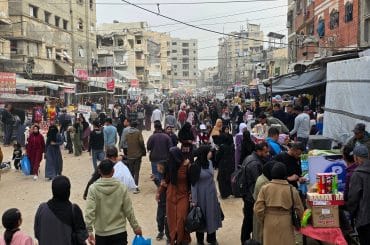
As the residents of Nabi Chit settled in to sleep on the night of March 6-7, 2026, Hajjeh Hamda al-Halbawi heard strange digging noises in the Shukr family cemetery right outside her home, an unusual disturbance at such a late hour. When she stepped out of her home to investigate, a drone immediately opened fire at her. Witnesses tell Mondoweiss that the moment her son and daughter rushed over to take her to the hospital, the drone targeted them as well. All three were killed.
The strikes soon became a massacre, as another neighbor emerged from a nearby house and was struck by a drone on his balcony. The town’s WhatsApp groups were blasting with news about a possible Israeli incursion as residents began to prepare for what promised to be a long night.
Nabi Chit and several other towns in eastern Lebanon’s Beqaa Valley had been issued a blanket evacuation order by the Israeli army earlier in the day on March 6. Almost 20 minutes after the warning, Nabi Chit was subjected to several Israeli airstrikes, killing 41 villagers and injuring 40 others throughout the day, according to the Ministry of Public Health.
Despite the bombardment and the evacuation order, many residents had elected to remain in the town. According to Hadi Shukr, a local journalist from the village who witnessed the events and later reported on them, many residents didn’t have anywhere to go and had decided to stay put.
Shukr says that movement had been reported near the Beqaa’s eastern borders with Syria after a long day of airstrikes. “But we knew something was off when we noticed the noises coming from the cemetery in the center of town,” he told Mondoweiss, noting that the airstrikes earlier in the day were meant to instill fear in village residents and precipitate their flight. Those who remained offered resistance.
Later reports confirmed that Israeli special forces had infiltrated the town in an attempt to recover the body of captured Israeli pilot, Ron Arad, who had disappeared in Lebanon in 1986. During the raid, armed residents joined Hezbollah fighters in exchanging fire with the Israeli force.
The following day, Israel announced that the mission had failed, with Israeli Prime Minister Benjamin Netanyahu stating that the operation “did not yield the findings we were looking for.”
Two days later, on the evening of March 9, Israel attempted another drop in the Syrian border town of Serghaya. This time, the Israeli force encountered more organized resistance. Hezbollah and local witnesses described a large helicopter sweep and an aborted landing near the Syrian town. According to Hezbollah, a helicopter was struck in the process, but it was able to leave.
Sources who spoke to Mondoweiss say these attempts might have less to do with recovering Ron Arad’s remains than with possibly testing the ground for a wider incursion. These fears come amid Israel’s expansion of its ground invasion in southern Lebanon, which has reportedly been met with “stiff resistance” from Hezbollah in the villages of Khiam, Kufr Shuba, Aita al-Shaab, al-Taybeh, and a number of other border towns. Earlier this week, Axios reported that Israel was planning for a “massive” ground invasion of southern Lebanon, allegedly meant to occupy the entire area south of the Litani River. One Israeli official reportedly threatened to “do to south Lebanon what we did to Gaza.”
But while the bulk of the fighting is concentrated in southern Lebanon, the Beqaa Valley in the eastern part of Lebanon has become increasingly important for Israel’s military strategy during the war, according to Lebanese experts who spoke to Mondoweiss.
The logic of Israel’s military operations in eastern Lebanon
The Lebanese Army’s official timeline of the Nabi Chit invasion records the detection of hostile Israeli helicopters at around 10:50 p.m. on March 6, with “two helicopters” deploying a “hostile force” in the vicinity while “intense and widespread airstrikes targeted nearby villages.” According to the army statement, upon identifying the Israeli force, it launched flares to expose the landing zone. Later, the Israeli force and local residents engaged in an exchange of gunfire, which continued until about 3 a.m.
Another statement put out by Hezbollah adds more details to the night’s events: fighters reported detecting helicopters at around 10:30 p.m., engaged the invaders near the cemetery at around 11:30 p.m., and later focused concentrated rocket and artillery fire at roughly 4:15 a.m. the following morning, with the support of the town’s people.
On March 9, the resistance counted “around 15 helicopters” sweeping the eastern mountain range before an attempted landing near Serghaya, which was met with immediate fire and aborted by the Israeli army. The Hezbollah account is consistent with eyewitness testimony from the ground.
Major Munir Shehadeh, a career officer and the Lebanese government’s former coordinator to the UN’s Interim Force in Lebanon (UNIFIL), explains that the repeated Israeli attempts to invade the Beqaa Valley are tied to its strategic depth, as the region straddles a wide border with Syria. “It is a logistics artery and a staging area with steep, open, and mountainous terrain that is hard to control from the air alone,” Shehadeh tells Mondoweiss. “And it is even harder to operate inside the area physically.”
For Israel, the Beqaa would offer three primary advantages, Major Shehadeh explains: richer intelligence on movements across the border, opportunities for targeted raids on specific individuals or assets, and the ability to signal that Israel’s reach extends far beyond the south.
The Beqaa Valley is also known as a significant stronghold of resistance where Hezbollah holds significant sway, Shehadeh and Shukr say. This is why analysts describe the ongoing Israeli war as an attempt to drive a wedge between Hezbollah and its popular base of supporters by meting out wholesale destruction among the civilian population. The well-worn strategy of collective punishment, known as the “Dahiya doctrine,” was employed by Israel during the 2006 war with Hezbollah when it leveled Beirut’s southern Dahiya suburb, another base of popular support for Hezbollah.
According to Shehadeh, Israeli military activity in the Beqaa is also tied to broader geopolitical shifts in the region. After the fall of the Assad regime in Syria, Israel occupied the Syrian side of the summit of Mount Hermon — Jabal al-Sheikh — one of the most strategic locations in the Levant, as it gives a clear vision of parts of Palestine, Syria, and almost all of Lebanon. It even offers a view of Cyprus.
This newly changed status quo gives Israel the chance to monitor the Beqaa much more closely, Shehadeh says, possibly giving rise to the strategic assessment that there might be a new opening for an Israeli incursion.
“From a military point of view,” Major Shehadeh added, “this is about building a better intelligence picture and testing the Lebanese environment: how the army responds, how the resistance and civilians respond, and which deterrence equations hold.”
Hadi Shukr also ties the Nabi Chit incident to a previous operation a couple of months earlier, when the Mossad abducted retired Public Security captain Ahmad Ali Shukr from the village of Zahle in connection with the effort to recover the body of Ron Arad.
The last known sighting of Arad had been reported in Nabi Chit four decades ago before he disappeared, and no one has an official account of his whereabouts. According to Hadi Shukr, those who know are dead, and the elders in his town tell more than 20 different stories about his possible fate, even as stories and rumors continue to tie him to the village.
An ‘honorable history’ of armed resistance
The operation also goes beyond the military component, Shukr adds, believing that Israel is also testing the social environment and how it responds to an incursion attempt.
The Beqaa region is known for its clan-based social makeup, in which clans and families operate as social entities that have played an active role in defending the land. Shukr explains that when the Israeli force entered Nabi Chit, it was opposed not only by organized fighters, but locals with their own personal arms.
Major Shehadeh explains that clans in the Beqaa have historically been armed. “They are socially tied to the area, and they tend to defend their land against any outside invader,” he says. “In any large confrontation, the clans play a supportive local role in protecting villages and roads.”
This doesn’t only apply to Israeli incursions; over the past year and a half, clashes have also been reported between the clans and infiltrators from the Syrian army under the new government of Ahmad al-Sharaa. Before the fall of the Assad regime, deadly clashes between local clans and jihadist factions from Syria were reported back in 2014-2015.
Now with thousands of Syrian army troops deployed at the border under the new regime, and within the context of the war with Israel and two attempted infiltrations, residents of the Beqaa are in a heightened state of alert. After the second helicopter incident in Serghaya, Damascus accused Hezbollah of firing missiles towards its troops with no mention of the Israeli incursion.
Even though Syria’s new president assured the Lebanese government that his troops are only trying to keep things calm at the borders, locals in Beqaa remain wary. Major Shehahdeh believes that the presence of Syrian forces on the border could be al-Sharaa’s attempt to signal that Syria isn’t interested in a conflict with Israel, or “an attempt to redraw the borders based on how Lebanon emerges from the war,” he explains.
“Syria is indirectly aligned with Israel’s vision,” Major Shehadeh says. “For years, Israel has sought to weaken or disarm Hezbollah, and any rhetoric in that direction serves Israeli goals.”
Following the second attempted commando drop, Syria’s president stated that he supports the Lebanese Government’s decision to disarm Hezbollah.
Viewed together, the two incursions resemble a sequence of experiments: a night landing in Nabi Chit met by a combination of fighters from Hezbollah, local clans, and Lebanese Army units. The second attempt was repelled far more quickly, given the advance notice.
“This region has an honorable history of armed resistance to occupation and invasion,” Shukr emphasizes. “So it wasn’t surprising that a drop happened and that the locals confronted it with their personal weapons.”