
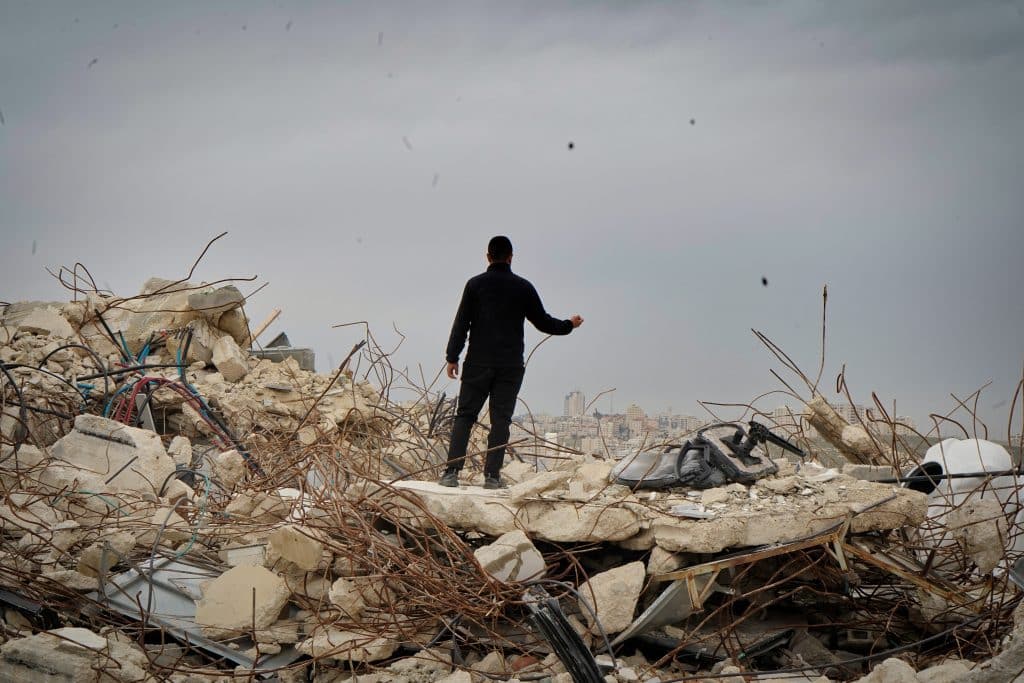
The gray sky casts a pale light on the entrance to the Palestinian village of Qalandia, north of Jerusalem. The rugged street at the roundabout looks like an abandoned urban site, with an Israeli watchtower in the distance and the Israeli separation wall cutting through the landscape over a nearby hill. A few cars rush to leave the roundabout towards Ramallah, while an old arch at one side reads, “Welcome to Qalandia.”
Inside the village, the landscape stands in sharp contrast: green gardens, olive trees, and parked farming trailers surround stone houses, separated by quiet, narrow streets. A man stands in front of a pile of rubble, greeting visitors. “Welcome to what used to be my home,” he says.
Samer Hamdia, a middle-aged construction worker, walks over the remains of the house he spent a lifetime of savings building, and where, until recently, he had lived with his wife and six children. Israeli forces demolished it last December as part of Israel’s surge of demolitions of Palestinian homes in the West Bank.

The village of Qalandia, adjacent to Israel’s separation wall, is treated by Israel as part of annexed Jerusalem. This has made it a target for demolition over the past several years, with some 30 houses demolished in Qalandia in a single night in 2016. Since then, it has been periodically issuing demolition orders to more families in the village.
According to Jamal Jumaa, the coordinator of the grassroots Stop The Wall campaign, the north of Jerusalem area “is a crucial part of Israel’s settlement plans around Jerusalem, as it has already surrounded the city from all sides, isolating it from the rest of the West Bank.”
In Qalandia, the only thing separating the Israeli-annexed part of Jerusalem from the West Bank is the wall. But Israel has plans to change this reality. “Since 2009, Israel has announced plans to build a settlement for Orthodox religious Israelis on the lands of Qalandia in the area that used to be the Jerusalem airport before the occupation,” Jumaa explains. “For this, a buffer zone needs to be created, which would cripple the growth of nearby Palestinian communities like Qalandia.”
But this home demolition policy is not limited to the north of Jerusalem. In mid-February, the Jerusalem Legal Aid Center (JLAC) reported that Israel had demolished 300 Palestinian properties in the West Bank in the first month and a half of 2026. Haaretz reported that the Israeli wave of demolitions was “clearing the way” for Israeli settlement expansion, while the UN warned of the irreversible “de-Palestinisation” of Jerusalem, warning that the Gaza genocide could be “spilling over into the West Bank.”
By not issuing building permits, Jumaa says, Palestinians are forced to build homes without them, which are then demolished. “This blocks any future plans for Palestinians in the area, ultimately pushing them to leave,” he adds.

At the site of his demolished home, Samer is joined by his son, Mahdi. Both begin to recall what their home used to be.
“Here we had built two separate apartments in a single building,” Samer says, motioning to the pile of rubble. “One for all the family, and one for Mahdi, who was preparing to marry.” Mahdi smiles but keeps looking at the rubble.
“I worked on building the house with more passion than at any other building site,” Samer continues. “It’s our house, after all. My house.” He laughs when he remembers his first night in their new home. “I slept that night like I hadn’t slept in a long while. It was a feeling of peace and satisfaction.”
The Hamdia family began building their home in 2020, but the dream of owning it had started much earlier. “I began working when I was 17, which is a long time ago,” Samer says. “I’ve been saving to build a home ever since. Once I got married, my wife and I lived at my parents’ house on the other side of town.” He points toward the distance, where several houses can be seen in Qalandia.
In 2016, Samer purchased the small plot of land for his home. He applied for a building permit from the Israeli military authorities — rather than from the Palestinian Authority (PA) — because his land lies in Area C, the roughly 60% of the West Bank under complete Israeli military control. The remaining 40% of the territory, designated as Areas A and B under the 1993 Oslo Accords, fall under varying degrees of shared administration between the PA and the Israeli military.
While building permits are granted by the PA in Areas A and B, the Israeli authorities rarely issue such permits for Area C. But Samer still applied, he says, because he had a better chance of getting one. He explains that his land is just a few steps from Area B, which he says would make it easier to get approval. Or so he thought.
“I did all my paperwork through a law firm in Ramallah, but then soon after I applied, the lawyer at the firm called me into his office,” Samer details. “He told me to prepare a lot of money, because the legal case was going to take a while.”
By 2020, the case was still tied up in the courts, and the family needed to move into a new home. “Both my family and my elderly parents needed more space, and the permit formalities were ongoing, so we thought we’d begin building the house,” he explains.
Samer’s petition for a building permit remained tied up in Israeli courts for 10 years. He spent NIS 10,000 ($3,164) in legal fees, and the permit was never issued. But the threat to the family’s home came much earlier. “In 2016, the Israelis came and distributed demolition orders, and I had already filed my building permit petition, but I came in the morning and found a demolition order delivered to my land when almost nothing had been built yet,” Samer says. “The lawyer was perplexed, and he told me that this had to be a mistake, that it wasn’t for me. He said he would follow up on it in court.”

‘Like a hammer to my heart’
For the Hamdias, building the house was more than fulfilling a dream or getting more space. It represented the growth of their extended family and the deepening of its roots in their village.
In Palestinian villages, extended families have lived together in small complexes for centuries. Commonly known as a “hosh,” these complexes are composed of multiple individual houses belonging to siblings and their families. When even the grandchildren marry and begin forming their own families, they split off and form a new hosh for themselves. “Mahdi getting married and Mahdi building a house were the same thing,” Samer explains. “This was going to be the first building in the Samer Hamdia hosh, which would include more homes for Mahdi’s brothers when they married as well.”
Samer’s wife, Najla, joins the conversation with her youngest daughter, Mira, aged 11. They walk around the rubble, looking at the details in every corner. “I never came back since the demolition until now,” says Najla. “It hurts my heart seeing it in rubble. It’s like living through the loss all over again.”
“Building the home was the most important project we had as a family, it was like a lifetime achievement,” she explains. “We wrote out all these checks in my name to pay for the construction material, and I went dozens of times to Ramallah to put money into my bank account, and even put up my wedding jewelry at a jewelry shop as collateral. We are still in debt to this day.”
In the final weeks before she moved in, Najla stopped working at her in-laws’ house and spent all her time at the new house, fixing every detail of the decorations and furniture with her daughters. The family moved into their new home on January 18, 2024, on Samer’s birthday. “From January 2024 to January 2025, I had peace in my house,” Najla remembers. “I woke up in the morning to birds singing, then I made breakfast for all the family, and for most of the day I stayed at home, making it as beautiful as I could.”

That peace began to fade in early 2025, when the lawyer called Samer to say that Israeli authorities would not issue a construction permit after all. The petition was missing documents, he said. “That is when I felt that the countdown had begun, but the lawyer also said that the Israelis wouldn’t come to demolish without prior notice,” Samer says. “And yet, they did.”

On the morning of December 16, 2025, the Hamdia family woke up to the rumble of Israeli engines. A police jeep had arrived at the street of the Hamdias’ house, followed by a bulldozer. Samer immediately understood that it was the moment he had been dreading.
“The Israeli officer told me outright that they had come for my home,” Samer recalls. “He also said that they had sent a notice, which I never received, and then he said that he was going to the other side of the village to deliver a demolition notice to another family, and then come back to oversee the demolition of my home.”
“Every hammer from the bulldozer was like a hammer to my heart. I had put so much of myself into that home.”
Najla Hamdia
“A female police officer entered the house and began to tap on the walls to see what they were made of,” Najla details. “She ordered my daughters and me to go out. I told her, ‘this is my house’ and shouted at her to leave. But then she put her hand on her rifle and screamed, so we left in our pajamas without taking a single thing with us.”
When the Israeli officer came back, hundreds of Qalandia residents had already gathered and begun to take out the furniture and other family belongings. “I was surprised at the speed of the response by the neighbors,” Samer says. “And when journalists showed up, police officers began to order everybody to disperse before firing tear gas.”
The Israeli police fired so much tear gas that Al Jazeera reporter Tharwat Shaqra was crying on air while covering the demolition. Samer and his children watched as the home they worked hard to build fell apart, but the scene was too much for Najla to witness.
“Every hammer from the bulldozer was like a hammer to my heart,” she recalls. “I had put so much of myself into that home, and I couldn’t just look at our furniture being thrown to the street.”
For Samer, the demolition of his house was like throwing out “an entire lifetime of work.”
“I don’t know how we are going to pull ourselves out of this,” he exclaims. “One thing is sure: if they expect us to leave, they are dreaming. We will remain here, no matter the cost.”

Qassam Muaddi
Qassam Muaddi is the Palestine Staff Writer for Mondoweiss. Follow him on Twitter/X at @QassaMMuaddi.

Is this what it means for the Jewish people to return to their ancestral homeland??
Some days, some articles are just too upsetting to read.
A gun to the head? An offer they cannot refuse?
Meanwhile here in the UK, the leader of the Green Party of England & Wales, Zack Polanski, who has garnered enormous positive publicity in leftist media (apart, thankfully, from the WSWS) refuses to admit that Zionism is a racist ideology. He apparently thinks that there are good Zionisms.