

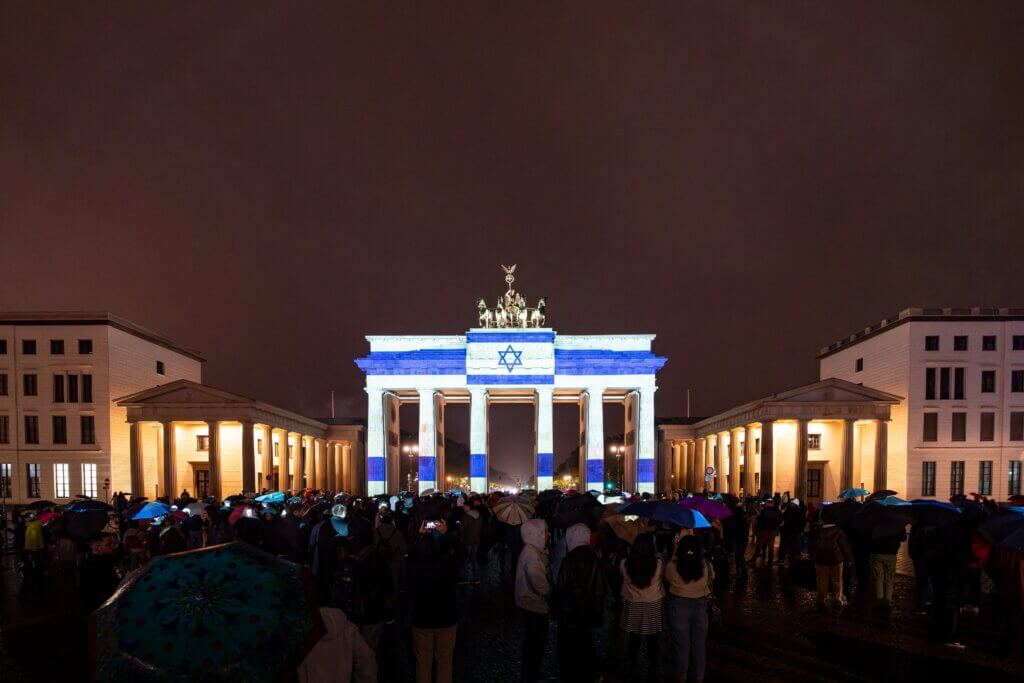
We Germans live in a reality shaped by our genocidal history. But while the national narrative of “collective guilt” for the Holocaust is omnipresent, German lived experience exposes this as more myth than reality. With our performative “commemoration culture,” we instrumentalize the Holocaust to distance ourselves from our past, to deflect from our current far-right problems, and to rebrand ourselves as a champion of morality. A central part of crafting our self-serving image, our “genocide hubris,” is our current unquestioning support of Israeli war crimes, a hubris that has crumbled under the weight of our complicity in the Gaza genocide.
German dogma and German reality
I loved growing up in West Germany of the 1980s and early ‘90s. As a half-German, half-French child, I only had a vague conception of nationality, or of why I should be proud of being what my passport says I am. Thus, I was happy that Germany appeared different from other countries, seemingly less concerned with national pride. That, after two catastrophic World Wars, we didn’t have to have our flag plastered everywhere like the Americans. We were reformed, we were sober now. No more nationalism, no more wars, and no more genocide. If we were proud to be German, it was because we were proud of our “constitutional patriotism” and our new, postwar humanistic values.
In German childhoods, our recent history loomed large. We knew how Germans had been sadistic, hateful, even genocidal in the past. We knew why movie supervillains, from Dr. Strangelove to Hans Gruber, were naturally German. In school, we learned everything about the genocide of the Jews, with footnotes on the Romani genocide, Aktion T4, and – since I went to a Catholic school – the persecution of the Catholic church. (No mention of the countless Slavic victims of Nazi Germany, however, those remained firmly below the awareness threshold.) A Holocaust survivor came to school to give us a first-hand account of the unspeakable horrors that the Jewish people had been subjected to. We read Anne Frank. We memorised Paul Celan’s Holocaust poem “Todesfuge,” with the haunting refrain that “Death is a master from Germany.” We saw Schindler’s List on a school trip to the cinema. We saw the first “Stolpersteine” memorials being installed in the ‘90s. Our school theatre performance was – naturally – Eugène Ionesco’s Nazi allegory, Rhinocéros. When our final high school trip took us to Prague, we made the obligatory, gut-wrenching stop at the Theresienstadt concentration camp.
The lesson couldn’t be clearer: we, as a people, had committed the ultimate sin, and we had to be thoroughly educated to ensure it would never happen again.
And yet, while I was growing up, current affairs were more “again and again” than “never again,” as an endless string of neo-Nazi terrorism echoed uncomfortably the late Weimar Republic: Nazi riots in Hoyerswerda and Rostock-Lichtenhagen, deadly arson attacks in Duisburg-Wanheimerort, Schwandorf, Mölln, Solingen, Lübeck (twice), the murder cases of Amadeu Antonio, Silvio Meier, Noël Martin, Beate Fischer, Michael Berger, and in later years Marinus Schöberl, the years-long NSU murder spree, Walter Lübcke, Halle, Hanau and the Reichsbürger plot to name but a few. Thus, as I watched the televised news in the ‘90s, the suspicion grew in me that far-right and antisemitic politics were not eradicated as we were led to believe, but on an unstoppable rise: ever more neo-Nazis marching on the streets, ever more far-right politicians sitting in parliament, and widespread neo-Nazi sympathies within police, state security, and army.
How could such a gargantuan national re-education effort fail so miserably? How could so many Germans learn absolutely nothing and repeat past horrors?
Disturbed by these echoes of darker times, I knew that, as a German, I had a duty to continue educating myself after graduating from school. I read the harrowing Holocaust accounts of Elie Wiesel, Victor Frankl, Primo Levi, and others. I read Art Spiegelman’s “Maus” and Amos Oz. Like many egalitarian-minded and progressive Germans, I became a fan of the kibbutzim. I went to the newly opened Jewish Museum in Berlin, and when I travelled, I made a point of visiting places of remembrance. When I went to Israel, I visited Yad Vashem; when I went to Japan, I visited the Hiroshima Peace Memorial. I knew that we, as Germans, have a special duty to be vigilant, to make sure that we would not commit, or be accomplices to, such atrocities.
I gradually realised, however, that school had not taught us the bigger picture. I cannot remember whether we learned about the Herero and Nama genocide in school, or any other German atrocities. It seems today that World War II overshadowed everything else and hovered above us, singular, contextless. I had, for example, only the dimmest understanding of the sadistic, hateful, even genocidal side of European colonialism. As a child, I was proud that my birthday coincided with the day Christopher Columbus had “discovered” the “New World”. And even if colonialism had not been all great, Germany, for once, seemed to have little to do with those atrocities. Only later, through my readings and travels, did I learn just how limited this historical reading was.
By removing the rich historical context of the Holocaust, the post-war German narrative created this singularity outside of space and time, this black hole. Gone was the connection to colonial atrocities, gone the continuity with the American Indian genocide and the Armenian genocide, gone also the inspiration that American Manifest Destiny and Anglo-American race science and legislation provided for German race laws and Lebensraum ideology. To borrow historian Fritz Fischer’s memorable phrase: “Hitler war kein Betriebsunfall” – Hitler was not an accident. And, most conveniently, gone was also the covert continuation of Nazism after the war.
Commemoration as deflection
In light of this stunted historiography, I also began to re-evaluate the post-war processing of our Nazi past (“Vergangenheitsbewältigung”), namely our ostentatious “remembrance culture” (famously derided as “commemoration theatre” by the Jewish sociologist Y. Michal Bodemann). At the core of this narrative is our “collective guilt.” This oft-repeated mantra was little more than a charade: no German I know has ever felt personally guilty for Nazi crimes. How could one feel guilty for something that had happened decades before one was even born? But by framing our relationship as guilt instead of responsibility, we performed a magic trick: our relationship with the Holocaust was portrayed as our past, not our present. The equation was simple, elegant even: by single-mindedly focusing on our historical crimes, we were simultaneously distancing ourselves from them, like gazing fascinatedly at a foreign object, frozen in time, and thus unambiguously past and separate.
But remembrance culture not only separated us, paradoxically, from our abhorrent history; it also served as a convenient way to paper over our far-right present with performative atonement. A corollary of the first equation was: since we were so hyper-aware of our Nazi past, we could not possibly still have a Nazi problem. And so it happened that, in the post-war decades, our brown past was swept under the rug instead of processed, with little to no reckoning for the perpetrators. “Denazification,” at least in the West, seamlessly reintegrated an awful lot of unreformed Nazis in politics, judiciary, military, police, intelligence, and business.
Tellingly, the Day of Liberation (May 8, the capitulation of Nazi Germany), which was celebrated in much of Europe, including East Germany, was not a holiday in West Germany, which instead chose to celebrate June 17, the anniversary of an East German popular uprising in 1953. Indeed, the first time a West German official would call May 8 a “day of liberation” was President Richard von Weizsäcker in a 1985 speech, fully forty years after the war, and even then, this qualification caused a scandal. Over thirty parliamentarians boycotted the presidential speech in outrage over his daring to call the defeat of the Nazi regime a “liberation,” while a quiet majority still seemed to regard it more as a Lost Cause, or at least a mark of shame. Clearly, all the aesthetics of Holocaust guilt did not run deep. In light of this mindset, the continuity and eventual resurgence of open far-right politics and violence in later years seemed natural.
German-style commemoration, then, was little more than historical pageantry akin to a visit to the Renaissance fair. We could consume dozens of books, TV dramas, and documentaries on the Third Reich without ever taking responsibility for the very real antisemitism, racism, and violence that Germans were still producing domestically and enabling abroad. It drew a line under our shameful past and absolved us from dealing with our present.
But perhaps most insidiously, our memory culture had centred the criminals instead of the victims, who often only featured as hapless extras without agency, an abstract number, six million, so enormous and industrial that it buried all individuality. We outsourced the care for Holocaust survivors by writing reparations checks – over 80 billion euros. And having bought our peace of mind, we remain blissfully oblivious to the fact that many Holocaust survivors live today in ignominious misery in Israel, because if the victims exist in our guilt processing, they do so largely in the past tense.
By sidelining the victims and focusing on us as perpetrators in this theatre of self-flagellation, we had succeeded in reinventing ourselves not only as reformed criminals but as true moral exemplars. Since we were the only country in the world that had heroically reckoned with its horrendous past, we were really better than the rest. We developed the smugness of the reformed sinner lecturing others about morality without having to reflect too deeply about the actual lessons we should have learned from the crimes of our forebears. Our performative “collective guilt” had thus turned out to be “genocide hubris.”
Pro-Israelism as a shield
The creation of the state of Israel in 1948 was another crucial event that allowed us to jettison the past. Sure, we had massacred the European Jews, but now the survivors had gone and moved on. I had seen this narrative at Yad Vashem, the Israeli national Holocaust memorial-cum-museum, which not only shows the horror of the Holocaust but also presents Israel as the happy ending, the Jewish people finding a safe home in Palestine Israel. The German government and, unconsciously, we as a people, have enthusiastically embraced this narrative. Not only does it reinforce the notion that our dark past has been resolved with the creation of Israel, it has truly become history, making us good.
There are obvious holes in that logic. While our government claims that the Holocaust implies Germany’s historical responsibility for the existence of a Jewish state, it is very comfortable with the fact that, as an act of atonement for its murder of the Jews, other people’s land would be confiscated, against the will of its inhabitants, to found a Jewish state. And no German seems to mind that it is not us – the perpetrators and their descendants – who pay the territorial price of their crimes. Germany may have written checks, but Palestinians were expelled from their lands to provide the real estate.
The focus on the Jewish Holocaust also conveniently circumscribes German responsibility for a state to only one of its many genocide victims. No German politician is campaigning for the establishment of a Sinti and Roma State, or even just paying the same reparations to our Romani victims as to our Jewish victims. It would indeed be very costly for Germany if it commemorated more than one of its many genocides.
The foundation of Israel was thus, as far as Germany was concerned, a “happy resolution” of its Jewish problem. Completely ignored was the decades-long catastrophe that this “relocation” would engender for Palestinians. Indeed, the plight of the Palestinians could hardly be more non-existent: most Germans have never heard about the Nakba, schools do not teach it, broadcasters do not show movies or documentaries on the topic. When I was looking for streaming options for my non-English-speaking parents of films like Tantura or 5 Broken Cameras, I was astounded that I couldn’t find any with German dubbing or subtitles (although I shouldn’t have been surprised). The problem is taboo, and if it ever comes up in conversation, we are quick to change the subject.
And so it happened that I, like most Germans, had not the faintest idea of the Israel-Palestine conflict. When I visited Israel in 2016, Palestinians were invisible, to the point that I could cross through the illegally-occupied West Bank on an Israeli-only highway from Jerusalem to Ein Gedi to take a dip in the Dead Sea without even thinking about who lived here, and under what conditions. When I attended a conference at the Hebrew University in Jerusalem, I was oblivious to the fact that it was partly built on illegally annexed land, contravening the Fourth Geneva Convention.
Everything changed for me with the Sheikh Jarrah evictions in 2021. I can pinpoint my Eureka moment precisely, to a social media clip that showed “Jacob from Long Island”, who had come to East Jerusalem to take over a Palestinian family’s home as his “birthright,” say the shocking words: “If I don’t steal it, someone else is going to steal it.” I was stunned. What was happening? How could this be okay? I started educating myself, as I had with the other topics. I learned about the 56 years of military occupation and apartheid, the over 700,000 illegal, violent settlers in the occupied territories, about “administrative detention,” about the ongoing 17-year Gaza siege that imprisoned 2.3 million people, putting them “on a diet” while regularly “mowing the lawn.” I was astonished by my previous uncritical blindness and lack of curiosity. I had heard about Palestinian “refugee camps” but never asked where these refugees had come from. I learned that these refugees and their descendants were insisting on their right – granted by the Hague and Geneva Conventions, the United Nations Universal Declaration of Human Rights, and countless UN resolutions – to return to their usurped lands in present-day Israel, to the over 500 “depopulated” and erased villages. A right of return that Gazans had peacefully marched for, just to be sniped from across the wall, with IDF soldiers making fun of the number of knees they had shot. I learned that the existence of these villages had been erased by the newly planted pine forests of the Jewish National Fund, and a couple even with the kibbutzim I had so admired. I learned that I had unwittingly passed one of these erased villages, Deir Yassin, the site of one of the bloodiest Israeli massacres, when I visited Yad Vashem. Once you see the cognitive dissonance, you cannot unsee it. I cried uncontrollably in Yad Vashem at the sight of the murdered children’s shoes, and I am crying the same tears over the murdered children in Gaza.
As someone who grew up in Germany, I understand the psychology that underlies this collective blindness. From the inside, Germany’s unconditional, unquestioning support for Israel, to the point of making it a (legally questionable) “national purpose” (“Staatsräson”), is not only an easy way out of a deeper examination of our brutal past. Israel also provided us with another set of equations that corroborated the first one: since we are “pro-Israel,” we cannot be antisemitic (anymore). (Never mind that declaring the state of Israel to be Judaism reified is, in itself, a crude stereotype.) In fact, since we are the most pro-Israel country, we must be the least antisemitic, we are anti-antisemites! And since we are not antisemitic, we are also not far-right. German Chancellor Friedrich Merz pulled that trick when he shed tears over the Holocaust and gave a “Never again” speech (terms and conditions apply). Granted, domestically, he is moving ever closer to the far-right AfD and, internationally, he enthusiastically embraces the Gaza genocide, but if he cries at a synagogue, he can’t be right-wing, can he?
Even better, though, the specious equation of anti-Israel = antisemite meant that now it is everybody who is anti-Israel who is the new antisemite. And with that sleight of hand, we effectively ended the era of the Nazi supervillain and passed the buck of present-day antisemitism to “Islamist” protesters (glossing over that many of them are Jewish), as if far-right antisemitism weren’t still a very German problem: more than 90 percent of antisemitic offenses in Germany are committed by those who have a far-right background. In that regard, broadening the definition of antisemitism from the traditional Judenhass to encompass dislike or criticism of the state of Israel, as the controversial IHRA definition suggests, is also a convenient way to minimise the German state’s problem with “homegrown” antisemitism. While the state increases the number of incidents that qualify as antisemitic, it dilutes the fraction attributable to German right-wing extremism and makes antisemitism look like an “imported” issue, thus conveniently providing a cheap excuse for cloaking our anti-Muslim racism in the mantle of combating antisemitism.
The cost of our myths
It does seem, however, that all that convenience for us has a price, not only for Palestinians and those who advocate for them. Are we really being good friends to the Jewish people if we focus on Israel rather than the rising tide of far-right antisemitic violence in Germany, a violence that our government is not only fostering but also perpetrating? Because, once again, the German state is turning against Jews. It prefers to cancel school events with Jewish Holocaust survivors; to cancel an award ceremony for a Jewish recipient who drew parallels between Gaza and the Warsaw Ghetto; to uninvite Jewish-American guest professors; to freeze assets of Jewish associations; to arrest Jewish protesters for holding signs like “As a Jew and Israeli, stop the genocide in Gaza” or “Jews against Genocide”; to have riot police storm a Jewish event, which, apparently, is also “Islamist”; to ban the speaking of Hebrew – all in the name, apparently, of “combating antisemitism.” Berlin, whose police brutality has caused alarm at the UN, Council of Europe, and Amnesty International, is especially keen on suppressing dissent. I guess German police would, if they could, also arrest the plaintiffs who brought Germany to trial at The Hague for aiding and abetting Israel’s genocide (not that Germans would know of the case, which German media do not seem to deem newsworthy).
It is easy to remain mired in this twisted logic when you grow up steeped in it. Fortunately, I have lived outside of Germany for two decades – an experience that has afforded me the humbling distance and space to be introspective and self-aware. I realised that my German upbringing had obstructed my ability to recognise how violently our attitude clashes with the outside view. Especially people in the post-colonial world, where Germany is still very much seen as the serial genocidaire it used to be, perceive its current entanglement in the destruction of Gaza as a seamless continuation of that criminal legacy. But German politicians, who pride themselves on their uber-morality, are genuinely clueless when the Global South (including Germany’s former colony and genocide victim, Namibia) expresses dismay that Germany has not learned from its past. According to the German self-perception, being the descendants of genocidaires qualifies us to whitesplain to the victims of atrocities that what they are suffering through is, actually, not genocide. We should know, we are the world record holders.
It seems as if the temptation is too great to deflect from our own neo-Nazi predicament and claim a moral high ground by vilifying anybody who voices criticism of the ongoing genocide or, indeed, any pro-Palestinian sentiment. But this ruse is crumbling now under its farcical consequences. Are we, as Germans, really the best arbiters of antisemitism? Are Jewish Holocaust and genocide scholars antisemitic for describing Israel’s war on the Palestinians as ethnic cleansing and genocide? Are the Holocaust survivors who called the 2014 bombing of Gaza a genocide also antisemites? Are rabbis antisemitic if they call Gaza a genocide? Is the Israeli ex-intelligence chief Avraham Shalom antisemitic when he compares the occupation of the Palestinian territories to the Nazi occupation of Eastern Europe? Are Indigenous peoples and Black rights groups antisemitic when they draw parallels between their own suffering and Israel’s treatment of the Palestinians? Are Desmond Tutu or Jimmy Carter antisemitic when they draw parallels between South Africa’s apartheid regime and Israel’s occupation?
Incidentally, the selective silencing of Jewish voices is a tradition as old as post-war Germany itself. Much too late, I discovered that many of the literary heroes of my youth were also anti-Zionist. But Primo Levi’s anti-Zionism, which earned him persona-non-grata status in Israel, went conveniently unmentioned in German discourse, as did Viktor Klemperer’s, whose haunting diaries of living as a Jew in Nazi Germany I read with a burning heart, but whose dread of Zionism, which he compared to Nazism, went unmentioned in German discourse. In that regard, nothing seems to have changed.
In short, is everybody antisemitic, including the many Jews and Indigenous people who have spoken against the genocide, except for us, white Germans and the far-right, sadistic, hateful, even genocidal Israeli government composed of expansionist ethno-state proponents who call for Israel’s borders to extend to Damascus and say Palestinians should go to Saudi Arabia? Do we buy our get-out-of-antisemitism-free card by tying our fate to an extremist government whose ruling party proclaimed already in its 1977 founding charter that “between the Sea and the Jordan there will only be Israeli sovereignty”? If we want to stand with the Jewish people, why do we stand with Benjamin Netanyahu, Itamar Ben-Gvir, and Bezalel Smotrich when we could instead stand with Edith Bell and Gabor Maté, Judith Butler and Kenneth Roth, Jeffrey Sachs and Ilan Pappé, Amira Hass and Gideon Levy, and countless others who oppose the genocidal apartheid state of Israel?
And even if we define our raison d’état as “Israel, right or wrong,” would that entail being the abiding acolytes of the current Israeli government? Are we helping the Israeli people if we prop up a regime without an exit strategy, a death cult that is not only tearing apart the Israeli state from within but also turning it into an international pariah? Ironically, our self-righteous, self-serving “pro-Israel” stance is in danger of coming at the cost of the Israelis and their state.
And even more ironically, the group that sees most clearly through the threadbare spectacle of guilt is the very same far-right fringe that our government has coddled and left to fester in the shadows since the end of World War II. Neonazis are fond of ridiculing the German “Schuldkult” or “cult of guilt.” Commemoration theatre, then, is not only ineffective, but in its flagrant insincerity, it even serves as a recruitment tool for the most rabid Nazis.
The colossal weight of the ongoing genocide in Gaza is crushing all our facile myths, forcing us to re-examine our historical dogma. It takes a lot of ignorance about the carnage waged against the Palestinians to dismiss the loud and conscientious voices crying, “Never again for everyone.” It also takes a lot of ignorance about our own history. We are a nation with a varied portfolio of atrocities: Herero and Nama, Maji-Maji, the rape of Belgium, poison gas in Flanders, complicity in the Armenian genocide, Guernica, Jews, Sinti and Roma, communists, LGBTQ communities, disabled people, Polish and Soviet PoWs, the Blitz and V2 rockets on London. How can we, with all this history of crimes against humanity to learn from, self-assuredly proclaim the wrong, particularist lesson that some genocides are allowed?
We need to change course, urgently. Because if we don’t, when the history of 21st-century Germany is written, the insincere processing of its Nazi past will be identified as a critical contribution to its slide back into fascism. Time is running out as we watch the wave of right-wing antisemitism and islamophobia, the transformation of our police into a Sturmabteilung, and the fascist takeover of our politics. As things stand, I fear that, when a future Yad Vashem of the genocide of the Palestinians is opened, Death will still be a master from Germany.
Frédéric Schneider
Frédéric Schneider is an economist and senior fellow at the Middle East Council on Global Affairs. His research interests include West Asian political economy, particularly the post-oil economic transition in the GCC, including industrial policy, labor policy, the knowledge economy, and climate change.

Part 1
I enjoyed your article and meant to comment about it earlier. The USA has suffered from all of the same faults and shortcomings, but no sense of guilt for our centuries of forever wars and exploitation of the lion’s share of the World’s resources. We historically tend to be represented by governments that still engage in wishful thinking, Christian nationalist exceptionalism, refusal to honor our treaties, or pay reparations to those we’ve harmed.
When European settlers arrived in the Americas,historians estimate there were over 10 million Native Americans living here. By 1900, their estimated population was under 300,000. We practiced every form of torture and the most inhuman methods of committing murder and executing the condemned, but we labeled the isogenous populations as savages. Our founding fathers admired The Great Law of Peace that had united the “Six Nations,” comprising the Mohawk, Onondaga, Oneida, Cayuga, Seneca, and Tuscarora peoples as a democracy. It was originally founded between 1142 and 1451 CE, The Tuscarora, formally joined the union in 1722 They had also cultivated maize, potatoes, and beans for thousands of years.
Elihu Root served as the U.S. Secretary of War from 1899 to 1904, playing a pivotal role in organizing the U.S. occupation and governance of the Philippines. U.S. General Jacob Smith instructed his Officers “I wish you to kill and burn.” When the officer asked for an age limit, Smith replied “10 years.” The Army employed artillery, gatling guns against undefended rural villages, and “the water cure” (waterboarding) to torture and interrogate prisoners. It was a war of extermination, that is recognized today as a genocide. “Little Brown Brother” was a term used by Americans to refer to Filipinos. The term was coined by William Howard Taft, the first American Governor-General of the Philippines (1901-1904) and later the 27th President of the United States. See also “The White Man’s Burden”, by Rudyard Kipling in 1899, regarding The United States occupation of the Philippine Islands. Although the United States government declared the “insurgency” was over by 1902, guerilla resistance movements against the American occupation continued until 1913. In 1912 Elihu Root was awarded the Nobel prize for his efforts to promote international arbitration and his work in organizing international peace tribunals, and getting others to accede to the Hague Conventions of 1899 and 1907.
Part 2
The USA had violated all of the same Hague 1899 and 1907 prohibitions as Herzl’s schemes with the Russian Minister of the Interior von Plehve, Kaiser Wilhelm II, the Emperor of Germany and King of Prussia, and Colonial Secretary Joseph Chamberlain.
The last recognized armed conflict between the U.S. Cavalry and Native Americans occurred under President William Howard Taft on February 26, 1911, at the Battle of Kelley Creek (also known as the “Last Massacre”) in northern Nevada against the Shoshone.
Taft had told President McKinley that “our little brown brothers” would need “fifty or one hundred years” of close supervision “to develop anything resembling Anglo-Saxon political principles and skills.” — NPS Presidio.
President Taft’s inaugural address covered the full spectrum of White Nationalist issues: the Panama Canal, labor legislation to address “the admission of Asiatic immigrants who cannot be amalgamated with our population.” The needs of the US Southern advocates in favor of laws excluding from voting “both negroes and white not having education or other qualifications thought to be necessary for a proper electorate.” He expressed approval for “industrial education of the negro” to make them “useful members of the community.” Congress failed to adopt legislation regarding Puerto Rico as the Puerto Rico Legislative Assembly failed to pass the usual appropriation bills The National Negro Conference met in New York City and adopted a Platform ending with three demands to Congress and the Executive: to enforce civil rights of the 14th Amendment; equal educational opportunity; equal voting rights.
Like the West Bank and Gaza, Taft issued Proclamation 873—Establishment of the Navajo National Monument, Arizona that confiscated Indian owned lands and holy sites.. It evicted the Hopi, Zuni, and San Juan Southern Paiute, Navajo and Apache inhabitants: He added: “Warning is hereby expressly given to all unauthorized persons not to appropriate, excavate, injure or destroy any of the ruins or relics hereby declared to be a National Monument, or to locate or settle upon any of the lands reserved and made a part of said Monument by this proclamation.”
Proclamation 874—Opening Lands in the Flathead, Coeur d’Alene, and Spokane Indian Reservations to colonization by white settlers under the Homestead Act. See. The UCSB William Howard Taft (27) Event Timeline