

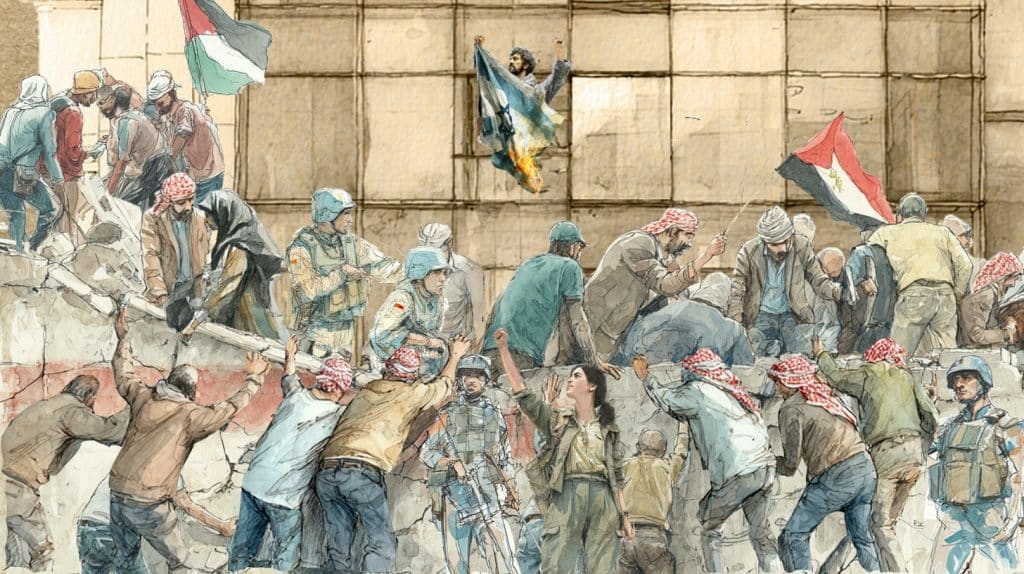
Late Egyptian President Gamal Abdel Nasser’s famous slogan, “no voice rises above the sound of battle,” has been brought to the fore again as a result of the world-altering event that is Israel’s genocide in Gaza. The slogan reflected the sentiment in the 1950s and 1960s that the national liberation struggles in the recently decolonized (with the exception of Palestine) Arab region should take precedence over other pressing issues, such as how to organize society, the state, and the economy.
Across the Arab left, questions of national liberation were central to the radical and progressive projects of the time, whether these were Arab nationalist, socialist, communist, or even liberal. Where exactly national liberation was to be ranked in relation to other pressing political, economic, and social issues was debated, but it quickly became evident that the establishment of the Israeli Zionist colony in Palestine constituted a spanner in the works for these nascent projects. Attempting to find their feet in an era of decolonization, the Arab left was suddenly forced to reckon with what they deemed an archaic colonial project that could not be further from the aspirations of the people of the region.
Colonial anachronism in the era of national liberation
Even prior to the foundational violence of the Zionist state in 1948, Palestinians – and Arabs in general – rejected this clearly colonial project and ethno-supremacist project being implanted in their midst, not because the Arabs were against Jewish immigration per se, as the standard Western narrative would like us to believe, but because they could see that Zionism was an anachronistic supremacist colonial project that would halt the realisation of the competing progressive projects they envisioned for the region. Even prior to the massacres and ethnic cleansing of the Nakba and the establishment of Israel on Palestinian land, Palestinians and Arabs were aware of the realities of this exclusionary colonial project that Britain chose to support and enable without consulting the land’s actual inhabitants. This was clear in the Arab revolt of 1936, the peasant working-class nationalist uprising by Palestinians and Arabs against British colonial rule and expanding Zionist settlement in Palestine under the British Mandate.
When Israel was established, the material conditions of the people of the region had to shift to accommodate the new reality of this settler-colonial enterprise in their midst. Hence, the priority for any leftist, progressive, or developmentalist project became national liberation first and foremost. The argument was often made that economic and social questions had to be relegated, or at least considered alongside this new reality, adding a further challenge for the people of the region. The archetypal concerns of the left, such as economic planning, union organizing, democracy, and social issues, were important, but they either took a backseat to the cause of national liberation, had to be considered alongside it, or had to be reassessed in light of the new context. At a time when socialist and communist aspirations were arguably at their height, and when people elsewhere in the world were able to draw on ubiquitous left-wing ideologies to push for progressive gains, the people of the Arab region did not have the liberty of dedicating themselves solely to these questions, as they were forced to reflect on how the new Zionist colony would affect their projects of development and modernization.
In this context, the Arab left came to be characterized by its rejection of separating social and political freedoms from the issue of national liberation. Competing ideas about whether the two causes – national liberation and social and political development – could exist in tandem were welcomed, but it was clear that national liberation was to be integral to the character of the postcolonial state. This was evidenced by the rise in popularity of Gamal Abdel Nasser and Ba’athism, the Arab nationalist ideology that emerged from Syria and Iraq, both of which prioritized national liberation.
The slogan “No voice rises above the sound of battle” came to represent this tendency on the Arab left. Generous interpretations view it as a manifestation of the material realities in the context of the ensuing wars with Israel. More critical and retrospective interpretations came to view it as a cynical way in which, in Egypt (as elsewhere in the region), the state silenced criticism, combatted opposition, and delayed or avoided addressing issues pertaining to democracy and personal freedoms. Wherever you stand on this debate, it remains the case that the crux of the matter has never been resolved: Israel, now a US proxy par excellence, is armed to the teeth with the deadliest and most advanced technologies in the world and continues to wage constant war on the people of the region, while the masses across different Arab countries remain in a tragic state, mired in authoritarianism, corruption and impoverishment.
“No voice rises above the sound of genocide”
Critiques of the approach embodied in Nasser’s slogan, and of its cooptation by current Arab leaders (most of whom prioritize neither national liberation nor social and political issues), somehow always ignore the elephant in the room (the primary contradiction, to use Marxist terms): Israel. If observers dislike this approach and deem social and economic justice to be of primary importance, rising above the issue of national liberation and sovereignty, they must offer solutions that acknowledge that the continued presence of Israel in the region, as the primary manifestation of US imperialism, is one of the primary causes of the region’s underdevelopment. The events of the past two years (if not those since the inception of the ‘War on Terror’ and the 2003 invasion of Iraq) have shown that by failing to acknowledge this reality, we run the risk of treating the symptoms and not the cause.
The specificity of the regional context, including its geographical position, the presence of key chokepoints for global trade (like the Suez Canal, the Strait of Hormuz and the Straits of Tiran), its significant resources (like oil and natural gas) and its millions of people who share a common language and common cultural, social and historical ties, mean that any attempt at sovereignty – even if not socialist per se, and whether attempted collectively, individually, democratically, or in an authoritarian form – will be considered a threat to global capital and empire. Contending with this reality does not equate to ‘whitewashing authoritarianism’ or absolving repressive regimes of their crimes. A sober assessment of the Arab region’s global and regional position, and an investigation of its history, has proven this on several occasions over the span of decades.¹
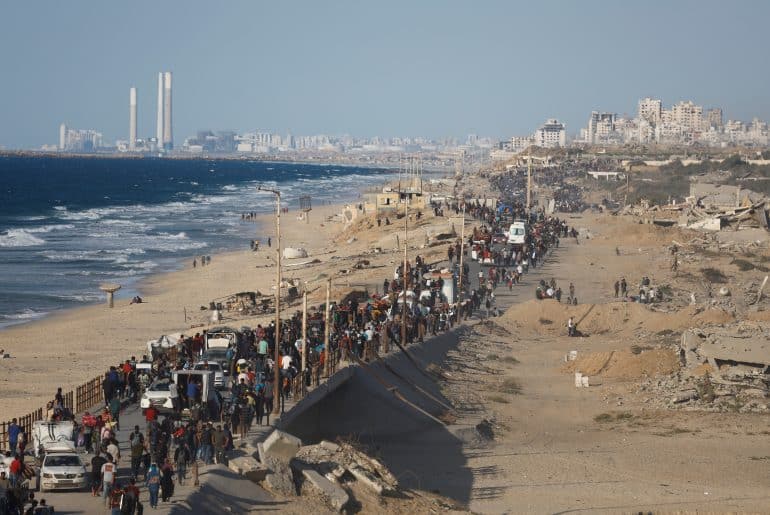
The devastatingly grim proof of the collective failure to adequately assess and deal with Israel’s continued presence in the region is the genocide against the Palestinian people over the last two years. Instead of Nasser’s slogan becoming obsolete, it has escalated to a new form: “No voice rises above the sound of genocide.” There is simply no future for the region, let alone economic prosperity, social justice, and individual rights, as long as its people are forced to coexist with genocide and unbridled aggression. As evidenced by previous attempts, such as the Camp David Accords and the Oslo Accords, no amount of enforced normalization in the name of “peace,” settlement, or surrender can be a decisive solution to this problem.
As the Palestinian cause has been steadily narrowed, ‘Arab’ and ‘Palestinian’ have increasingly come to be defined along identitarian, racial, or ethnic lines, rather than being political categories. Yet it remains evident that the history of the Arab world during the era of so-called modernization is also the history of the Palestinian cause. Historical resistance to Zionism has been fundamentally Arab in character – including in its Islamist dimensions. It is not possible to abstract distinct Arab histories outside of the context of the colonization of Palestine and the imperialist Zionist project because Arabs, like Palestinians, are the targets of that project.
The struggle in the Arab region outside of Gaza is a reflection of what is happening within Gaza. Societies must choose between becoming surrender societies or becoming new, resistant, and confrontational societies. It is completely unjust that Gaza bears the brunt of this most brutal of realities, while many other Arab countries, including Egypt, receive only a warning. The fates of the region’s peoples are intrinsically linked, whether they acknowledge this fact or not. At its core, what is currently taking place is a class struggle, one that is occurring within a settler-colonial and genocidal framework. While Palestine is a universal cause – for the free people of the world, for Muslims, for the wretched of the earth, and for all those who refuse to accept a monstrous world where such horrors persist against the will of the majority – its essence and character remain, historically, materially, and existentially, Arab.
This article is a shortened version of the essay, “The condition for freedom is for the Egyptian masses to take to the streets”: Egypt’s centrality in the struggle for Palestine” published by The Transnational Institute here.
Nihal El Aasar
Nihal El Aasar is an independent Egyptian writer, researcher, political analyst, and radio host. She has written about politics, political economy, culture, literature, and music in several publications, including Verso, Jacobin, Parapraxis, The Baffler, Art Review, The Wire, Protean, Novara Media, Africa is a Country, GQ, Mundial, and others.


Also “what is taken by force can only by force returned”. Both slogans appear to be true given what the region had endured in the last 2 to 3 years. Also it appears that a democratic , secular Pan Arab Nationalism is the only viable and free future for the region.