

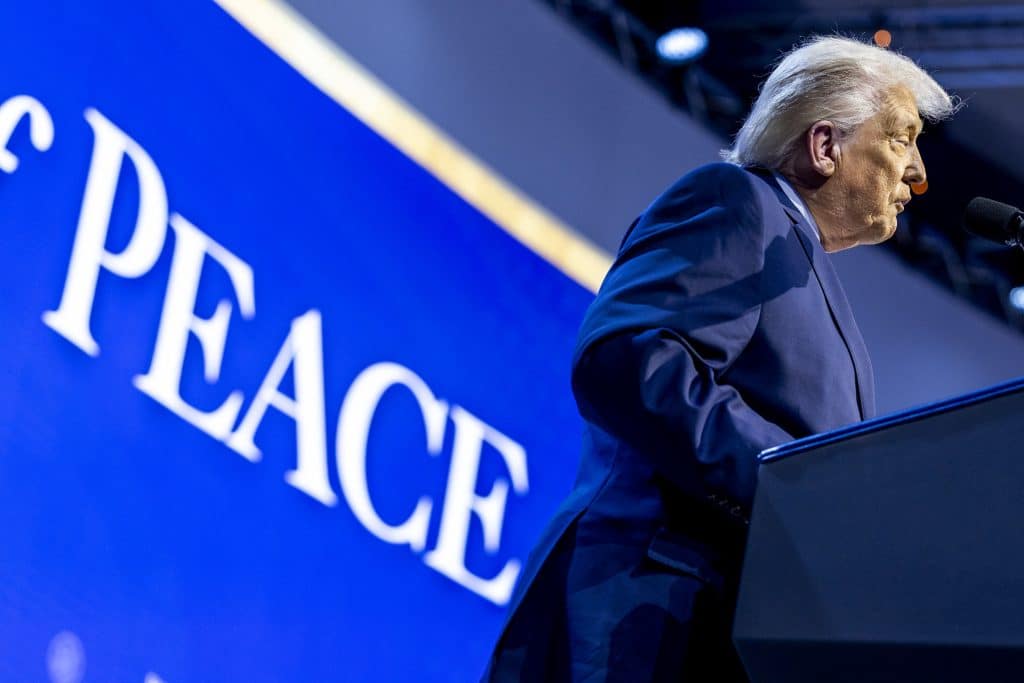
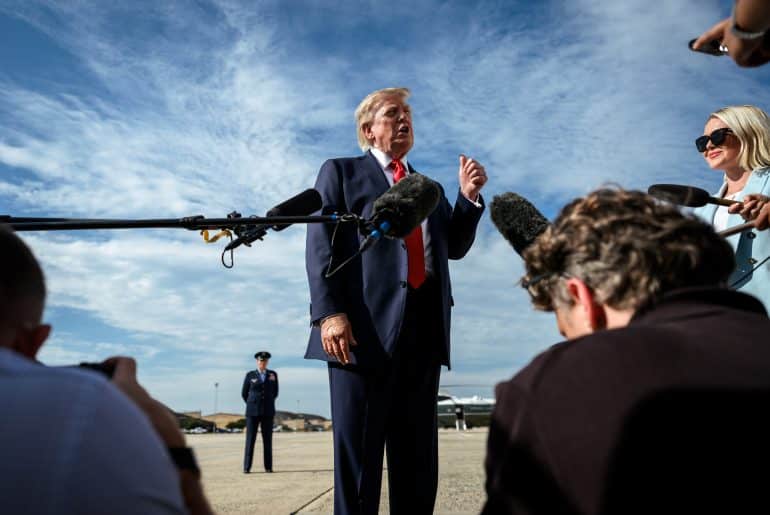
US President Donald Trump’s Gaza plan has finally surfaced its central contradiction. The so-called “Board of Peace” cannot fund its own reconstruction project, and Washington is now considering asking Israel to redirect part of $5 billion in clearance revenues it has been withholding from the Palestinian Authority (PA) toward the Gaza Strip – money that belongs to Palestinians living in the occupied West Bank, whom the PA nominally represents.
The Trump administration has not formally decided whether to make the request, and as of late May, neither Israel nor the PA had reacted to the idea on the record. Yet the PA may be asked to pay for the reconstruction of Gaza despite not being invited to join the Board of Peace, which treats Gaza as a wholly separate jurisdiction from the West Bank, while the Palestinian population in the West Bank is already living through the deepest fiscal crisis the Authority has faced since its creation, engineered by the very withholding that now serves as a slush fund for an external reconstruction authority.
Ramallah has historically refused any cooptation of its funds, even for purposes that would benefit civilians in Gaza, treating it as a violation of its sovereignty. A PA official has now told reporters that the Authority is reconsidering that position, out of desperation to access even a fragment of its money held by Israel. The coercion, in other words, is already working.
This purported financial arrangement could become the deepest moment of fiscal colonialism in the post-Oslo Accords era. The colonized population is being asked to pay for the administrative architecture of its own dispossession. Palestinian Authority Prime Minister Mohammad Mustafa told donors in late April that Israel’s confiscation of West Bank revenues constituted “another occupation.” Washington’s contribution is to turn that occupation into a transfer payment.
A funding crisis exposing the plan’s designs
The Board of Peace was launched in February with representatives pledging $17 billion to the initiative, a small amount compared to the estimated $70 billion needed to rebuild Gaza. By April, only three of 10 pledging states – the United States, the United Arab Emirates, and Morocco – had transferred any funds, totaling under $1 billion.
The purported financial arrangement could become the deepest moment of fiscal colonialism in the post-Oslo Accords era.
The pledges from Gulf capitals were always conditional, with Saudi Arabia and Kuwait signaling their disbursements would occur over multiple years. The structure itself deterred participation. Trump’s draft charter, circulated to around 60 states, demanded a $1 billion cash pledge from any member seeking a term longer than three years, a price most governments declined to pay. Indonesia, which had committed the largest troop contingent to the proposed International Stabilization Force, suspended its participation in the Board of Peace in March, citing the Iran war and shifting regional priorities, amid domestic pressure from the Indonesian Ulema Council and student protests for full withdrawal. The hesitation of Arab and Muslim states has been further compounded by Trump’s demand that they adhere to the Abraham Accords once the war with Iran is over.
Most European states have stayed away, with France openly declining membership and members of the European Parliament blasting the European Commission for sending a representative to attend the Board of Peace’s inaugural meeting in an observer capacity.
After the Iran war disrupted regional balance sheets in the spring, disbursements to the Board of Peace stalled. The body that was supposed to administer billions has been calling for capital it does not have, and the National Committee for the Administration of Gaza (NCAG), the Palestinian technocratic committee it was meant to install in Gaza, cannot deploy because it has no operating budget.
The official line from the board is that money sitting in a bank does nothing for the plan, an unmistakable reference to the Palestinian Authority’s withheld funds. Clearance revenues – the taxes collected by Israel on imported goods destined for the Palestinian territories – have been almost entirely withheld since the spring of 2025. Of the 10.293 billion shekels ($3.5 billion) in clearance revenue owed for 2025, Israel transferred only 1.951 billion shekels ($670 million), equivalent to the first four months of that year.
In late April 2026, Mustafa confirmed that the PA had not received a single shekel of clearance revenue for twelve months. Monthly revenue from other channels does not exceed $130 million. In comparison, minimum monthly operating needs total $320 million, leaving even survival-level health, education, and security services chronically underfunded, while public sector workers are being paid only 60 percent of their salaries.
The PA’s total accumulated public debt has reached roughly $14.6 billion, equivalent to about 106 percent of the PA’s GDP. Public debt to local Palestinian banks alone reached $3.4 billion by November 2025, leaving the banking sector dangerously exposed to a near-insolvent government. The 2025 fiscal year closed with a deficit of more than 4.5 billion shekels ($1.6 billion), compared to under $400 million had the withheld funds been transferred in full.
That accumulated reservoir of stolen Palestinian fiscal capacity is now the most accessible pool of capital Washington can identify for its post-war architecture. There are no other politically viable donors. There is no congressional appropriation legislation to fund the US pledge. The board is a chairman-controlled body whose master account is in private negotiations with a bank that the chairman, Donald Trump, is personally suing. The structure cannot raise sovereign credit. It cannot legally tax. It can, however, lobby Israel to release Palestinian money under conditions Washington sets, and that is what is now under discussion.
Paying for the occupation twice over
The fiscal logic is explicit. A portion of the released revenue would flow to the NCAG transitional committee. The PA would get a fragment of its own money back if it agrees to a political project in Gaza that it has no say in, and implements unspecified “reforms” in the West Bank. The Palestinian population in the West Bank is being told that the cost of stabilizing Gaza will be deducted from the wages of its civil servants, the medicines available in its hospitals, the salaries of its teachers, and the operating budget of its schools.
The Israeli occupation of the West Bank produces the revenue. The American occupation of Gaza spends it. The Palestinians pay twice.
Between 1967 and 1994, when the Israeli military directly administered the West Bank and Gaza, Israel collected all taxes on Palestinian imports and income itself, with no Palestinian body involved at any stage. The 1994 Paris Protocol did not end that control. It relabelled it, routing the same Israeli-collected revenue through the PA as an intermediary, while leaving the collection, and the power to suspend it, entirely in Israeli hands. What was presented as Palestinian fiscal autonomy was, in fact, the formalization of direct extraction. Israel has weaponized that arrangement ever since, withholding the revenue as political punishment. Now, a third party, the US president’s private so-called peace architecture, proposes to monetize the captured fiscal base on its own account in order to fund its institutional presence inside Gaza.
The Israeli occupation of the West Bank produces the revenue. The American occupation of Gaza spends it. The Palestinian population pays twice: once through the original confiscation of customs sovereignty under the Paris Protocol, and again through the conversion of that confiscation into a transfer payment to an external administrator.
Earlier proposals tested the principle. Israel had already proposed using portions of the withheld funds to pay for the clearance of the estimated 68 million tons of rubble in Gaza, and previously, to underwrite the Gaza Humanitarian Foundation, the privatized aid distribution system that killed more than 2,600 Palestinians before its closure in October 2025.
Each iteration normalizes the idea that Palestinian fiscal resources can be reallocated by the occupier and its sponsor toward whatever military, humanitarian, or commercial project they prefer. The reform conditionality attached to the new proposal is a euphemism. It means the political subordination of what remains of the Ramallah leadership to a body that excludes it. As one Palestinian commentator put it, the file has shifted from “the sphere of direct Israeli pressure into a regime of ‘conditional international management'” that places Palestinian decisions under permanent external surveillance.
A divided geography, a single wallet
The contradiction is sharper than the simple injustice of the payment. The Board of Peace is built around deliberate fiscal and administrative separation between Gaza and the West Bank. A new financial intermediary fund at the World Bank was created precisely to bypass the Palestinian Authority’s consent, with no reference to existing Palestinian reconstruction plans and no link to the World Bank’s standing framework treating the territories as a single economic unit. The proposed dollar-pegged stablecoin for Gaza, led by an Israeli former intelligence officer and floated through executive board members tied to the US president’s own cryptocurrency business, would functionally separate the Gaza payment system from the West Bank shekel economy entirely. The reconstruction master plan unveiled in Davos described skyscrapers, tourist zones, and industrial parks in a new Gaza disconnected from the rest of the occupied Palestinian territory. Critics on the US side of the proposal have warned openly that this could create a closed Gaza economy incompatible with future Palestinian statehood.
In every dimension of governance, finance, infrastructure, and currency, the Board of Peace treats Gaza and the West Bank as separate jurisdictions to be managed under different sovereignties. The political message is that the two territories will not be reunified under any Palestinian national framework. Yet when the bill arrives, the same plan suddenly discovers a Palestinian fiscal unity it spent eighteen months dismantling. The territories are separate in terms of political rights, governance, currency, and reconstruction priorities. They become a single economic body only when there is an invoice to settle.
This is the operational definition of double occupation. The West Bank pays. Gaza is administered. The endgame is not statehood. It is a permanent regime of external administration funded by Palestinian taxes.
This is the operational definition of double occupation. The West Bank pays. Gaza is administered. The Palestinian Authority is hollowed out from the inside, stripped of its fiscal base, denied any role in the body that will spend its money, and pressured into delivering reforms whose only purpose is to legitimize the very transfer that is bankrupting it.
The endgame is not statehood. It is a permanent regime of external administration funded by Palestinian taxes and overseen by an unaccountable American chairman with discretionary spending power. The PA finance ministry has been blunt about the intent, describing the squeeze as an existential threat “designed to destroy the Authority through a financial siege.”
Washington has run out of money for an occupation it created, and rather than admit its project is an unfundable failure, it is preparing to bill the population it is occupying. The West Bank funds Gaza. Gaza funds Trump’s board. The board funds the institutions of permanent transition. The transition has no endpoint. The Palestinian population, fragmented into separate jurisdictions by the same plan that demands their unified payment, ends up owning none of the territory and paying for all of its administration.
This is not reconstruction. This is not peace. It is the deepest expropriation of Palestinian capacity since 1948, conducted out in the open, with paperwork.
Ahmed Alqarout
Ahmed Alqarout is a political economy expert with a focus on the MENA region and great power competition.
Survival outside Gaza was a lieA year since I left Gaza for survival and freedom, I am now, however, trying to survive a mental occupation and emotional death.
Abubaker Abed
….
Minutes later, the sounds of explosions reverberated through the calls to the dawn prayers. I paused at the window, breathing in the gunpowder-polluted dawn breeze. I knew this would be the last time I’d hear these ugly sounds of death in Gaza for a while.
The clock was ticking. My mother was rushing me to hurry up and get ready. I took my four pens, my journalistic notebook, two sets of clothes, and my personal documentation and squeezed them into my travel bag. We were only permitted to bring one small bag, although I wish I could have brought much more. I felt that possessions from home could soften the impact of this imposed exile. But the occupation wanted us stripped of everything.
https://www.palestinedeepdive.com/p/survival-outside-gaza-was-a-lie
28 May 2026: “Israel has been added to the United Nations’ blacklist for sexual violence in conflict zones, the country’s ambassador to the UN said on Thursday.
Danny Danon condemned the decision as “political” and “detached from the facts and from reality”. — Middle East Eye
So ghoulish. So cruel. I think we know who the “human animals” are in this conflict. And it’s not Palestinians or Persians or Lebanese.
See: “Israeli minister confirms goal of large-scale expulsion of Palestinians from Gaza” and your headline “Trump wants the Palestinians to pay for the U.S. occupation of Gaza”. I’m confident Mexico won’t ever pay to build the Trumps Wall, or that Palestune has enough money to rebuild Gaza from exile.
As we are constantly reminded, the Palestinians are a single people geographically divided. So absolutely yes to using Palestinian funds to rebuild what is claimed to be Palestine. And yes to sidelining the PA until they become less of a kleptocracy.