


On January 15, 2026, the Gaza Board of Peace was imposed on the people in Gaza, chaperoned by President Trump, and dressed in the language of reconstruction, trusteeship, and peace. But this scheme is better understood as the latest colonial facelift of the Nakba project. Colonial powers have systematically used economic tools and “development” plans to manage, fragment, and dispossess Palestinians. And in return, Palestinians have always resisted, through boycotts, mass mobilization, political refusal, and armed resistance.
By looking at four key periods of development schemes under British rule, post-1948 Zionist Judaization, the Oslo era, and the Board of Peace in Gaza, it is clear that today’s reconstruction and trusteeship proposals are just the latest chapter in a long, sinister history of Nakba deals that trade away Palestinian land and sovereignty in the name of economic and developmental prosperity.
The Electrification of “Palestine”
In 1921, under British Mandate occupation in Palestine, British officials brought in Pinhas Rutenberg to erect the Palestine Electric Company (PEC). At face value, this represented a pivotal technological advancement and an infrastructural leap that would be poised to provide electricity to all of Palestine and develop Palestine into the new age.
Instead, the British surrendered the legal permissions for electrification across Mandate Palestine to one person, the migrant Russian-Jewish engineer and Zionist, Rutenberg. The result of this was the spread of electrification to enrich Jewish settlements and embolden ambitions. These ambitions manifested in the start of the electrical annexation of Palestine by the mid-1920s. By then, the PEC power network was spreading quickly, supplying Jewish settlements in Yafa, Haifa, and Tabaria while excluding Palestinian towns in those areas and major Palestinian cities such as Nablus.
Key to the growth of such projects was the deep-seated marriage of British colonial ambitions with the growing settler mindset. The result was the betrothal of various development contracts to Zionist settlers while systematically excluding Palestinians. This arrangement did not merely allocate a utility contract; it concentrated infrastructural power in Zionist hands while foreclosing Palestinian control over a vital public utility.
Despite this, Palestinians resisted. They resisted both the expansion of the British-facilitated encroachment of the Zionist electrification scheme. From the onset, Palestinians rejected Jewish monopoly over electricity but were ignored by British Mandate authorities. This dismissal emboldened Palestinians to declare a boycott of the Rutenberg plan in the Fifth Palestinian National Congress held in Nablus in 1922. What followed was the continued escalation of strategies and tactics towards the ever-expanding Rutenberg project.
Political voltage spiked as PEC grew, and demonstrations erupted across many Palestinian towns with chants such as “Rutenberg’s poles are our gallows” أعمدةُ روتنبرغ مشانقُنا” reverberating across the land. This keen awareness of the enemy’s colonial project, combined with a diplomatic dead-end as Rutenberg and the British refused to cede any “partnership” efforts with Palestinians, served as a cradle from which sabotage operations were born. These operations saw great success in the earlier years, resulting in large-scale power outages. Another wave of more intense operations was carried out during the Arab Revolt, however by then, the expanded Rutenberg network was more resilient to outages due to heavy reliance on British authorities for protection and logistical backing.
It was not surprising then to see the same colonial landlord, that transferred the rights to the PEC in the first place, returning to protect the PEC against Palestinian attempts to excise this electric tumor. Winston Churchill boasted about awarding the electric concession to a Jewish company by claiming that “the Arabs in Palestine would not take effective steps toward irrigating and electrifying Palestine, not even after a thousand years”
Throughout PEC’s expansion, Palestinians understood the sinister nature of this development project. The project was simple: to implant an electric grid in Palestine to feed the foreign host. 90% of electricity was being consumed by Jewish settlements in the 1940s. In the eyes of many Palestinians, the poles and wires that Rutenberg planted, that the British tended to, were but gallows threatening to suffocate them and their land, gallows they met with clear-eyed resistance.
“Colonialist groups came to Palestine, not to live in peace, not to assimilate with the Palestinian people, but to capture the land and its resources and to expel mothers and fathers from their land with an eye towards controlling the resources in the Arab region.”
George Habash (The Youth Will Build Our Future 1979, PFLP Bulletin #31)
The Judaization of Palestine
Where the electrification of settlements in Palestine paved the way for the mass expulsion of 1948, the Zionist legal and economic development projects of the 1950s and 60s quickly exploited the colonial catastrophe.
A few years after the Nakba, Zionist “development” in Palestine was codified through a series of laws stripping Palestinians of their rights and entitling Jewish settlers to these exploits. This culminated with the Development Authority of 1950, which deeded stolen Palestinian lands to the new ownership of the Zionist entity. The result was the wholesale theft of one million dunams (roughly 16.6% of the total land mass of Palestine), which was transferred to Jewish owners and institutions such as the Jewish National Fund.
One early Zionist project exemplifies this architecture of the ongoing Nakba. Under the banner of “Galilee Development”, new settlement waves in the 1960s and 70s began to take root in Northeastern Palestine alongside an expanding belt of security and surveillance points. The Galilee Development project swallowed tens of thousands of dunams of Palestinian land and compressed Palestinians into isolated, surveilled islands. This metastasis served to protect settlements against Palestinian resistance efforts and to monitor Palestinian growth. This policy reached peak amplitude in 1976, when additional seizures targeted 20,000+ dunams around Deir Hanna, Arraba, Sakhneen, and Al Nasra.
The coordinated Palestinian resistance to this theft is what we have come to know as “Land Day”. Land Day was notable for its collective participation in the form of a popular strike, but also for reverberating solidarity actions in the West Bank, Gaza, and the refugee camps in Lebanon.
It is worth noting that Land Day did not emerge in a vacuum. By the early 1950s, it became clear that resistance to these projects was shaped by time, space, and material conditions imposed by the Nakba. In Gaza, Palestinian refugees crossed the armistice line to reclaim their land. In time, these efforts grew and adopted armed resistance as a means to resist ethnic cleansing. On the other hand, Palestinians living in the newly occupied land identified the legal forum as their arena of struggle. In 1952, they faced arbitrary citizenship and residency requirements from their new occupier that threatened to label tens of thousands of Palestinians as stateless. In response, Palestinians (alongside leftist Jewish activists) in occupied Palestine, appealed to the Knesset without avail and thus turned to local popular support. Leaders met with affected villages and organized protests that culminated in a general strike on the day the law was enacted.
In short, in the years following the Nakba, resistance efforts against colonial development were characterized by sharp, intense, and reactive swells in response to the accumulation of catastrophe. These were often unorganized and, in turn, could be managed by their schematized settler-occupation project.
Land Day was due to its organization under national politics that refused to surrender their lands for the mirage of “Galilee development”. It’s through organized village convenings, demonstrations, sit-ins, and formation of local land defense committees that that identity was formed, and the enemy named. Through this lens, we see that Land Day sits within a lineage of Palestinian popular resistance, in which national committees were formed to harness identity and goals against the occupier.
Development Under Occupation: The Mirage of Oslo’s Industrial Zones
The Oslo agreement was an attempt at the impossible: to erect the dream of statehood on a foundation already collapsing under the jaws of an ever-expanding Zionist occupation. This contradiction became clear on many fronts, most visibly in security coordination, but also in economic and developmental dependency on the occupier. Development became the PA’s tool to institutionalize the underbelly of the PA state normalization project; to fuse the destiny of its economic and developmental future with that of Israel’s. This is especially visible in how the West Bank’s industrial zone projects were peddled as the passage to economic peace and the development of a Palestinian state.
Jenin’s industrial zone project was one of many industrial projects positioned as a free-trade economic corridor to boost employment and attract investment to the Palestinian state. Official documentation positioned the project as a provider of a formal, predictable environment to facilitate joint venture operations between Israeli and Palestinian firms. However, nested within this agreement were clear schemes to cement economic ties with the Zionist economy and foreign developer-centric concessions, in effect eroding Palestinian agency.
A legal investigation from Adalah / Bisan Center revealed that despite the Jenin industrial zone being under full PA authority, concession terms stripped the PA of the rights (bestowed solely on the developer) to refuse tenants and created the practical possibility (eventuality) of leasing to “a settler, or companies operating in settlements, or Israeli companies.” Another linked concession explicitly permits the developer to build relations with the “Israelis” to promote the zone, establishing a clear pathway for the occupier to benefit.
Jenin’s industrial zone did not arrive on empty land, but on top of Palestinian agricultural land in Marj Ibn Amer, which was land already being expropriated by settler land grabs. And so, when the PA forcefully supplants an export-oriented industrial zone over this land, it becomes clear that this is an assault on agricultural land and the self-sufficiency of Palestinians. This is the first prong of the attack: on the land itself, through rezoning, expropriation, and the erosion of agricultural self-sufficiency.
The second prong is economic. It becomes a two-pronged attack (from the Zionist occupation and its administrative puppet): on the land itself, through rezoning, expropriation, and erosion of agricultural self-sufficiency; and on the economy through the reorganization of Palestinian production around a system that relies on the occupier’s crossings, market access, and proximity to its economic centers such as Haifa. As these projects took root, it became clearer that an unavoidable function of these projects was to strip the Palestinian from self-determination over their land and bind it to the occupier.
Resistance against these efforts came in many forms. It was stifled by the hopefulness of developmental prospects from the state-building dream on the one hand, but, more materially, by being positioned against the interests of the occupier and the PA’s hand that feeds this developmental order. This is why resistance often appeared fragmented, with farmers and landowners pursuing lawsuits, researchers and legal advocates exposing the hidden architecture of concession agreements, and Palestinian national committees calling out normalization efforts. In a 2008 statement issued by the District Coordinating Body and the Supreme National Committee for Nakba Remembrance, the proposed industrial projects were clearly identified as staging grounds for clear normalization with the Zionist entity. The statement concluded that additional steps must be rooted in Palestinian self-determination, “…to strengthen the steadfastness of the Palestinian people and a step towards liberation from dependence on the occupation and its economy”.
Instead of uplifting Palestinian rejection of these projects, the PA had positioned itself as a gatekeeper against resistance to these developmental efforts. What emerged was the containment and management of Palestinian resistance by the state apparatus, promising a state-building mirage through development alongside the occupier, an apparatus that, instead of building towards liberation, brokered dispossession for the Zionist master.
Imperial Reimagination of Gaza: The Board of Genocide
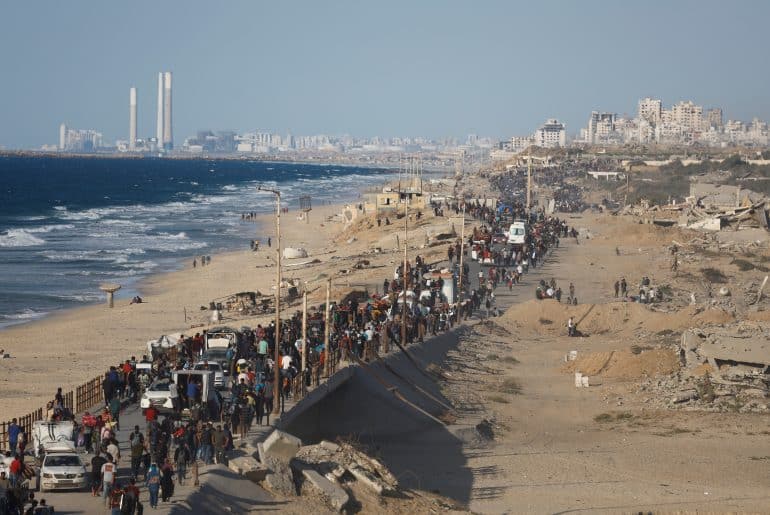
The Gaza Board of Peace represents empire’s attempt to sit on the throne after a genocidal campaign meant to uproot the Palestinian by every brutal means possible. To understand this colonial reimagination of Gaza, we must understand the architecture that was systematically built over the course of the genocide itself. By now, it is clear that the architecture of genocide, in addition to mass killing and maiming, had another output. It sought to identify the systems that allow for Gaza’s sumud, a people that faced over a decade of occupation and siege and continue to be a thorn in the occupier’s side, and systematically target and destroy them. This is where we see the mass devastation of agricultural lands, water purification facilities, local markets, communal food pantries, municipal infrastructure, roads, hospitals, mosques, schools, universities, and the everyday social and communal universes through which Palestinians in Gaza sustain life and remain rooted to the land. This was the zio-imperial scheme to decimate every basis for collective production and impose a hyper-dependency on what comes after the rubble, external aid, and developmental infrastructure. Aid infrastructure that could be rationed, withheld, redirected, and weaponized at a moment’s notice as part of a regime of collective punishment aimed at achieving political objectives the occupier could not otherwise impose.
This was the occupier’s master plan through the architecture of genocide, to manufacture a vacuum so devoid of life so that the mere restoration of a fragment of life could later be used as a manipulation, extortion, and bait for a people driven into desperate necessity. What emerged after this vacuum was neither ceasefire nor relief, but the administrative sequel to genocide. The Board of Peace merely repackages the destruction of the material basis of Palestinian life in Gaza, followed by the conditional management of what is permitted to return.
That logic was already visible in the starvation architecture and the Boston Consulting Group-masterminded “Gaza Humanitarian Foundation” (GHF) death corridors. The production of famine, the destruction of local capacity, and the concentration of what remained of food access behind externally managed chokepoints revealed the political function of aid under genocide. What was presented as relief operated instead as punishment, containment, and control. The GHF showed, in practice, how a population driven into desperate necessity could be forced into foreign-administered channels of survival and made vulnerable to manipulation, extortion, and bait. In that sense, the Board of Peace formalizes at the level of political administration what the GHF had already rehearsed through the management of hunger and aid.
Through this lens, the Board of Peace’s saran-wrapped veil is uncovered, and we see it as an effort to punish the popular cradle of resistance and impose it upon the cost of resistance to liberation. The cost continues to be compounded on the Palestinian people through hunger, destruction, and displacement, and the attempted conversion of survival itself into a tool for negotiation. The sinister wager of the genocidaires of the Board is that a people exhausted by genocide can be forced to accept a reconstruction plan as a Trojan horse that contains another type of managed occupation. But this, too, reveals the last wound the people of Gaza left upon the body of empire, the compounding crises of the Zionist entity and the imperial sponsors of genocide. The entire scheme is born of their failure to achieve control of Gaza through massive levels of violence. This is why the viability of the Board has repeatedly been discussed in relation to disarmament, external security arrangements, and the unresolved struggle over who will control Gaza’s “day after”; because the scheme is not the expression of achieved control but rather salvaging through force in the absence of control. At the end of the day, Gaza refused to surrender its future to the occupier, to imperial trustees, or to the fantasies of investors.
Gaza answered its genocides with a resounding and hemorrhaging, ‘no!’ The people of Gaza and the Palestinian people, near and far, rejected these plans at every stage. They rejected the starvation architecture. They rejected the GHF’s death corridors. They rejected the language of trusteeship, whether Arab or non-Arab, and they rejected the fantasy that Gaza could be rebuilt without its people and self-determination. This rejection first emerged from Palestine itself: in official statements from Palestinian resistance factions, in popular slogans, in civil society denunciations, and in repeated refusals of externally imposed arrangements. It also surfaced through local social bodies and families in Gaza, amid repeated attempts to pressure, bypass, or coerce them into collaborationist or donor-approved governance forms. As a result, we saw documented cases in which families were bombed after refusing cooperation with Israeli-backed militia schemes, accentuating that these were clear efforts to manufacture an alternative social base under conditions of genocide.
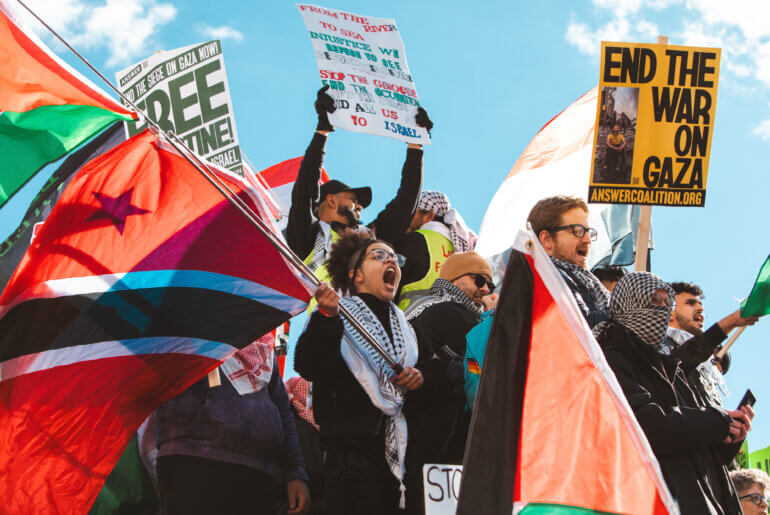
Rejection also erupted in the streets of global protests and emerged from Palestinian diaspora convenings, such as the People’s Conference for Palestine in Detroit, held in August 2025. The conference explicitly framed itself around the current political moment in Gaza and Palestinian liberation. Other diaspora convenings and networks operating from Turkey and beyond, including the Popular Conference for Palestinians Abroad, publicly denounced the U.S. Board of Peace and sanctions tied to it in January 2026. The throughline of these refusals centered around how Gaza will not be administered into submission, and it will not be rebuilt through the confiscation of Palestinian political will.
At the end of the day, Gaza refused to surrender its future to the occupier, to imperial trustees, or to the fantasies of investors. And Gaza continues to resist these efforts through the stubborn reconstruction of life itself: families rebuilding shelters from mud and rubble because construction materials remain blocked, and local rebuilding efforts reusing rubble under conditions of siege and scarcity. These are examples of sumud under siege.
This moment demands that we synthesize what our history has already taught us about zionist-imperial subjugation of our people and our land. It also demands that we turn these experiences into concrete lessons; the political, structural, and organizational strategies for confronting the threats before our people. It demands a clear understanding of the enemy, a clear refusal of development detached from liberation, and a clear material rootedness in supporting the steadfastness of our people to rebuild and sustain themselves on a pathway towards liberation. This moment demands a rejuvenated and sober reassessment of how to develop towards an economy and cradle of sumud capable of resisting occupation and developmental extortion. And most importantly, it demands a unified Palestinian vision capable of confronting every colonial assault that arrives veiled in the language of peace, development, and aid. Gaza does not stand outside the historical pattern traced in this article: Gaza reveals colonial ambitions in their most brutal and concentrated form. From electrification, to Judaization, to Oslo’s industrialization, to the GHF and the Board of Peace, the themes of conquest through development remain the same. Colonial power destroys or captures the material basis of Palestinian life, then reappears offering managed development or survival in exchange for capitulation. These lessons, and their accumulation, must provide us with a clear-eyed understanding of our charge, as have the generations of resisting Palestinians, that liberation is the precondition, not the byproduct, of any real nation-building or development in Palestine.
Saleh Abbas
Saleh Abbas is a Palestinian writer, researcher, and organizer. He is interested in the lessons current advocates can draw from Palestinian history, and when not organizing or writing, he can be found teaching dabke.

An important article. Filled with the history of intentional occupation, suppression, ethnic suffocation and cleansing. So intentionally twisted the control of the electricity. Endless proof of the plans to construct an apartheid state of Israel. The proof of intent to dominate and eliminate Palestinians embedded in the history of Zionism and creation of Israel. Ruthless intent woven through the history.
I so admire and respect the spirit of the Palestinians. I also am internally ripped up by all of the suffering,death and destruction they have been forced to experience via the hateful, racist plans of Zionist and the creation of Israel. All done with support by the U.S. which clearly has its own horrific history.
Important to share this piece everywhere people can do so. The BDS movement continues to grow. There is no way Israel can survive and thrive given the fact based information millions upon millions of people around the world have access to about Israel’s apartheid, genocidal, sadist behavior.
https://www.youtube.com/shorts/B5d8xr8WHos
https://www.pewresearch.org/short-reads/2026/06/04/most-people-across-36-countries-have-negative-views-of-israel-and-little-confidence-in-netanyahu/
“Gaza answered its genocides with a resounding and hemorrhaging, ‘no!’ The people of Gaza and the Palestinian people, near and far, rejected these plans at every stage. They rejected the starvation architecture. They rejected the GHF’s death corridors. They rejected the language of trusteeship, whether Arab or non-Arab, and they rejected the fantasy that Gaza could be rebuilt without its people and self-determination. This rejection first emerged from Palestine itself: in official statements from Palestinian resistance factions, in popular slogans, in civil society denunciations, and in repeated refusals of externally imposed arrangements. It also surfaced through local social bodies and families in Gaza, amid repeated attempts to pressure, bypass, or coerce them into collaborationist or donor-approved governance forms. As a result, we saw documented cases in which families were bombed after refusing cooperation with Israeli-backed militia schemes, accentuating that these were clear efforts to manufacture an alternative social base under conditions of genocide.”
Francesca Albanese…persist! She is remarkable!
https://www.youtube.com/watch?v=8VVwLSP-quI
“roughly 16.6% of total landmass of Palestine”. Did you mean of cultivated landmass? Total landmass of Palestine is roughly 30 million dunums.
Great piece.
“ This moment demands a rejuvenated and sober reassessment of how to develop towards an economy and cradle of sumud capable of resisting occupation and developmental extortion. And most importantly, it demands a unified Palestinian vision capable of confronting every colonial assault that arrives.”
________________________________
Mondoweiss is positioned.