

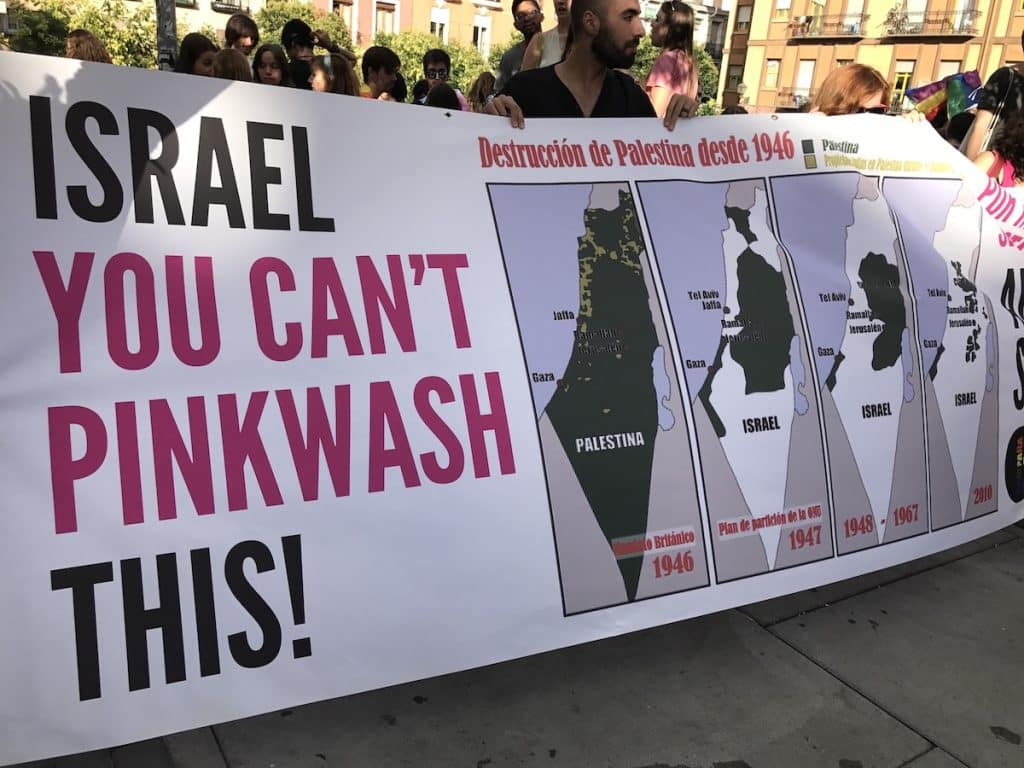
Every June, Pride Month arrives carrying the weight of Stonewall — a rebellion begun by Black and brown trans women who understood that survival and resistance were inseparable. It arrives as a declaration that queer lives are worth celebrating, that our loves are worth protecting, that we are owed the full dignity of existence. For many around the world, Pride Month is still precisely that: an act of defiance dressed as joy, a reminder that the right to be visible was never given, only taken.
For Palestinian queers, Pride Month arrives with a question the rest of the world is never asked: whose freedom are we celebrating, and at whose expense? We watch the rainbow flags rise over a city built on the ruins of our people, and we are told this is progress. We are offered liberation — but it comes with a condition. Forget who you are, or be unwelcome. We are handed a pride that was never meant to carry us.
This is pinkwashing: the art of waving a rainbow flag to hide a fist — using queer visibility as a shield against accountability, dressing conquest in the colors of liberation. I learned what looks like from the inside — the warm offer, the hidden condition, the erasure dressed as rescue. What I could not have imagined is that it would be performed at the scale and audacity it is today, in the middle of a genocide. I am speaking about Pride Land, planned for this June 2026 at the Dead Sea — billed by its organizers as the largest LGBTQ+ festival ever held in the Middle East: four days, fifteen hotels, a temporary “Pride City” of performance stages, beach venues and round-the-clock entertainment, promoted directly by the Israeli Ministry of Foreign Affairs. The private production group behind it describes it as something “crafted from within the community.” The Ministry of Foreign Affairs promoting it makes the architecture of Brand Israel visible once again: a cultural spectacle that launders an international image while the bombs continue to fall.
They are counting on your presence to make this look like freedom. Do not give it to them.
Pinkwashing
I have been queer all my life. I have also been Palestinian all my life. The world has made sure that I find both difficult. Western powers have, in certain contexts, celebrated my queerness yet continually fund my people’s genocide, and see no contradiction in either. That same Western gaze presents corners of Tel Aviv as proof of Middle Eastern progress — ‘look, a gay bar, therefore civilization’ — while maintaining a studied silence about the military checkpoints, the movement permits, and the apartheid wall that decides who gets to freely exit, or even exist, and who does not. I was told by the gays I met in Tel Aviv, reporting the wisdom of the West, that the price of queer belonging was political silence — that liberation was available to me, but only if I checked my Palestinianism at the door. That I could be queer or I could be Palestinian — but wanting to be both, fully and without apology, was asking for too much.
I have never been able to afford forgetting I am both.
Tel Aviv has a reputation as the gay haven of the Middle East. Rainbow flags snapping in the sea breeze, drag queens glittering under string lights, the whole warm grammar of queer belonging performed with such conviction you almost believe it. A city that loves you for who you are — as long as you come from the right country, carry the right nationality, and have no memory of what stood here before. What I know now is that this reputation was not accidental. It was engineered. In 2005, the Israeli Foreign Ministry, Prime Minister’s Office and Finance Ministry — in consultation with American marketing executives — launched Brand Israel: a government-backed campaign designed to rebrand Israel from a militaristic, ethno-religious state into something modern, cosmopolitan, progressive. By 2010, marketing Tel Aviv as a global gay tourism destination had become a central pillar of that strategy, backed by a dedicated investment of approximately $88 million. The rainbow flag was not flying on its own. It was planted.
As a teenager with no access to the rich Arabic literature that speaks to my desire, the only lifeline available was a telephone support line run by an Israeli organization. When I called, the voice on the other end had one answer: move to Tel Aviv — offered as a gift. I know now it was the first act of erasure. What I found there were Israeli queer friends who would accept my queerness only if I left my Palestinianism at the door. When I insisted my name alone made clear who I was, they offered to rename me. Tel Aviv was never a haven for me. It was a colonial project with a dance floor — a funhouse mirror held up to show Palestinians what they could become, if only they were willing to stop being Palestinian.
There is no pink door in the apartheid wall — no gate that swings open for queerness, for solidarity, for the shared knowledge of belonging to the outcast tribe of queers. The pink stops at the checkpoint. Beyond it you are not a queer deserving of liberation. You are simply Palestinian — and in their calculus, that is enough to erase everything else.
Queerness, at its most honest, is about refusing the terms the world sets for your existence. That refusal is the beating heart of every pride march, every act of love in defiance of a world that said no to our existence, our lives, our loves. I have lived that refusal twice over — once for loving the way I love, and once for being Palestinian.
I have spent my life making clear that I am not here to be fixed.
The Pride Land Festival
The tagline for the Pride Land Festival is “Pride rises at the lowest place on earth.” It is, admittedly, a good line. But there is a teaching that runs through many wisdom traditions, Buddhist among them: do not confuse the beauty of the vessel with the truth of what it carries. The vessel here is gleaming. What it carries is a genocide.
Read the Pride Land website, and the language is almost unbearable in its audacity. The organizers describe it as a venture built on “the values of freedom, acceptance, and the fundamental right of every person to self-realization.” They promise to “redefine the discourse of pride in Israel and around the world.” They call it the first Pride City in the Middle East. And then — with a candor that should strip away any remaining doubt about what this is — they name their project an “active Zionism” that seeks to “strengthen Israel’s status as a vibrant liberal centre through the tourism industry and positive outreach.” Active Zionism. They say the quiet part in the language of a press release. Freedom, self-realization, the fundamental right to exist as you are — these are the precise rights being annihilated in Gaza, denied at every checkpoint, stripped from every Palestinian who has ever been told that their identity is a problem to be managed. To use those words, in that place, at this moment, is not irony. It is the logic of erasure stated plainly: our freedom requires your disappearance.
The Dead Sea sits in the West Bank — occupied Palestinian territory recognized as such under international law. The resort infrastructure being offered as festival grounds has been built through decades of Israeli encroachment, erasure, and settlement on land that was taken, which is not theirs to offer. To throw a rainbow over that geography is not liberation. It is a flag of conquest, wearing the colors of freedom. As of the time of this writing, the war in Gaza continues, with casualties and displacement on a massive and still-unfolding scale.
The Dead Sea loses more than a meter of shoreline every year, hollowed out by the same diversions that feed the settlements. Palestinian lives are disappearing — violently, deliberately, on livestream, in real time. To plant a festival on that shore is an act of erasure dressed as celebration.
There is an image that circulated during the genocide: a soldier in the rubble of Gaza, holding a rainbow flag. On the flag, the words: In the name of love. We bomb with one hand and wave a flag of love with the other. Pinkwashing is maya — the veil of illusion — asking you to look at the flag and not the fist beneath it, to see the festival and not the mass graves it floats above.
This is a moment of truth. The bodies are visible. The rubble is visible. The genocide is visible — documented, livestreamed, undeniable. We cannot allow it to be pinkwashed. And the world is beginning to refuse. The International Lesbian, Gay, Bisexual, Trans and Intersex Association removed the bid by The Aguda — the umbrella organization for Israel’s LGBTQ community — to host its next World Congress in Tel Aviv, and suspended the organization from its membership. Thousands of queer artists have pledged not to perform in Israel. Pride organizations across Europe and North America are excluding sponsors complicit in the actions in Gaza. The coordinator of the Palestinian Campaign for the Academic and Cultural Boycott of Israel has declared that “No Pride in Genocide” has become the global queer slogan. These are not fringe positions. They are the sound of a global queer movement recognizing, with clarity, what pinkwashing has always been: not a celebration of freedom, but a cover for its destruction.
This June — while Pride Land rises at the Dead Sea, Queer Cinema for Palestine: No Pride in Genocide will be taking place across the world. 110 screenings, 34 countries last year, and this year, in its fourth edition, with 300 in 60 countries across five continents.” Queers who refused to separate pride from justice showed up. Filmmakers and cultural workers withdrew their work from TLVFest, choosing solidarity over comfort. They said: not in our name. And the world answered. That is a global queer solidarity movement — ungovernable, decentralized.
Queer Cinema for Palestine is an act of collective witness — a world of queers saying: we see you, Palestine. We will not look away. That is what I ask of you now: see me.
See me not as a symbol, not as a casualty, not as a complication. See me as I am — queer, Palestinian, whole, here, refusing erasure. And then do something with what you see. Join in refusing to party on occupied land. A rainbow draped over ruins cannot be allowed to hide the genocide. Queer pride is for an outcast people — conscious, tender, furious, whole — still choosing each other. That is the act of faith. That is what pride looks like when it carries everyone.
Ghadir Shafie
Ghadir Shafie is a Palestinian queer activist and co-founder of Aswat —Palestinian Feminist-Queer Center for Sexual and Gender Freedoms. She organizes at the intersection of feminist, queer, and Palestinian liberation, holding all three as inseparable. Her work and writing have been featured across Arab and international media and academic platforms.
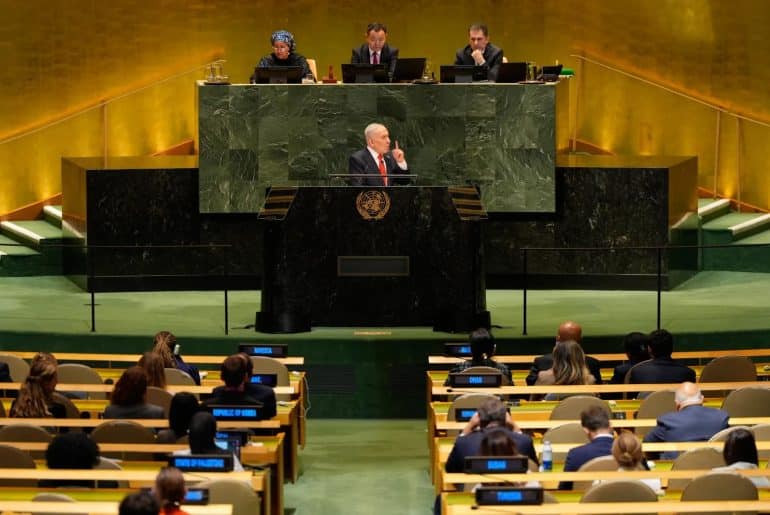

Off the topic of pinkwashing but on the topic of colonialism, this article in the Forward nicely shows how the ideas of Zionism are cracking up. Keep in mind that the Forward bills itself as “Jewish, Independent, Non-profit”:
The real anti-zionists are at the highest levels of the Israeli government… it’s time to acknowledge that a movement to undermine Zionism has taken hold within the Israeli government….If Zionism is the movement for a secure homeland for the Jews, then any forces that reject or undermine that homeland’s legitimacy or security are anti-Zionist. That includes the people whose positions and policies actively undermine the existence of a Jewish homeland.
The democratic Jewish state enshrined in the country’s Declaration of Independence has given way to something that looks a lot more like a herrenvolk democracy, in which democratic rights apply only to the dominant ethnic group. History has many examples of such arrangements, and — spoiler alert — they don’t end well for the majority. French Algeria until 1962, Rhodesia until 1980, South Africa until 1994 — all eventually faced one of three fates: negotiated transition to full democracy, violent collapse or ongoing instability and international isolation. To date, none have stabilized permanently….
https://forward.com/opinion/830510/israel-anti-zionism/
Israel is no haven for LGBTQ+ people. Because it is a society composed largely of Jewish supremacists with a large element of religious believers, public attitudes to LGBTQ+ people are far from positive and often violent:
(”People hurled stones at my house for three months’: survey shows sharp rise in anti-LGBT+ violence amid war’, YNet News 29 May 2024)
“The Dead Sea sits in the West Bank”
It’s usually a good idea to look at a map before posting an obviously inaccurate assertion. Are the hotels hosting the PrideLand festival in the West Bank?