

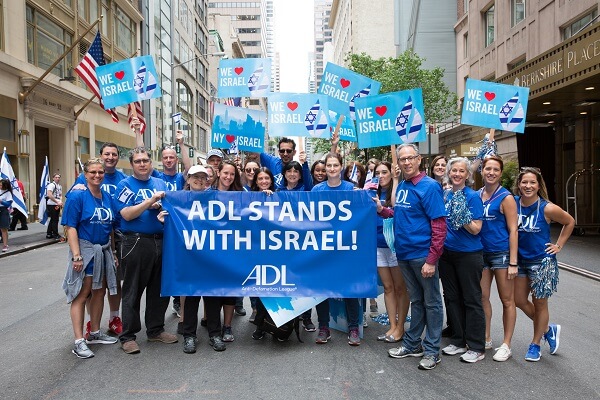
The Anti-Defamation League (ADL) has consistently been viewed as a reputable civil rights organization within mainstream media, but in recent years, activists have pushed back against this view and encouraged organizations to cut ties with the group.
In 2020, the Drop the ADL movement published a primer detailing the ADL’s history of repressing Palestinian rights, spying on activists, and infiltrating social justice movements.
“Even though the ADL is integrated into community work on a range of issues, it has a history and ongoing pattern of attacking social justice movements led by communities of color, queer people, immigrants, Muslims, Arabs, and other marginalized groups, while aligning itself with police, right-wing leaders, and perpetrators of state violence,” read a statement from the coalition. “More disturbing, it has often conducted those attacks under the banner of ‘civil rights’.”
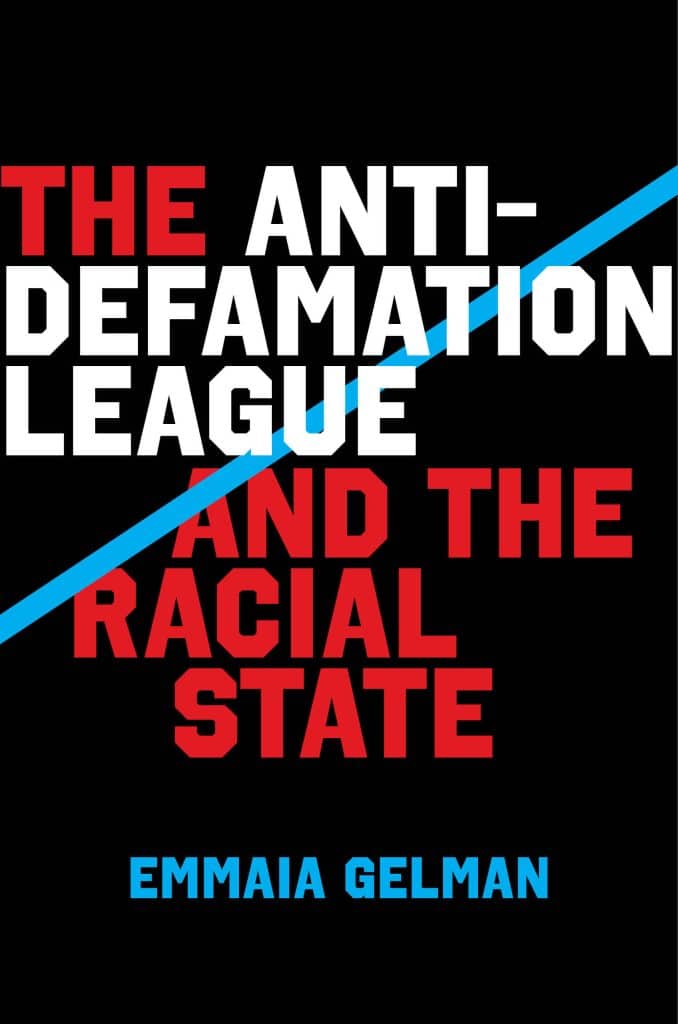
This history is detailed in Emmaia Gelman’s important new book, The Anti-Defamation League and the Racial State. Gelman, a founding Director of the Institute for the Critical Study of Zionism, provides readers with the first-ever history of the ADL and its connection to Western Empire.
Mondoweiss U.S. correspondent Michael Arria spoke to Gelman about the ADL’s origins, its anti-left history, and its current role in U.S. politics.
Mondoweiss: I wanted to start by talking about the ADL’s origins. Can you talk about its founding, its original politics, and how it was perceived?
Gelman: The ADL was understood as a conservative and upper-class organization by Jews of the working class and the left from its inception until at least the 70s. It was founded as an upper-class organization specifically to defend the reputation of Central European white Jews against the arrival of Jews whom they saw as less-than-white, unruly, unmodern immigrants, refugees from the Russian Empire.
To paint the picture, in the 1800s, as Jews emigrated from Central Europe, German-speaking Jews, largely were bourgeois or aspiring to be so. They entered into the U.S. settlement project, developing frontier businesses and, in some cases, participating in wars of conquest, and they established themselves as part of the white state-capital class.
By around the late 1800s, there were about 350,000 of those Jews. The next Jewish immigration wave from Russia, as people were fleeing the czar and horrific antisemitism, brought two million Jews to the United States. The upper-class German Jews who were already here and felt themselves to be very much part of the white upper echelons felt swamped.
German Jews themselves had a disdain for European Jews, a real disdain for what they called the östjude, the Eastern Jew. They thought of them as – these are words from the history books – bumpkins, backward, uncivilized. They were rightly worried that other American white people would share their antisemitism toward these Jews, and paint all Jews with the same brush.
They were also worried that these new immigrant Jews, who had been organizing against the czar and who were, in many cases, anarchists, communists, and socialists, would politically organize in ways that challenged the state that they were trying to build.
And lastly, they were worried that many of them were too religious, and so they would damage the secular liberal nature of U.S. life.
So they saw these immigrant Jews as a threat, partly because they were worried that immigrant Jews would activate white nationalists who were also attacking Jews at the time. Their defense against antisemitism was conservative. They were understood as sort of the police by the working class and politically leftist immigrant Jews whom they were trying to control. And they were understood by other U.S. elites classes, what I call the state-capital class, as allies.
So absolutely, U.S. Jews understood the ADL as conservative. And in the lead-up to the Nazi Holocaust, that conservatism showed itself. The ADL, rather than defending Jews in Europe against Nazis’ charges that they were a communist cabal, denounced the idea that any Jews were communist, denounced communism, and essentially left those Jews to be attacked, to be vilified by Nazis.
The ADL, and also others of their class, were also concerned with a new wave of poor, desperate Jews that might wash up on the shores of the United States as refugees from Nazi Europe. And once again, their concern was that that would exacerbate antisemitism, the desperation, the non-assimilation, the foreignness of another set of Jews would again be bad for Jews in the United States.
So they initially did not advocate for the U.S. to loosen its immigration restrictions. Or in some cases, they advocated for the upper classes and the skilled among the refugees from Nazi Germany to be admitted to the United States. Instead, they advocated resettling refugees in Palestine.
It’s important to understand how the ADL’s conservatism pitched it against most Jews, for most of history, in ways that really had material effects. In the Cold War, the ADL became an anti-communist organization. That was its next era, and until the present, the ADL has been a deeply anti-communist organization. It cooperated with the McCarthy witch hunts and right-wing newspapers. Its chief lawyer was a colleague of McCarthy’s chief counsel, Roy Cohn, and anticommunist gossip columnist Walter Winchell.
What’s confusing about this is that, even though Jews on the left understood that the ADL was conservative and policing them, that kind of anticommunist repression was billed as “protecting democracy”. Not just by the ADL, but by the whole U.S. government and much of civil society. The state was also denouncing communists and hunting communists and declaring that to be a form of protecting rights and democracy. So I think that’s where we start to see the confusion come in, which is that the ADL has been so closely aligned with the U.S. state in its conservatism that sometimes it’s been mistaken for liberatory – in the same way that the United States itself has been mistaken for liberatory, when in fact it’s demonstrably a racist and imperialist institution.
You write about the group’s early opposition to anti-colonial movements in the Middle East. When did the connection to the Zionist project begin?
The ADL wasn’t Zionist until the mid-50s, but it was certainly anti-Arab before that.
In 1946, Arab League representatives began to try to speak into U.S. politics about the ways that U.S. support was driving colonization in Palestine and driving colonial conflict.
The ADL attacked those Arab representatives as a sort of foreign insurgency. It described them in its books and its materials as nefarious, trying to subvert U.S. foreign policy, which is kind of hilarious because they were advocating in exactly the same way as the ADL.
The ADL was deeply Americanist, its commitment was to the United States and the U.S. project.
So it was not initially interested in the settlement of Palestine, It was not interested in a Jewish liberation project. It certainly wasn’t interested in an agrarian project. But it became interested in Zionism in the mid-fifties when, during the Suez crisis, the groups that we think of as legacy Jewish organizations realized that Israel was a strategic geopolitical player in Western imperialism, that it could be a proxy, that it could be an outpost. It could become a tool for disciplining the Arab world.
In 1967, the moment that U.S. Jewry broadly was galvanized into interest and support for Israel by the Six-Day War, the ADL, along with other legacy Jewish organizations, realized that the issue of Israel was a really good organizing tool for U.S. Jews.
They were hemorrhaging membership at that point. U.S. Jews were assimilated, economically well-situated, and had what they generally wanted. They didn’t need to belong to Jewish organizations to produce their identity. They identified as white members of U.S. society and weren’t particularly religious. So Jewish organizations were grasping for ways to hold on to their people.
The idea that Jews were in danger, the idea of Israel as a cause, and the need for fundraising to support it, turned out to be a way to re-mobilize a lot of U.S. Jewry. And they reorganized themselves around it.
You mention that they were committed to anti-communism and had these connections to the state. Is that what enabled them to start being viewed as a civil rights authority among mainstream society?
There are two little pieces of history that we often miss, and that cause this confusion.
The civil rights movement initially, insofar as it became a national project in the mid-50s, was pretty limited. At the time, it was radical enough to call for equal rights under the law, formal equality, and colorblindness.
But we don’t think of anti-racism that way anymore. We understand anti-racism as requiring that we confront capitalism, that we redistribute resources and the power that has been hoarded, and undo the ways that whiteness has been a way of holding property and privilege. We know that many presumptions about what’s “normal” are actually white supremacist, white-centered presumptions, and that we have to break that order to dispel racism.
At the time thatthe ADL entered into civil rights, it didn’t mean interrupting racism in that way. It was more calling for simpler, formal equality.
Additionally, the ADL entered the civil rights movement as an anti-communist organization. Again, it was working alongside the U.S. state. The United States was trying to get nations around the world to align with U.S. leadership against Soviet communism. The government was making the case that it was the leader of the democratic ideal and the free world, but making this case in a country where Jim Crow was the law, and it was obviously very dissonant. So, for the United States and also for the ADL as its constant supporter, addressing discrimination and overt racism was actually a Cold War strategy.
You can see that in the ADL’s teaching materials, which combine anti-communism with ostensible anti-racism. So they say things like, “the key to democracy and freedom is that an individual has the right to profit and get ahead Racial equality means that both Black people and white people are allowed to do that. Communism doesn’t let you get ahead, it makes you have to share! You’ll be equally oppressed!” The ADL’s position was that communism – which was the basis for so much racial and economic justice organizing inside the United States – was inherently “totalitarian.”
The second piece of history that’s important tograsp is that those who were involved in that early, simplistic conception of civil rights, and who stayed there, became neoconservatives.
Neoconservatism claims civil rights. But it also says that redistributing power, or requiring people to give up privilege, is extremism. And communist. Many neoconservatives were initially involved in the civil rights movement. But by the late 1960s, they were far to the right of antiracist groups, opposing basic policies like affirmative action. Their names are still associated with civil rights, if only because we oversimplify our history. The ADL has been led by just such neoconservatives since the late 1960s, and it is still really a neoconservative organization.
Can you talk about the ADL’s 1993 spying scandal? What did it reveal about the organization and its targets?
In 1993, the FBI raided the offices of the ADL because they believed that the ADL had classified FBI information. In fact, the ADL had published it in a report on the Nation of Islam.
What the FBI found was that the ADL also had police records from an undercover anti-counterculture political surveillance unit of the San Francisco Police Department. That unit had been disbanded because it was deemed unconstitutional, and the records were meant to have been destroyed.
Additionally, they found that the ADL had been spying on and actually infiltrating a wide range of civil rights and advocacy organizations for 30 years.
The ADL had files on groups like the ACLU, as well as South African anti-Apartheid groups and Palestine-related groups. It was also surveilling groups that were working in Central America in solidarity with leftist movements there against the catastrophic human rights abuses of right-wing regimes.
This shocked people into realizing that the ADL was not a progressive organization. As the Drop the ADL campaign says, the ADL is not an ally.
The revelations of ADL spying on progressive groups jogged the memories, actually, of some of the key researchers on white nationalism who had been working with the ADL. One of those researchers was Chip Berlet. It jogged his memory about conversations that he had had with ADL directors in earlier decades, where they articulated to him that the ADL viewed the left as the primary threat to Jews and to the United States – not the right, even though the ADL was only known for surveilling white nationalists.
The ADL believed that the interests of the United States, the imperial interests of the United States, were closely intertwined with – and the same as – the interests of Jews.Which is quite a statement, right? Therefore the entire left – including the Jewish left, and including the left that was supporting people against death squads in Central America and supporting anti-colonialism –constituted a threat to Jews.
What’s interesting about those files is that it traced 30 years of surveillance, infiltration, and actions. The ADL’s assertion of its hostility toward the left goes back to 1967. In 1967, the ADL professionalized its surveillance unit by hiring Irwin Suall, who was called the ADL’s spy master.
Suall came from the left. He was one of many figures in the neoconservative movement who began on the left. He was anti-communist, Western supremacist, and he became a neoconservative. He thought the left was too challenging to capitalism, too challenging to the idea that the United States was the moral authority in the world. In fact, the final straw for Suall, and others who became neocons at that time, was that they supported the Vietnam War as a necessary war against communism. In 1967, he became the ADL’s spymaster. His comrades from the Socialist Party USA, who shared his trajectory, moved into other organizations within the neoconservative firmament.
For decades, the ADL seemingly embraced a liberal veneer and paid lip service to liberal domestic policies, while maintaining the line on Israel. Under ADL CEO Jonathan Greenblatt, it seems that it has been abandoned altogether, and now all they seem to talk about is anti-Zionism. Your book details how the ADL has always been this way politically, but do you think there’s been a rhetorical shift, and what do you attribute that to?
I make the argument in the book that the ADL has always been a right-wing organization, but I agree with you that the expression has shifted. What I mean when I say that the ADL has always been a right-wing organization is that it’s fundamentally a settler, white supremacist, and Western supremacist agency.
It has been a close partner of the U.S. state because that’s a shared aim.
The way to make sense of the ADL’s shifts is to understand that, even though its aims have been really consistent, it makes use of any social and cultural discourses that have currency at any given moment.
For instance, when ADL started, it certainly wasn’t making any comparisons between Jewishness and Blackness. To the contrary, it was rejecting any such comparison. But in the seventies, when it became important to assert a sort of racialization and claim Jewish interests should be cared for by the state, the ADL began to compare Jewishness to blackness.
It wasn’t because the ADL believed that Jewishness and Blackness were the same, or that it was advocating Black liberation. Rather, it was that Blackness had become a cipher in U.S. politics for rights, for the idea of rights and protection. Similarly, the ADL adopted concern for queer rights in the 1990s, in the context of hate crime laws that it was proposing. But the ADL wasn’t pro-queer. Queer organizations had been pressing for a full decade for the ADL to do that. The ADL had refused and refused, saying that queer rights were not part of an American value system.
Ultimately ADL leaders realzied thatqueers had built political power, and advocating for queer rights actually lent it political advantage. Very oddly, it became a neoconservative organization led by a homophobe who didn’t even think women should necessarily have equal rights, and it was misperceived as a progressive queer ally.
Now the ADL doesn’t need that progressive veneer anymore. The U.S. state is no longer using liberalism as a rationale for its wars and repression at home, and the ADL doesn’t need to do that either. The ADL has never been out of power, nor out of favor with any U.S. regime. It’s not like when a Republican president has taken office, the ADL has said, “Oh, we’d better wait for the Democrats because we’re a liberal organization.”
Right now, what’s ascendant is white nationalism, anti-wokeism, anti-critical race theory, and so we’ve seen the ADL adopt all of those.
I think that what we’ll see in the near future is that, as power and governance are shifted into the technocracy, into tech firms, weapons firms, and AI surveillance, that will be the place where the ADL looks for its partnerships. That increasingly, it’s not going to be interested in acting in the role of a rights organization. It will look for other avenues of power.
Michael Arria
Michael Arria is Mondoweiss’ U.S. correspondents. He is the author of Medium Blue: The Politics of MSNBC. Follow him on x at @michaelarria.


“Therefore the entire left, including the Jewish left, including the left that’s supporting people against death squads in Central America and supporting anti-colonialism, that the entire left constitutes a threat to Jews….”
Israel’s Bloodstained Legacy in Latin America
Israel proved an indispensable ally to the dictatorships and military juntas that ravaged Latin America in the late 20th century, described in detail in Bishara Bahbah’s seminal study, Israel and Latin America: The Military Connection. Israel’s clients in the hemisphere included the Pinochet regime in Chile, El Salvador’s military junta and the Duvalier dictatorship in Haiti, among numerous others. These regimes imported the counterinsurgency techniques that Israel practiced on Palestinians for use against their own populations…. Israel’s oldest ally in the region is Nicaragua, where the ruling Somoza dynasty provided arms and diplomatic cover to the Haganah (a Zionist settler militia) in 1939 and 1948. In return, Israel began selling automatic weapons, tanks and military aircraft to the autocracy in the 1950s….
Gelman’s book is also discussed here:
The Anti-Defamation League Was Rotten From the Start – Progressive.org