

Bruce Robbins is a professor of literature at Columbia. His new book Who’s Allowed to Protest explores the new McCarthyism in which campus supporters of justice for Palestine serve as the “new Communists, identified in the media… as supporters of violence and terror whose presence in American institutions is intolerable.” Liberals have failed to defend the protesters’ rights, Robbins writes. While right-wing critics have sought to discredit the protesters as spoiled elitists, and the left-wing critique of “unwarranted privilege” has also undermined the role of elites. Robbins’s book responds by outlining the obligations of the privileged to speak out.
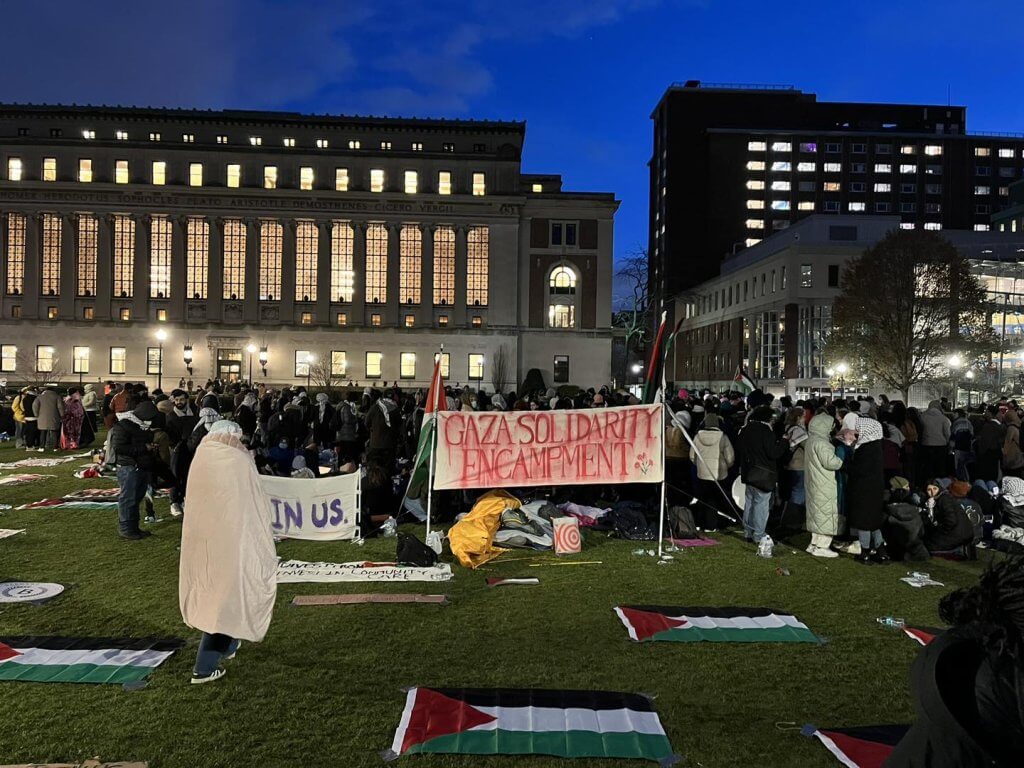
The book draws on Robbins’s own experience being investigated by Columbia for bringing a class to the Gaza encampment on campus, as well as the case of longtime law professor Katherine Franke, who was effectively stripped of her status because of her vocal support for students’ rights to protest genocide.
Mondoweiss Founder and Senior Editor Philip Weiss talked to Robbins about the book, lessons from the Columbia Gaza encampment, and the role of activist intellectuals.
Mondoweiss: Tell me how you gained awareness on Palestine?
Bruce Robbins: The radicalizing experience for me as a young person was the Vietnam War. When I was 18 and had a draft number and the idea was that we would be sent off to kill or be killed. I thought the United States was always supporting the wrong people out there in the world. And the logical entailment of that idea was, What about our support for Israel? Even though I’m Jewish and grew up with everybody around me supporting Israel to some extent.
Tell me about meeting Edward Said.
I was teaching in Switzerland in the late seventies and early eighties, and he was invited to address a meeting of the English departments of the French speaking universities of Switzerland. And I was appointed his respondent and he sent something for the respondent to read, And on the strength of that, I sent him something I had been writing about — The intellectual as an exile, which was very attractive to me. I didn’t know if I’d ever come back to the States.

And a couple of weeks later, the phone rings and he says this is Edward Said. I really liked your essay. Pick me up at the airport. We have a lot to talk about. It’s the single best telephone call I ever got in my life. He offered his help about me getting published, about me getting a job back in the States. So I owe him a lot.
Said was fighting for justice for Palestinians. This was 1982 and he was still pushing for a two state solution. It’s when Oslo went bad, after 93 that he went for the one state solution, which is now my position.
Q. Your book touches on an episode during the Gaza encampment in 2024 when you were charged with an ethical violation by Columbia.
In January of 2024, I passed around a syllabus for a course I was teaching called the literary representations of atrocity, which is something I was writing a book about. On April 22nd, our subject was atrocity in Gaza, and there was an encampment outside the classroom, which was basically protesting atrocity in Gaza. So I said to the class, look, I think this is a historic opportunity for us to hold the class there. If anybody doesn’t feel comfortable coming along for whatever reason, you don’t have to and there will be no consequences, but anybody who feels that this is an opportunity, let’s go. So some people went and some people didn’t.
Sometime afterwards, I was told that two students from the class had filed charges against me for violating their equality of opportunity to get an education because they had missed one class. Other students in the class told me they were veterans of the IDF. I did not know that. I was interviewed at some point by a reporter from the Times, and IDF veterans got into the story. I’m pretty sure I didn’t say they were IDF veterans, but the idea certainly came up. And saying anything about Columbia’s relationship with the IDF could get you in trouble. That is how Katherine Franke got thrown out because she said in an interview, something to the effect that it’s not a healthy thing on the Columbia campus for IDF veterans fresh off the battlefield to be our students because Columbia has arranged to just take them in the general studies program.
You can understand it from the Israelis’ point of view. They’ve been told that the people they’re shooting at are evil barbarians. And suddenly they arrive on the Columbia campus and they are presented as the evil barbarians. And the Palestinians are being presented as the good guys. I mean, it’s a pretty scary mixture.
But I quickly had to lawyer up. And there was a hearing and I explained myself. Nothing happened. Months went by. I wrote to them. And they said, actually, there are new charges against you. So we’re going to have to have another hearing. And again, months went by. Then I received a phone call from my department chair that a judgment had been rendered, that I was going to get a letter that would not say anything about sentencing, just that I had been found guilty, which is all very, very strange. And it turned out to be comical because my punishment was to spend 15 minutes talking to the Dean of the Humanities at my chair, then an hour and a half being trained by a young lawyer who explained that she was merely showing me how not to violate section six of the 1964 Civil Rights Act again.
Do you know whether the two students were IDF veterans or not?
I do not.
Is there a nationality part of section six?
I think the Trump administration expanded the categories which get you into trouble for to nationality. And since all Israelis are supposed to serve in the IDF, you are basically criticizing Israel as a country.
What were your students going to learn from going to the encampment?
I can’t say, it was the end of term and everything was pretty chaotic. But they seemed to be a little bit stunned because it was quite a scene. The encampment was modeling a community of differences, which was beautiful to see. There was a Passover Seder that was celebrated right in that space. There were a lot of Jewish kids who, for reasons of their commitment to Judaism, were there. And there were a lot of Muslim kids who, for reasons of their commitments to Islam or whatever, were there. And everybody was kind of beautifully melding with each other, protecting each other from the outside world, because there were threats.
There was a little bit of the sense of a utopian community of people who were really trying to be good to each other in every sense. There was a guy, I suppose he was Chinese, whose English was not great, next to the encampment screaming at the top of his lungs. I’m a victim of genocide. America is committing genocide against me. Okay, this made no sense to me. He was surrounded in the gentlest possible way by people from the encampment who offered him water and gave him hugs. And that was the spirit that they were offering to everybody. And these are the people who were supposedly violently disruptive, who had endangered safety on campus. They were the last people in the world who were making anything insecure for anybody.
Do you know how those students are doing two years on?
That’s a very good question. The one that I know best was a Jewish graduate student from my department who was suspended and arrested. He was the representative of the graduate student union. And they decided to expel him the day before negotiations were to happen over the grad students’ contract, a year later. So that showed me a little who these people are in the administration. I know that other faculty members are trying to get him into another school. I can’t say that he’s the paradigm of everybody else. But I’m sure that people were already having internships revoked and job opportunities lost and so on.
How has Columbia been transformed by these events?
The one thing that’s visible to anybody is that it’s still locked off. You can’t get onto campus if you don’t have a Columbia ID. That’s a real affront to the community. 116th street is supposed to be an open thoroughfare.
I haven’t been teaching this semester. But what I have seen is a resurgence of interest in faculty self-governance, so that the AAUP, the American Association of University Professors, has taken very good positions, has put together vigils on behalf of like Mahmoud Khalil, the student who was arrested in Columbia housing that Columbia did not lift its little finger to protect and never mentions. Another way to put this is, Either Columbia has sort of given in to the Trump administration or people on the board of trustees are colluding with the Trump administration because they wanted the university to treat the protesters the way the Trump administration demanded.
You write that universities like Columbia are bastions of the center. But you also say that in 2018, Columbia honored the students who occupied the president’s office 50 years before?
There was a commemoration of 1968. The tone was, Don’t you want to come to a campus which has so much history?
It wasn’t celebrating the student uprising?
No, not that I remember.
A little like John Brown’s farmhouse being on the national register of historic places.
Exactly.
In your book you explore the role of the activist intellectual, who is privileged and not a revolutionary.
It’s a subject that has always left me very tormented. During Vietnam, there were moments where I thought the organized labor movement is so patriotic and gung-ho about war that we are not on the same side. That was very blinkered on my part. I have struggled with the idea that my most formative political experience was a middle-class experience and wanting to do justice to it and also wanting to step outside it.
The middle class delivered a lot for you.
It did. Absolutely. And that’s a reason why I went back to this essay, “The Responsibility of Intellectuals” by Chomsky. It’s a classic. It was a talk to Harvard Hillel. What Chomsky says to make it very crude is, Look you people like me, we are all privileged, if only to have the kind of education that we’ve got, right? You can’t give that privilege away. What you can do is use it and take up the responsibilities that properly go with it.
How do you resolve it?
This is the best I can do? I live in New York City. The mayor of New York City is Zohran Mamdani. How the hell did Zohran Mamdani, being as supportive of the cause of Palestinian justice as he’s been, get elected? And one of the stories I tell myself is he won the primary in part by appealing to people who are not the poorest New Yorkers. People who have college degrees, and given our system, are struggling to make rent, to find some kind of decent job with benefits, who feel like they’re up against the system, even though they’re not the most disadvantaged. And if you look at the polls, this was a very important bloc, which, once he had it, he could build on and make sure that this affordability message got out there to people who had voted for Cuomo. I mean, people in communities of majority of color. So, if he had not made the appeal successfully to people who were not the most disadvantaged, he wouldn’t have had the chance to appeal to the others.
You write in your book that if you’re not interested in the nature of inequality then you’re morally useless. But you’re not one someone reading this essay!
Well, that issue explains why we have the administration that we have. When Hillary Clinton admitted that she had been paid $250,000 for a half hour talk on Wall Street, and they said, this is a funny thing for Democrats to do. She said, no, everybody does it. And that didn’t sound really good to the old Democratic base.
There are obviously racist, xenophobic elements in the Trump coalition. But there are a lot of people who look at the system and said, It’s not fair.
America, you and I know, never was fair. If you’re a woman or black, it was definitely not fair. But I think the terrible, terrible things that Trump is doing only became possible because people on the Democratic side were not thinking enough about inequality.
A Columbia professor recently said, Jewish students there are in two camps, JVP or Republican.
I’m conscious of this enormous JVP wave. At Columbia, it was JVP being outlawed, and then the school making up a new rule so as to say, JVP can’t exist on our campus. That was absolutely outrageous. But in general I feel pretty good about this. There’s just a lot more people on our side.
Your book is only parenthetically about being Jewish. You say there was a double standard for you and Katherine Franke, who is not Jewish. But I assume you’ve had Jewish colleagues who rationalized what Israel was doing, and young Jewish people who were overwhelmed with this tragedy and their responsibility in it.
I haven’t made it my business to seek out the kinds of rationalizations faculty members would offer. But one of the things that people do is they locate the source of absolute evil. And then they no longer have to think about anything else. So that is– Hamas, Hamas, Hamas. I mean, it’s really all you need. Or Assad in Syria… Therefore, we are good. We don’t have to say why we’re good. In fact, we don’t have to ask actually who we are at all. We just see evil over there. Therefore, we should bomb him.
There was hatred for the United States here during Vietnam. And there’s hatred today toward the U.S. Our image isn’t doing so well. And Jews too.
I have a daughter and a granddaughter, and when they’re traveling, I think if various people were to know that they’re from a Jewish father, they could be in trouble, right? And trouble because of what Israel’s doing. I think Israel has created a great deal of danger for Jews around the world.
Antisemitism is not, as Zionists say, just something that is eternal and inevitable. ‘It’s everywhere. They just hate us. So whatever we do to survive is justified.’
Is that analysis any part of the Columbia discussion of antisemitism?
It’s probably more taken for granted than a matter of discussion. What gets talked about is the weaponizing of antisemitism. There’s been a lot of organizing on the Columbia campus, especially by Jewish faculty, against the adoption of the IHRA. A bunch of us actually tried to get ourselves turned in by saying things that we announced were violations of it. But we were ignored.
Tell me more about Katherine Franke.
Katherine Franke has been absolutely amazing in defense of the students who were suspended, expelled, arrested. She has put all of her expertise to work in defending the students. I don’t think she was ever as committed to defending herself as she has been to students and fellow faculty members.
That’s moving.
Yes it is, but she is very moving. Her attorney, as you probably know, was told by her law firm that she could not have Katherine Franke as a client. And her attorney said, screw you, I quit. I mean, there’s been a certain amount of high principle, and that’s the kind of thing that Katherine inspires, and that she’s surrounded by. She has a YouTube channel. Let me recommend it to your readers. Called Office Hours. She offers legal analysis of the stuff that’s being said by the Trump administration and by the Columbia administration.
After October 7, a group of leading law firms sent a letter out, maybe in response to the Harvard radicals’ letters, to all the law deans and said, hey, If your students sign this, they won’t get hired by us. That was a very important message from the establishment. Has that line broken down?
I think the reason that this has happened has been the shift in public opinion brought about by the genocide in Gaza. And these people can see that they’re losing the game, and they’re losing the young people in particular. That’s the lesson people have drawn from Gaza. There’s a recognition of, this is absolute evil. We saw it uncurated on our social media. Nothing you can say can make this look good. It’s not a majority, but it’s a lot more than it used to be. If I’m feeling a little cheerier, it’s because deep down, I didn’t think I was gonna see anything like this shift in my lifetime.
Do you have any reflections on how the Jewish community is changing, and on its gatekeeper role in the Democratic Party?
I think that it’s crucial, the fact that opinion in the Jewish community has been changing. Have you seen the Molly Crabapple book, and the reception that that book has received? We have a noble Jewish anti-Zionist tradition, there were hundreds of thousands of us, not that long ago, saying, you can’t do this without abusing the population in Palestine.
And I’ll say that when I drifted away from the synagogue as a young person, it wasn’t clear to me what my Jewishness was gonna mean to me. And over the last 25 years, coming together with like-minded people who were all critical of Israel, and who were universalists, has been an incredible thing. It has meant a feeling of belonging with my people. Which I didn’t pursue or predict, but it’s been kind of blessing.
P.S. After publication, a reader identified as “Columbia Fact Check” faulted Robbins’s statement that Trump expanded the application of the Civil Rights Act to include national origin– a protection for the IDF. The reader says that “National origin was in the statutory language” when the law was passed in 1964. Robbins responds:
“I wasn’t being as precise as I should have been. My understanding is that the Trump administration chose to interpret that section of the Civil Rights Act so that any criticism of the Israeli military became a criticism on the basis of national origin. Which it is not. As if criticizing the Nazis meant criticizing the German people. The best case they could make–not a good one–is that because military service in Israel is universal (well, sort of–with exceptions), any criticism of the IDF is a criticism based on national origin. Not at all what the Civil Rights act was intended for.”
Philip Weiss
Philip Weiss is the founder and Senior Editor of Mondoweiss.

Philip,
Thank you for this excellent interview with Prof. Bruce Robbins. I didn’t know much about him.
My father knew and admired Prof. Edward Said. He was a remarkable mentor for so many in academia and elsewhere. Said introduced my father to Adam Shapiro and his wife Huwaida Arraf. Have you ever interviewed them?
I know Mondoweiss has written about the Gaza Relief Flotillas that Huwaida Arraf has helped organize.