

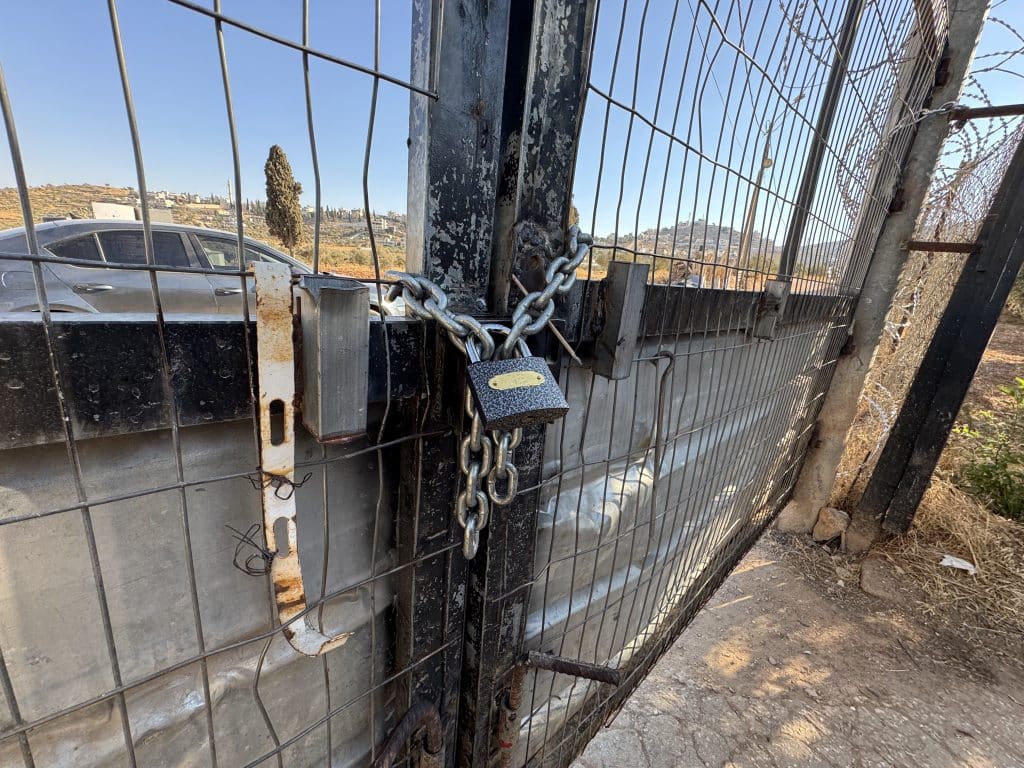
On a table set in the corner of the guest room, the cat belonging to Fadi Hamdallah al-Na’san, 17, climbs up and falls asleep among his belongings: his photographs, a collection of sports medals, and his school certificates. The small cat is still searching for her owner’s scent, still waiting for him to come home.
Fadi was declared a martyr on July 18, 2026, a week after being shot by Israeli forces while helping repel a settler attack on a home in his village of al-Mughayyir, east of Ramallah.
Since that day, the al-Na’san family’s home has declared open mourning for its child, hanging a large photo of him on the house. His parents cannot stop talking about the dream that he never got to fulfill.
“Despite his young age, the whole town loved Fadi and talks about him, remembering his character and how he got along with everyone,” Hamdallah al-Na’san, Fadi’s father, told Mondoweiss, his eyes wet, his voice barely holding steady. He shifted his weight on his crutches, wincing in pain from injuries inflicted by a settler attack decades ago that never fully healed.
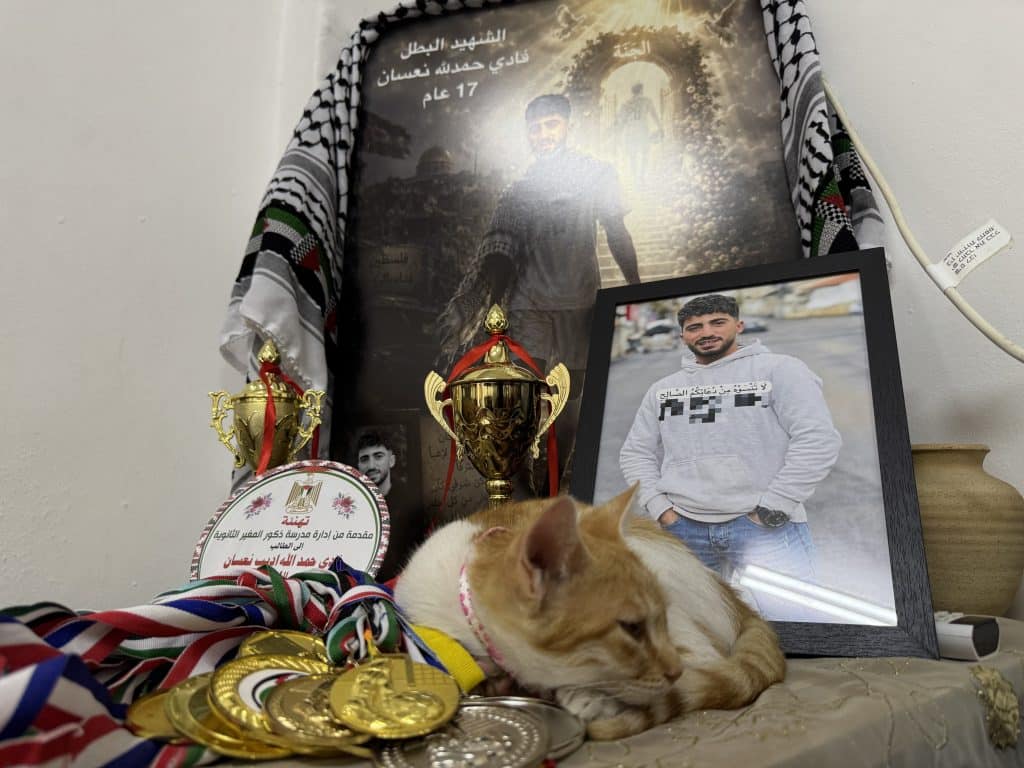
The al-Na’san family’s home is not the only one in al-Mughayyir in mourning. Since October 2023, seven of the village’s sons have been killed and dozens arrested. Al-Mughayyir is considered one of the most prominent flashpoints of confrontation with settlers in the West Bank, given its strategic location between Ramallah and the Jordan Valley –surrounded on all sides by ten Israeli settlements and outposts.
Israeli military force and settler violence have become a daily feature of life in dozens of villages in the West Bank. According to the UN Office for the Coordination of Humanitarian Affairs, settler attacks and access restrictions have displaced Palestinians across 97 communities since January 2023, most of them Bedouin and herding communities. So-called Israeli “shepherding outposts” of settler-operated farms and grazing operations backed by the Israeli military have become one of the primary instruments for seizing Palestinian land, with settlers using violence and access restrictions to empty villages of their residents. In al-Mughayyir, that process is visible in real time.

Killed while protecting his neighbors
At 10 a.m. on July 12, 2026, calls rang out from the mosque loudspeakers in al-Mughayyir, urging villagers to come to the aid of the family of Abd al-Latif Abu Alia, whose home dozens of settlers were trying to storm. “Fadi went toward Abu Alia’s house, like everyone else,” Fadi’s father told Mondoweiss. “Before he reached the house, an Israeli army patrol was standing in the road. One of the soldiers got out and opened fire at Fadi, hitting him with a bullet in the leg, in the thigh area.”
Half an hour after the confrontations began – during which seven Palestinians were shot – news of Fadi’s injury reached his family. He was taken to the Palestine Medical Complex in Ramallah, suffering from a wound caused by an explosive bullet that had severed the arteries in his leg and caused severe bleeding.
“Fadi suffered several complications,” his father said. “He developed blood poisoning, and his kidneys and liver stopped functioning. Doctors decided to amputate his leg to keep the poisoning from spreading through the rest of his body. But his small body couldn’t withstand it all, and he was killed on the morning of July 18.”
Fadi, a boy full of energy and life, stood out as a talented player at the al-Mughayyir Football Academy and later qualified for the Palestinian youth national team, representing the central West Bank region. Mourning him, the Palestinian Football Federation described his murder as a severe loss for a sports community that has lost 1,013 players in Gaza and the West Bank since the war of extermination began on October 7, 2023, including 568 footballers killed.
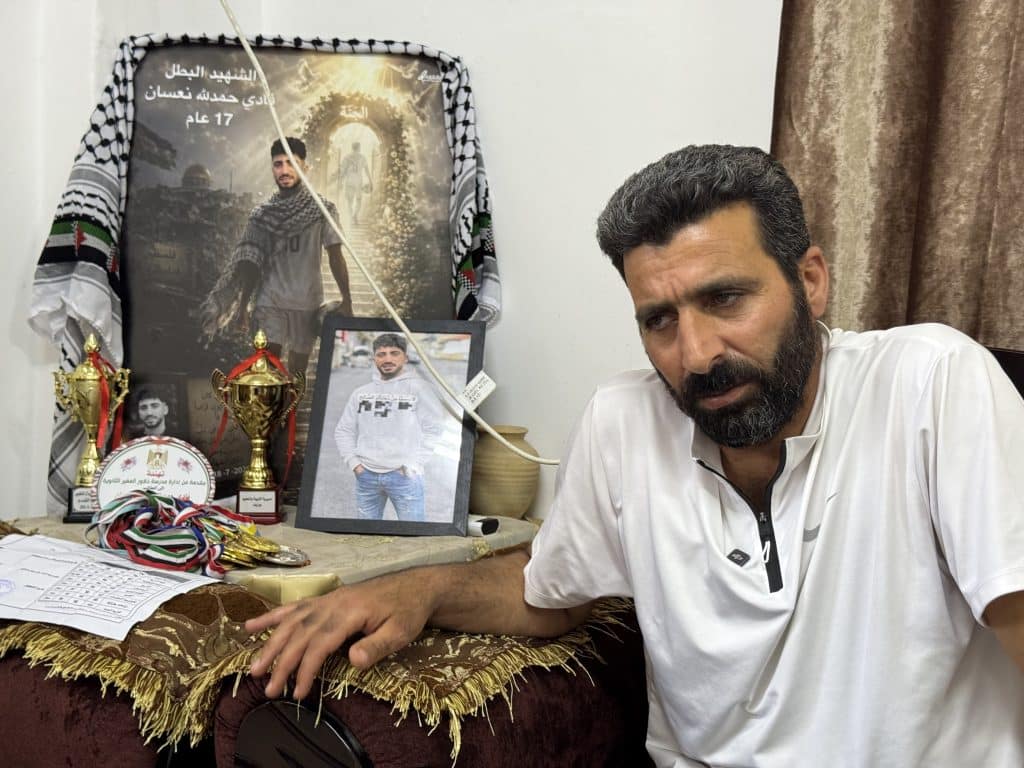
“Fadi’s ambition was to play for the Palestinian national team and represent it on the world stage,” his father Hamdallah said. “But even so, he wasn’t consumed by football all the time — he was also a diligent student at school and was getting ready to move up to secondary school.”
This is not the first time the al-Na’san family has suffered attacks by the Israeli army and settlers. Twenty-seven years ago, a settler ran over Fadi’s father, Hamdallah, near Alon Road, which runs alongside al-Mughayyir. He still walks on crutches today and suffers severe pain in his back and legs.
“Our suffering didn’t end with losing Fadi,” Hamdallah said. “A week after he was killed, the Israeli army stormed our home and held us in one room, and detained our son Adib alone in another room, where they beat him repeatedly while we could hear him screaming. They then took him to a nearby military camp, where they continued torturing and beating him before releasing him several hours later.”
For days after his release, 19-year-old Adib’s body was aching from bruises and wounds resulting from beatings he endured, his morale broken.
Walls that don’t protect the people inside
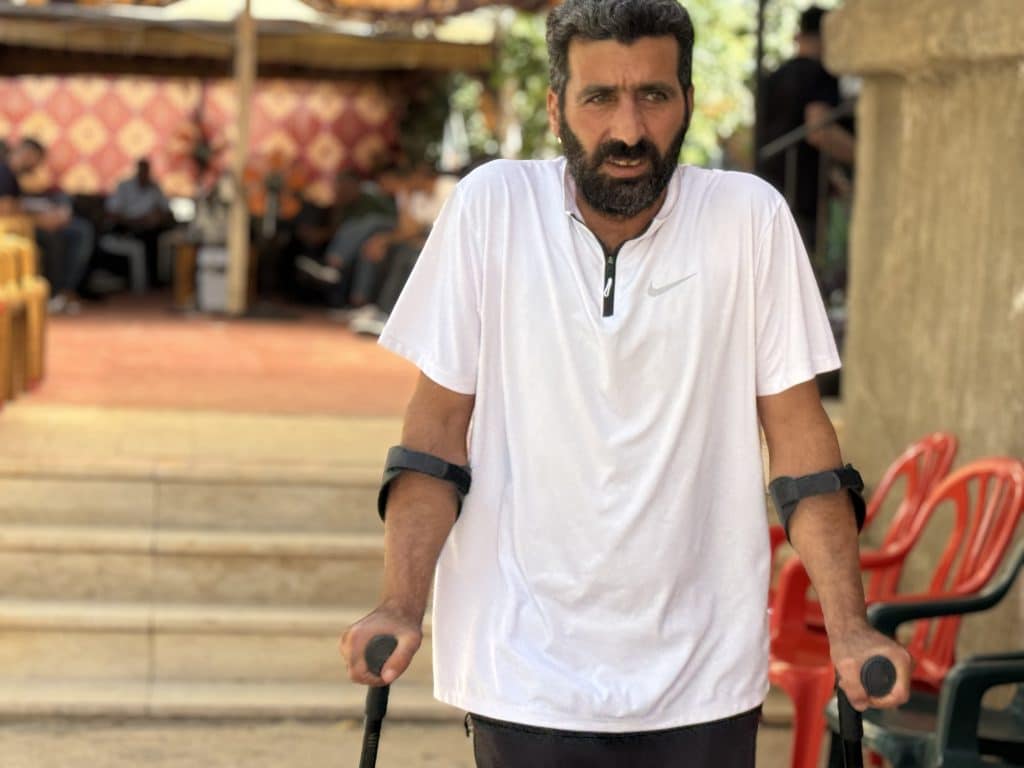
Fadi is the second Palestinian from al-Mughayyir killed defending the Abu Alia family’s homes. On April 12, 2024, Jihad Afif Abu Alia, 25, was killed while helping the family repel a settler attack on their home, located in the al-Mughayyir plain on the village’s eastern edge. Since then, the family has surrounded its homes with a high fence and installed a gate at the entrance.
But during the settlers’ attack on July 12, 2026, Israeli soldiers tried to tear off the gate and remove the fence. Footage showed soldiers breaking the gate’s lock and damaging it in a way that prevents it from being closed again.
“Things have been getting worse for us day after day since 2023,” Abd al-Latif Abu Alia, 56, told Mondoweiss. “But recently the attacks have become daily, in the morning and the evening. Today, the settler wants to come in and graze his sheep in my home’s courtyard, and the army protects the settlers and gives them whatever they ask for — that’s why they want to remove the fence and leave our home exposed.”
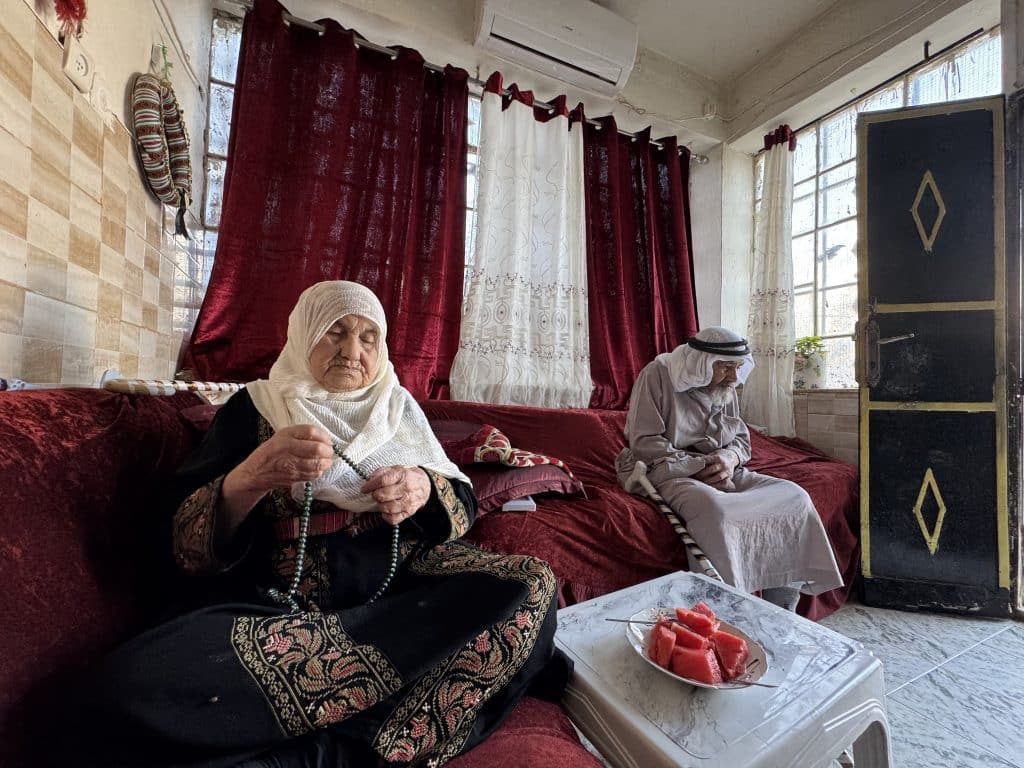
The Abu Alia family is made up of 23 members across five households, including Abd al-Latif’s parents, both over 90 years old, and his brother, who has an intellectual disability. Their homes sit on five dunams (half a hectare) of land in the al-Mughayyir plain.
“All these attacks are meant to pressure us and force us out of our homes,” Abd al-Latif said. “But that’s impossible — we will not leave our home no matter what happens, and we have no alternative to it.”
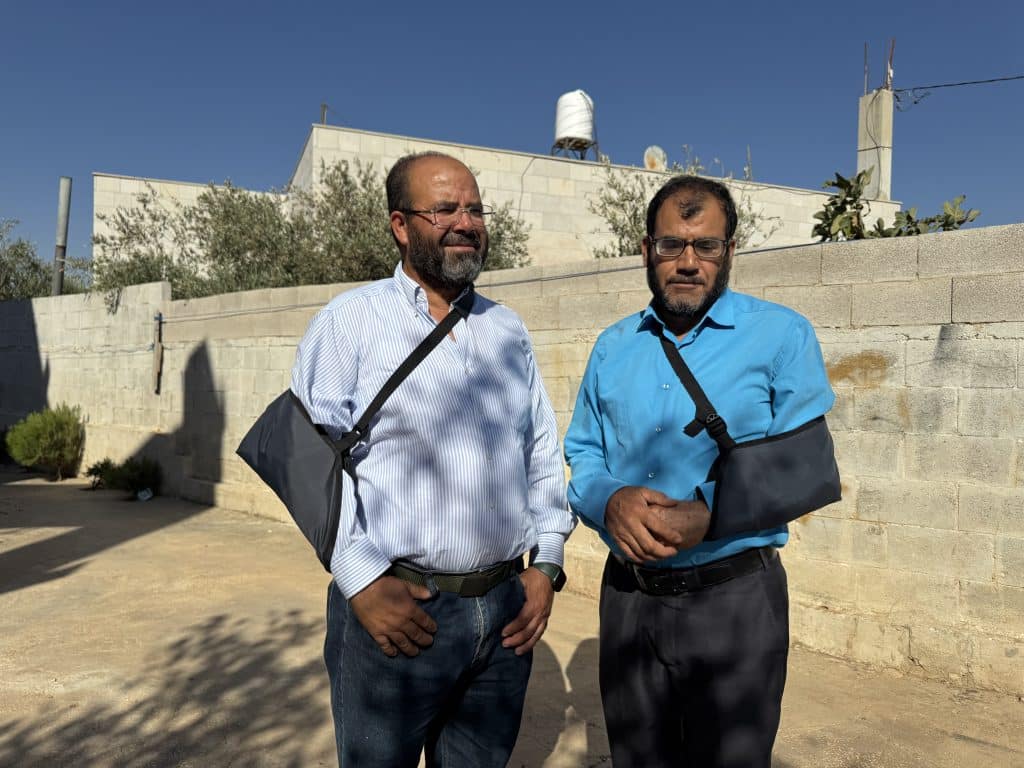
When Mondoweiss visited, the family was gathered in front of their home, braced for any settler attack, as a settler grazed his sheep next to the house. Looking out at the settler, the family described all the injuries they have suffered in recent weeks: Abd al-Latif, two of his sons, and his brother Rasmi all have broken hands and arms from beatings by Israeli forces.
“On July 8, 15 Israeli soldiers stormed our home and beat us severely, which caused fractures in my hand,” Abd al-Latif said. “We were taken to the hospital, but refused to stay overnight, out of fear of leaving our women to face a settler attack alone. Every time we defend our homes against settler attacks, the army comes and punishes us by beating us, searching the house, and destroying its contents. All of us have also been arrested and detained many times.”
Amid the escalating settler attacks, Israeli Minister of National Security Itamar Ben Gvir visited one of the newer outposts built on al-Mughayyir’s land on July 13, 2026 – the day after the assault on the Abu Alia family, a nod of legitimacy to the settler attacks on al-Mughayyir, and and a show of support by the Israeli government to the attacks that settlers are carrying out against Palestinian villages.
Israel erases al-Mughayyir’s plains
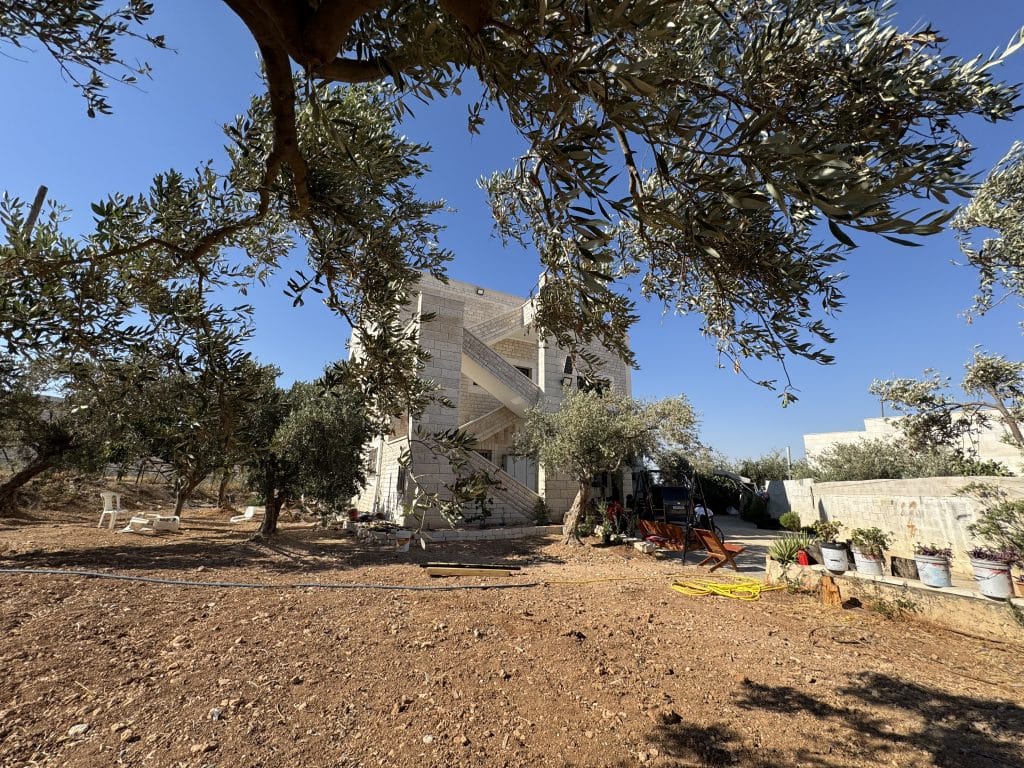
The eastern plain of al-Mughayyir looks like a barren desert today. Before August 2025, it spanned 350 dunams (35 hectares) and was one of the main sources of income for al-Mughayyir’s residents. It has since suffered wide destruction by settlers and the Israeli army. The Abu Alia family alone lost 50 dunams (5 hectares) planted with olive trees.
Ghassan Jamal, of the al-Mughayyir Agricultural Cooperative Association, told Mondoweiss that Israel and its settlers have seized all the agricultural land and grazing areas in the eastern plain, the western plain, al-Qabun, al-Dalia, Marj al-Dhahab, and al-Rafid, making up some 42,000 dunams (4,200 hectares) in total and leaving al-Mughayyir’s residents with only 1,000 accessible dunams (100 hectares) in the area covered by the village’s master plan, classified as “Area B” under the Oslo Accords.
“In the eastern plain of al-Mughayyir, 12,000 olive trees have been uprooted,” Ghassan Jamal said. “They’ve also blocked villagers from reaching thousands of trees in the village’s other plains, behind Alon Road. In other areas, settlers pour toxic substances on the trees to kill them, and bring in sheep to graze on and destroy what remains.”

“Our grandparents planted al-Mughayyir’s trees, and we never let go of them — we inherited them generation after generation,” Jamal said. “All of al-Mughayyir’s land was cultivated and cared for by its people the whole time, which is why al-Mughayyir was like paradise, and its people depended on its trees as their main source of livelihood.”
Holding on to what remains of al-Mughayyir’s land, Jamal and 15 other farmers founded a cooperative association to help each other shoulder the burdens of the loss of their land. Their first project was planting golden thistle on six dunams (0.6 hectares) in the eastern plain. “As soon as it started to yield a crop, they stopped us from harvesting it,” he said, referring to Israeli authorities and settlers. “We planted 270 grapevines seven years ago, but within a few days, the settlers brought in sheep and destroyed them completely. They also targeted the association’s greenhouses, burning and destroying them.”
The destruction of al-Mughayyir’s livestock
Al-Mughayyir was not known only for its farmland, but also for its open grazing lands, which in the past allowed residents to own thousands of sheep. Jamal Abu Alia, a local farmer, said that al-Mughayyir once had more than 18,000 head of sheep, producing 2-3 tons of cheese every day.
Today, the Abu Hammam family is nearly the only one left in al-Mughayyir that still owns a flock of sheep. The size of their flock, however, has halved in recent years, falling to only 130 heads, as a result of the family being barred from reaching grazing land.
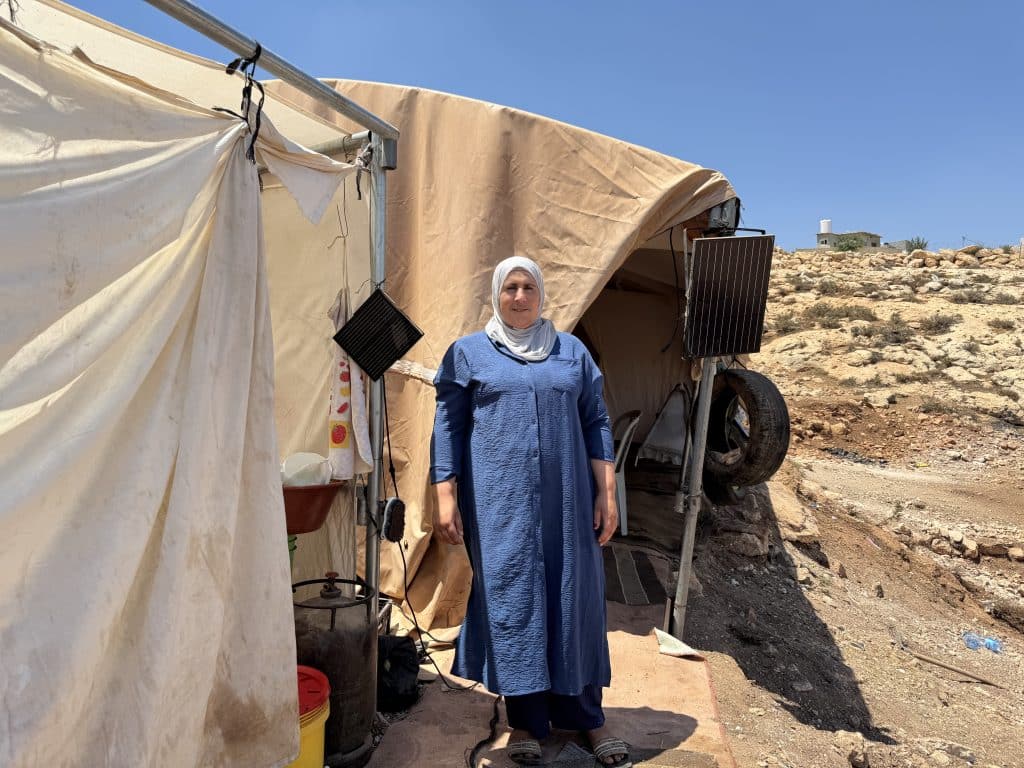
Since October 2023, the Hammam family has been forced, due to threats from settlers, to move from their home in al-Mughayyir village to their two dunams of land in the al-Khalayel area. But in December 2025, settlers launched a violent attack on the family, beating them and driving them off the land, which they are unable to reach today.
“Today there’s no grazing land for the sheep, which stay in the pen all the time, multiplying the cost for us significantly,” Fatima Abu Naim told Mondoweiss. “We’re able to stay in our home in the middle of al-Mughayyir, but we’re afraid that settlers will reach our land here too and take it, the way they took our land in al-Khalayel and the eastern plain. But we’re trying to bear the hardship of life and stay here, so we can keep settlers from reaching this place.”
Fatima, a mother of five, voices the fears of every family in al-Mughayyir. “Every day that passes in al-Mughayyir is worse than the one before it. We live in constant fear, anxiety, and readiness for any attack,” Fatima said.
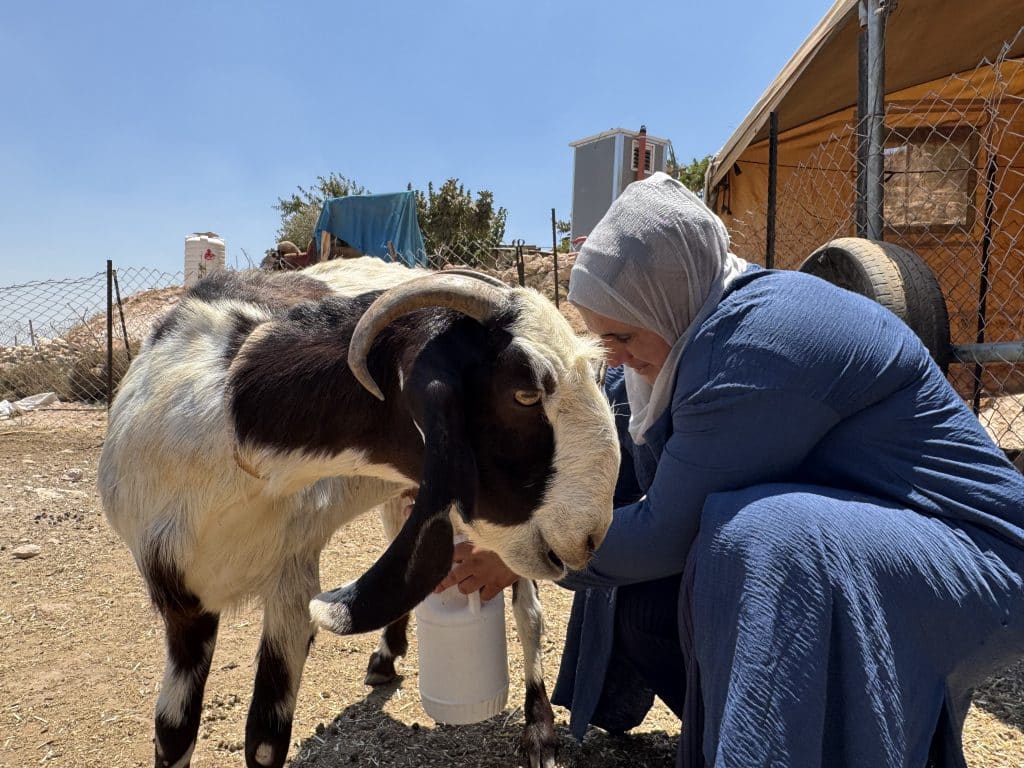
“I used to think about my children’s future and work so I could help them get an education and achieve their dreams. But today I’m consumed by fear for them, for their lives, and for their existence.”
Shatha Hammad
Shatha Hammad is a Palestinian journalist specializing in in-depth features in the West Bank, where she has reported on the ground since 2011. She holds a BA in Journalism and Political Science and an MA in Contemporary Arab Studies from Birzeit University.

Let’s look at what our colleagues at Hasbara U have been up to. The Regavim Movement** has a report on how ‘settler violence’ is all a plot by leftists to discredit Israel! Even Benny Morris is saying that Israel is on the brink of genocide, but the truth is that it’s all a left wing conspiracy!!
RegavimSilufEng0406digital.pdf
“A generously funded, carefully planned and well-organized campaign created a false perception of a widespread phenomenon of violence by settlers in Judea and Samaria against Arab residents in the area; the campaign’s objective was to turn spread the perception to the point that it became common knowledge, an undisputed fact The campaign was accompanied by videos and pictures that served as “proof” that these were not isolated incidents The campaign was designed to imprint the idea that this was a widespread phenomenon, and that the violent behavior was that of an entire segment of the population, a community of violent, lawbreaking settlers.”
**
About Us – Regavim
Yonah: “When in the course of human events a nation is exiled from its land for thousands of years and has acquiesced in this exile for traditionalist reasons and such a nation realizes that the exile is no longer tenable, they have a right to put their case to the nations and try their hand to change the situation so that their exile comes to an end.”
This is a historical justification for Zionism, not a universal human-rights justification for the creation of Israel. I was asking for a principle that would apply equally to Jews, Palestinians, or any other people.
The very fact that the argument has to be framed around this particular kind of historical “exile” is revealing: a genuinely universal right should not need parameters that have the effect of distinguishing Jewish displacement from Palestinian or ny other people`s displacement.
And even if we grant this particular historical, irredentist claim, the crucial question remains: what universal human-rights principle gave Jews, as Jews, the right in 1948 to override the self-determination of all citizens of Mandatory Palestine (Jews and non-Jews alikane) and impose a Jewish political order on the territory? The UN partition recommendation had been rejected by representatives of the majority of Palestine’s citizens; so what right did Jews, as Jews, have to impose that rejected recommendation by force, displace and denationalize the majority of the territory’s non-Jewish citizens, and deny their return in order to establish and preserve a Jewish majority? That is, in itself, the crime of apartheid as defined in international law.
We know Mondoweiss, Al Jazeera, Electronic Intifada, Democracy Now, reporting about what is happening in West Bank, Gaza… https://www.democracynow.org/2026/8/19/headlines/palestinian_american_travels_to_occupied_west_bank_to_defend_home_against_settlers Of course nothing out of Rachel Maddow, Chris Hayes, Lawrence O’Donnell, Ari Melber, Jake Tapper, Dana Bash etc etc.
While facebook/meta making it more difficult (I am blocked right now) for Pro Palestinian, Pro Peace, Pro Israel based on internationally recognized borders for people to post articles etc about what is going on in Gaza, West Bank.
Many being blocked…. making it impossible to get on fb. I have been posting accurate, fact based info about the conflict on fb since its creation. Now blocked.
https://www.hrw.org/report/2023/12/21/metas-broken-promises/systemic-censorship-palestine-content-instagram-and
https://www.bbc.com/news/articles/c786wlxz4jgo
https://www.facebook.com/trtworld/videos/how-social-media-censors-your-palestine-storiesmp4/1363871542197747/
https://novaramedia.com/2026/08/13/meta-systematically-suppresses-palestinian-voices-research-finds/
https://www.aljazeera.com/news/2026/8/20/state-backed-israeli-settler-violence-forces-west-bank-displacement-hrw
State-backed Israeli settler violence forces West Bank displacement: HRWHuman Rights Watch calls for sanctions and the suspension of military aid to Israel, as dozens of Palestinian communities in the occupied West Bank are at risk of erasure.
“The report found that, sometimes, armed settlers acted alongside Israeli military units or with soldiers standing by yet failing to intervene, during raids on Palestinian residents and property, contributing to a pattern of forced displacement.
Rising forced displacementIt said the UN Office for the Coordination of Humanitarian Affairs (OCHA) research found more Palestinians were forcibly displaced by settler attacks, demolitions and evictions in the first four months of this year than in the whole of 2025.”
jrg: “This reply is addressed to the editors of Mondoweiss rather than to Thomas Ellenberg. It’s hard to imagine a more clear-cut case of antisemitism than this sentence. This writer explicitly states here that the safety and well-being of Jewish Israelis is a matter of utter indifference to him, for no other reason than that they are Jewish, and that any right-thinking (by his lights) person should feel the same way. In other words, in his view, they are fair game to be shot, bombed, run over with cars etc. without consequences to anyone who does any of those things. I call upon the editors and content moderators of Mondoweiss to enforce this website’s guidelines that prohibit expressions of antisemitism and exclude Thomas Ellenberg from placing future posts in this space. If the local rules are to mean anything, there need to be sanctions for those who violate them.”
Yet another bizzare bizarre and completely unsupported reading of what I wrote. I said that the justification for creating a state has to rest on principles that apply equally to the people who already live there. I did not say that Jewish lives or Jewish security are irrelevant, still less that Jews are “fair game” for violence.
If you cannot or do not want to distinguish between rejecting a particular political justification and advocating violence against the people supposedly benefiting from it, then you are not responding to my argument, you are inventing one and attributing it to me – like you mostly do.
Every human being as a right and is to safety. The question is whether the rights and safety of one population can justify denying fundamental rights to another. That is precisely the universal principle I was asking you to address and you fail to answer.
Neither you, nor yonas, nor jon s will be be able to justify the creation of Israel based on universal principles. Period.