

Imagine that, in the waning years of South Africa’s apartheid regime, a new play premieres at a major off-Broadway theater examining the relationships between a group of intelligent, attractive South African whites. Some of these white characters are staunchly pro-apartheid, while others are more ambivalent, though even these ambivalent characters ultimately agree that their ethnic heritage binds their community together and needs to be preserved. One character even becomes anti-apartheid over the course of the play, and her anti-apartheid stances generate some of the play’s conflict, partly because her insistence that white South Africa is built on brutality and oppression sometimes makes her a lousy friend to her racist compatriots. Despite these characters’ differences, the play ends on a hopeful note as the whites sit down for a classic South African barbecue, putting politics aside to share food and camaraderie, the white South African way.
Imagine that this play, produced at a theater that proudly trumpets its “ongoing commitment to dismantle and disavow exclusionary structures and behaviors”, features no Black characters or perspectives. Imagine that it’s produced amidst growing global revulsion with South Africa’s brutal treatment of Black and Brown people, and amidst a worldwide solidarity movement committed to boycotting cultural products complicit in South Africa’s barbaric white supremacist regime.
Actually, you don’t need to imagine much of this: a version of it’s happening right now at MCC Theater in New York, where a new play called Birthright is running through late August. Instead of white South Africans, Birthright focuses on a group of white zionists (the playwright, Jonathan Spector, specifies in the script that all characters must be of Ashkenazi descent) who spend the play exploring their relationships with Israel’s apartheid regime.
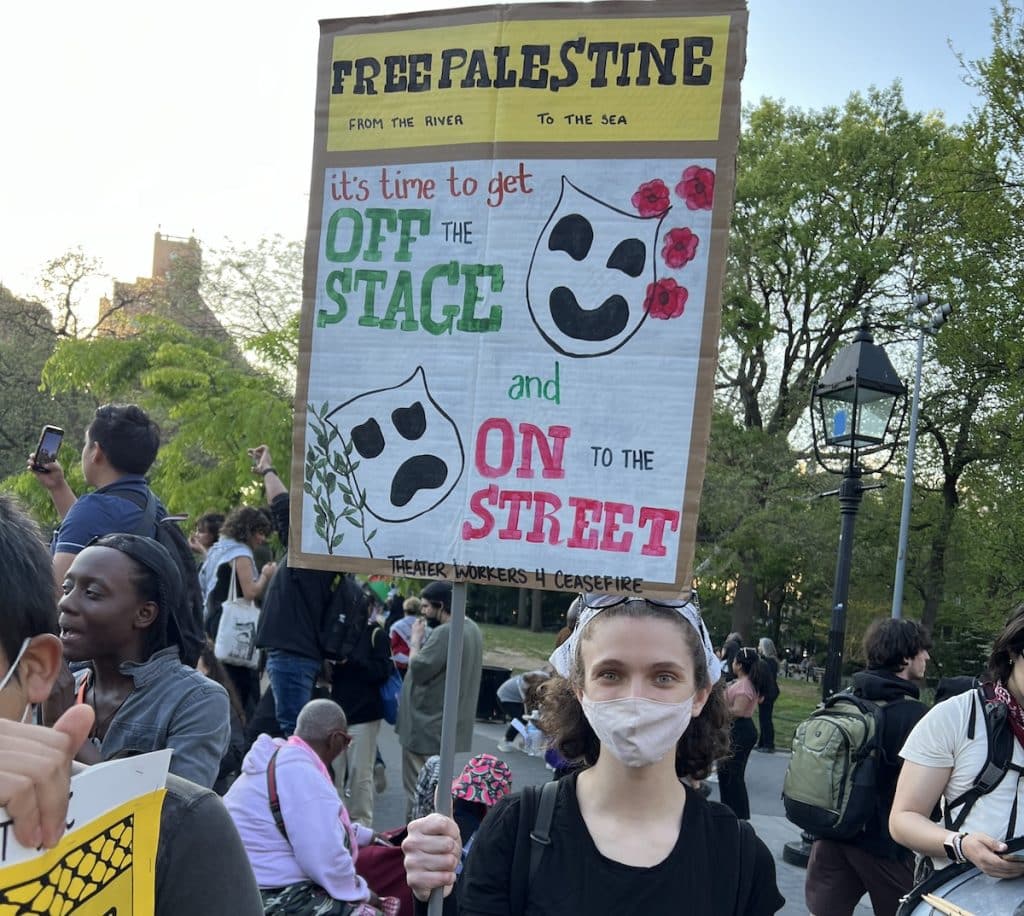
On July 7, Theater Workers for a Ceasefire (TW4C) called for a boycott of Birthright because the play violates the Palestinian-led Boycott, Divestment, and Sanctions (BDS) campaign’s anti-normalization guidelines. As a theater worker and organizer with TW4C, I’ve fielded lots of questions since the boycott began from theater workers who want more information about boycotts, normalization, and the role of the arts in Israel’s ongoing oppression of the Palestinian people.
Normalization is Complicity
The most common question has been something like, “I support BDS, but this play wasn’t funded by the Israeli government, so how can it be complicit in Israel’s crimes?” It’s true that cultural products, like plays, that are funded by the Israeli state are considered complicit by the BDS campaign (and therefore boycottable), but Israeli funding isn’t the only form that complicity takes.
The BDS campaign defines normalization as, among other things, “an attempt by the oppressor to colonize the mind of the oppressed with the notion that oppression is a fact of life that must be coped with, not resisted.” From start to finish, Birthright meets this criteria for complicity, as the entire play treats the existence of Israel as a Jewish-supremacist state on stolen Palestinian land as an immutable fact. In over three hours of dialogue, much of which centers on Israel, there is not one moment where the play’s audience is offered an opportunity to consider alternatives to Israel’s ethnosupremacist society.
If the Gaza genocide has revealed to the world that Israel and its supporters view Palestinians as nothing more than surplus population fit for erasure, Birthright invites its audience to fantasize about a world where that erasure is already complete. The play’s token anti-Zionist can lament the fate of Gaza’s children, but then finish the play breaking bread with Zionist friends who, at best, are indifferent to the genocide. Were the play not so desperate to function as a “healing ritual for the audience”, as a New Yorker critic observed, this final meal could be staged like a scene from Zone of Interest: a cast of disinterested characters enjoy a picnic while their genocide rages just beyond the garden wall. Instead, the play’s final meal is presented as a kind of wish-fulfillment: wouldn’t it be great if we could all forget about the genocide and just get along?
Beyond its final scene, Birthright clearly serves (intentionally or not) to normalize Israel’s oppression of Palestinians and aggressively encourages its audience to brush aside concern about the ongoing genocide in Gaza. Throughout the play, Palestinian suffering is dismissed, as are perspectives critical of Israel’s apartheid regime. Historically accurate descriptions of the Nakba are dismissed as “insane”, while Zionist announcements of a lack of concern for Palestinian suffering are treated as mic drops. If one of the functions of dramatic art can be to activate an audience’s imagination, Birthright chooses instead to foreclose imaginative possibilities, pushing its audience to accept the play’s projection of Israel’s apartheid state as an unchangeable reality that must be accepted.
Boycotts vs Censorship
Another question we’ve heard since the boycott began is some variant of, “Even if Birthright is politically objectionable, isn’t boycotting a play based on its content policing or censoring artists?” In fact, boycotts are themselves constitutionally protected free speech — literally the opposite of censorship — and as a form of collective political protest, the right to boycott has been under attack by rightwing forces around the U.S. for decades. Given that the argument that boycotts are censorship has been used to promote anti-BDS laws around the U.S., it’s critical that both supporters of Palestinian liberation and artists seeking to preserve their rights to free expression understand the difference.
Censorship, as the BDS campaign reminds us, “is the act by an institution, generally governmental, to control and manage morals and conduct. It is the act of securing and suppressing, from the public eye, anything that is deemed immoral, heretic or offensive to the government.” In other words, when city and state governments broke up the pro-Palestine encampments on college campuses around the country, that was censorship. A call to boycott by TW4C, a grassroots solidarity formation with no coercive power, is not.
It’s also worth noting that Birthright is hardly some scrappy passion project that found itself unexpectedly mired in political controversy. Birthright was actually conceived and commissioned by the Y6K Project, a partnership between Miami New Drama and Wasserman Projects, a Detroit-based arts organization. Founded in 2024 in response to what it calls “a climate of unprecedented vulnerability for Jewish communities”, the Y6K Project seems to be a sort of normalization pipeline, having developed a play titled The Zionists alongside Birthright, a play whose political approach and perspective are remarkably similar to Spector’s.
In fact, Y6K co-founder Gary Wasserman’s political perspective seems pretty clear. Shortly after Israel bombed the Al-Ahli Hospital in October 2023, killing nearly 500 Palestinians and wounding hundreds more, Wasserman shared a post to his Facebook account calling accusations that Israel had bombed the hospital a “blood libel” and stating that “the Palestinian liberation movement, with no exception, has dedicated itself to the killing of Jews.” This type of extremist language fueled support for Israel’s genocide from its earliest days.
Beyond his extreme views, Wasserman’s position as the CEO of Allied Metals, a Michigan-based company that operates as a defense contractor, adds another level of complexity to Birthright’s origin story. Wasserman’s involvement in the world of prestige play development echoes back to the 2018 scandal at New York’s Whitney Museum, when it was discovered that the vice-chairman of the Whitney’s board was also the CEO of a weapons manufacturing company.
Disrupting Normalization
The last question that TW4C organizers have a head a bunch goes something like: “Even if I agree with you about Birthright, the play is running and tickets are selling well, so what’s the point of continuing to call for a boycott?”
In fact, when TW4C learned about Birthright, our plan was not to launch a boycott, but to use MCC’s complicity as leverage in our work to move the theater community forward regarding solidarity with Palestine. We reached out to MCC and informed their staff that this production would violate the BDS criteria for complicity with Israel’s crimes. After consulting with BDS campaign organizers, we urged MCC to hold itself accountable for its complicity by adopting a Policy on Ethical Programming and Sponsorship — a public commitment to operate in alignment with international law. Our hope was that if a theater of MCC’s stature adopted such a policy, it would become a model for other theaters to follow.
After stalling for weeks, when MCC leaders finally met with us, they told us that the demand to operate in accordance with international law was “too vague” to comply with, that they would not even put out a statement expressing the intent to adopt an ethical programming policy, and that they remained open to programming material similar to Birthright in the future. Seeing that MCC’s leaders had no interest in holding themselves accountable, TW4C called the boycott.
As for Birthright’s ticket sales, the unfortunate truth is that MCC’s production of Birthright is proof that for many people, the genocide has already been normalized. Like the characters in this play, many theater artists and audience members — even some who call themselves anti-Zionists — acknowledge that Israel commits daily acts of brutality against Palestinians, but are eager to put their concerns about genocide on the back-burner and get back to whatever they see as normal.
Meanwhile, the Israeli government and its supporters have announced intentions to combat Israel’s status as a global pariah by dramatically intensifying their propaganda efforts. Earlier this year, The Jerusalem Post reported that the Israeli government is quadrupling its annual propaganda budget to $730 million – nearly 20 times larger than the budget was before the Gaza genocide began.
With that in mind, we in TW4C believe that one of the tasks of the Palestine solidarity movement is to disrupt attempts to normalize Israel’s crimes. While Birthright is a particularly egregious example, it’s just part of the first wave in the normalization assault that’s going to hit our stages and screens in the coming years. We will continue to disrupt attempts to use arts and culture to normalize genocide in whatever ways we can.
William Johnson
William Johnson is a co-chair of TW4C’s PACBI Committee and a longtime member of Jewish Voice for Peace. To learn more about the “Boycott Birthright” campaign, visit TW4C’s campaign page.

This is unfair to me. I try, but I can’t top this. They should change the name to “Beyond Parody”
Or “Birthfright”.
Y6K? Wasn’t explained, but I expect it refers to the year 6000 in the Jewish calendar. Currently 5786.
I was once asked, “Why can’t they just get along?” Answer: Because the Jews want all the land with none of the people.
I’m guessing that it has nothing like the power of Tom Stoppard’s last masterpiece: “Leopoldstadt”.
I have mixed feelings about this boycott prropsak and bcg’s comment contains an important point— the play describes how people act in real life.
i think it is fine to boycott it for yourself— I wouldn’t pay to see it. But it also provides an opportunity to criticize the narcissism the play apparently describes. As I just said, I haven’t seen it, but I was able to read the New Yorker review ( libraries are great) and it sounds like it provides an opportunity for people who see it and review it to point out what is wrong with the attitudes on display. If anything, I wish the play sparked the amount of attention we currently see for Nolan “ Odyssey” movie. We don’t have to accept the play’s message that people getting along is more important than their disagreement about a little thing like genocide. ( Assuming that is the play’s message.)
Also, if we make it about boycotting this play, IMO it just gives the pro Israel side the excuse to yell censorship and then we have a stupid debate about a secondary issue, rather than the genocide.
If the writer is saying, “We consider Zionism odious and therefore any theater that does not label Zionism as odious should be boycotted.” I suppose that is a perfectly logical statement. But on the other hand, what I hear is, “We are right. We are righteous, and the arts must be aligned with our point of view.” This actually seems pretty sick.