

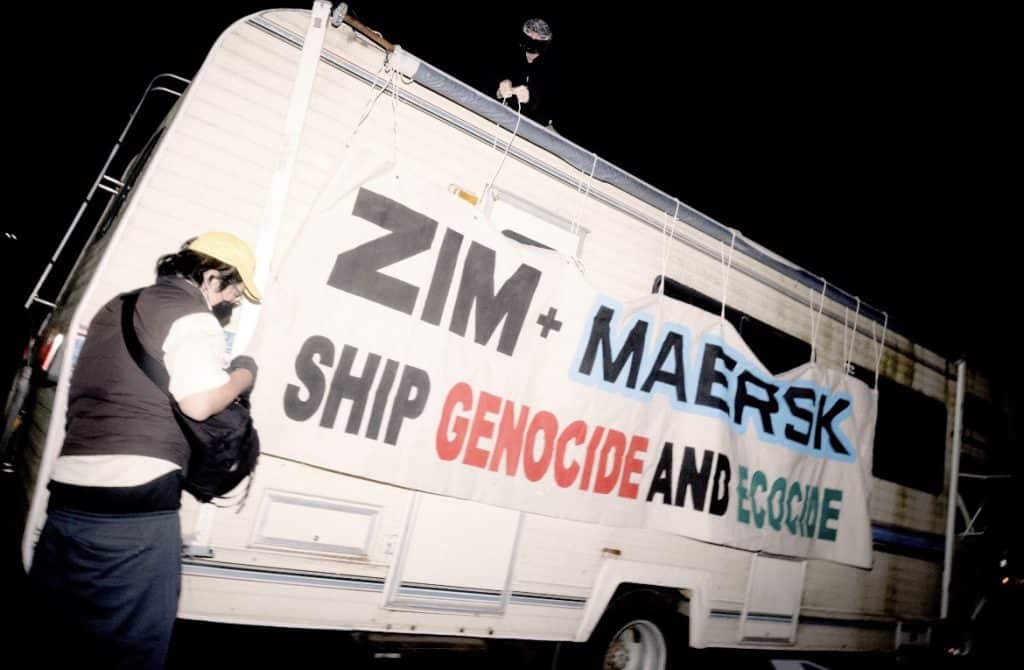
A line of trucks rounded the bend toward Port Newark-Elizabeth on October 3, 2025. Inside the trailers were combat boots and weapons components — including 61 tons of forging rings used for military jets — bound for Israel via a Maersk vessel departing that morning.
But before the truckers could enter the port and the Maersk Sentosa could be loaded, 100 activists organized under the banner “Port of Elizabeth Movement” (POEM) sprang into action.
“It was ass o’clock in the morning. The sun was far from up. It was pitch black. Everyone was tired. Someone yelled, ‘Go, go, go, go!'” said Danny Creamer, who was later arrested at the POEM action.
Port Newark-Elizabeth is the third-largest port in the U.S. and the largest on the East Coast. And it has become a recurring target for activists concerned with the weapons supply chain to Israel. About 900 tons of sea cargo — comprising 91% of all military cargo bound for Israel that does not pass through a military base — originates from a nearby warehouse and is transported through Port Newark-Elizabeth.
The Port Authority of New York and New Jersey has jurisdiction over the port, with commissioners appointed by the governors of each state. Organizers claim that this power structure makes the organizing landscape less conducive to pressuring elected officials because of the Port Authority’s insulation from the local community.
“We don’t get into that kind of politics. If it’s local, if it was the city of Newark then maybe it would be worth a shot,” said Tova Fry, a long-time organizer with Port Workers and Communities for Palestine, a group focused on facilitating worker solidarity at ports across the U.S.
Instead of electoral or legislative strategies, the battle for Port Newark-Elizabeth is fought on different terrain: the dual threat of labor organizing by Port Workers and Communities for Palestine, and escalated direct actions by POEM. The two groups work autonomously and share the same goal — preventing vessels at Port Newark-Elizabeth from shipping U.S.-made weapons to assist Israel’s genocide in Gaza.
A poem for direct action
Back at the October 2025 action, Creamer and his fellow activists ran into the street, unfurled banners and laid 15 shrouds representing babies killed by Israel in Gaza. At one point somebody started playing the bagpipes. The activists blocked the road for about one hour with traffic cones and their bodies, obstructing the truckers’ entry and delaying the departure of the Maersk vessel. “It felt momentous, like ‘shit something’s happening here,’” said Creamer.
Eventually, the Port Authority Police responded with a dispersal order. Four people who refused to comply, including Creamer, were arrested and charged with disorderly conduct. Almost one year later, the four were found guilty of a violation (which Creamer compared to a traffic ticket) and sentenced to community service.
“We didn’t dismantle the U.S. imperialism shtick in one action, but we’ve at least inconvenienced it a little bit,” said Creamer. According to Creamer, this initial action demonstrated POEM’s animating principle. While large-scale rallies and marches show opposition and “serve as a threat, if we don’t follow through, then we can lose our leverage,” explained Creamer. “So we decided to try and stop the weapons shipments ourselves.”
At Port Newark-Elizabeth, this means using bill of lading data to track when Maersk and ZIM ships — the two major logistics companies that supply U.S.-made weapons to Israel — are set to depart and to coordinate timely escalations.
Difficult terrain for labor organizing
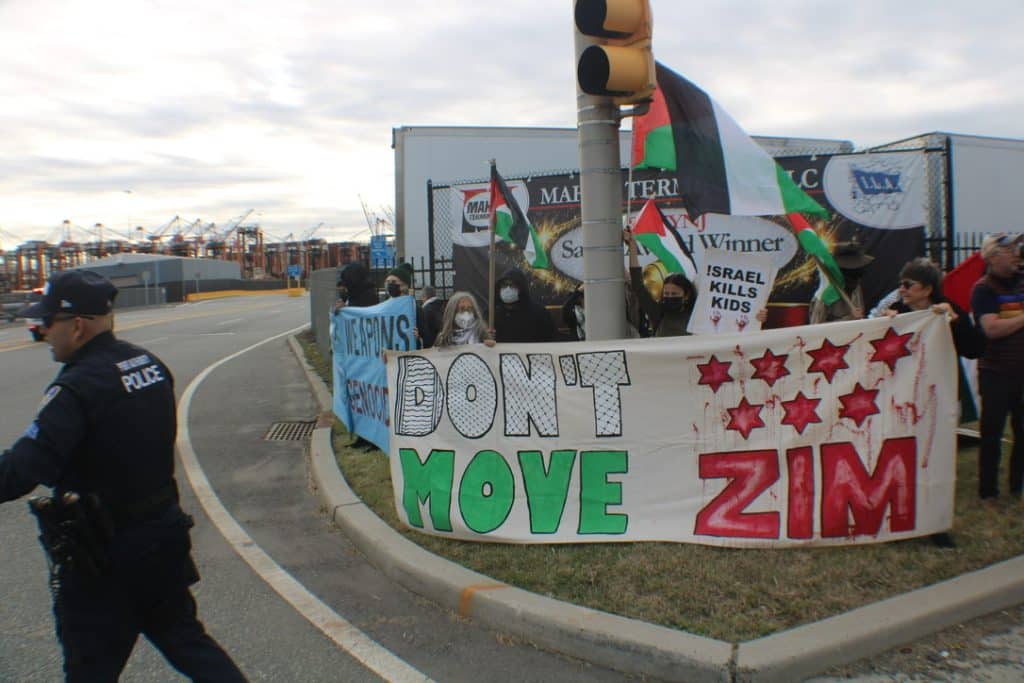
Maersk, an international Danish shipping company, is an integral player in this supply chain, and has been a target of the Palestine solidarity movement since the Palestinian Youth Movement (PYM) launched the “Mask Off Maersk” campaign in June 2024. Recent research by Oxfam and PYM found that regular Maersk shipments out of Port Newark-Elizabeth include components for bullets, bombs, and mortars. Between October 2023 and July 2025, Maersk transported approximately 3,000 tons of weapons components to Israeli weapons manufacturer Elbit Systems.
ZIM, the other cargo carrier that transports weapons from Port Newark-Elizabeth to Israel, was founded in 1945 by the Jewish Agency and was Israeli-state owned until the company privatized in 2003. ZIM is one of Israel’s main weapons transporters, frequently chartered for emergency orders by the Israeli Ministry of Defense.
In 2014, Palestine solidarity organizers achieved a historic victory when West Coast dockworkers with the International Longshoremen’s Union (ILWU) refused to unload a ZIM ship at the Port of Oakland. ZIM has not returned since.
Tova Fry with Port Workers and Communities for Palestine was living on the West Coast and was involved in the 2014 movement against ZIM. But the labor landscape on the East Coast is different.
While the ILWU continues to express unprecedented solidarity with Palestine, “unfortunately there’s a different union here,” said Fry. Instead of the progressive ILWU, the International Longshareman’s Association (ILA) works the docks, manages the cranes, and ties the ships at Port Newark-Elizabeth. The ILA president expressed support for President Donald Trump in 2024. “I would say it’s one of the most right-wing unions in the country,” said Fry.
Port Workers and Communities for Palestine is taking an alternative route to labor organizing. The ILA has proven intractable thus far, “but who we do work with here, with much more success, is the [non-unionized] Port Truckers,” said Fry.
Port Truckers are independent contractors, often described as “sweatshops on wheels.” According to Fry, the truckers are a largely immigrant workforce who are aware of international politics. “Therefore, they tend to be supportive of Palestine,” said Fry. Some truckers even send pictures to notify the organizers when they spot military equipment on their ZIM trailers.
However, Port Workers and Communities for Palestine said that the truckers’ lack of union and reliance on ZIM and Maersk for work has proven a challenging organizing terrain.
The ILA has the power to stop shipping weapons to Israel, but not the will; the Port Truckers have the will, but not the power.
“It’s a constant strategy discussion about how to move forward and it’s a long term struggle. Unfortunately, as we see what’s happening, the genocide is not stopping,” said Fry.
For now, Port Workers and Communities for Palestine pursues two main tactics: pickets at the port and community outreach with truckers.
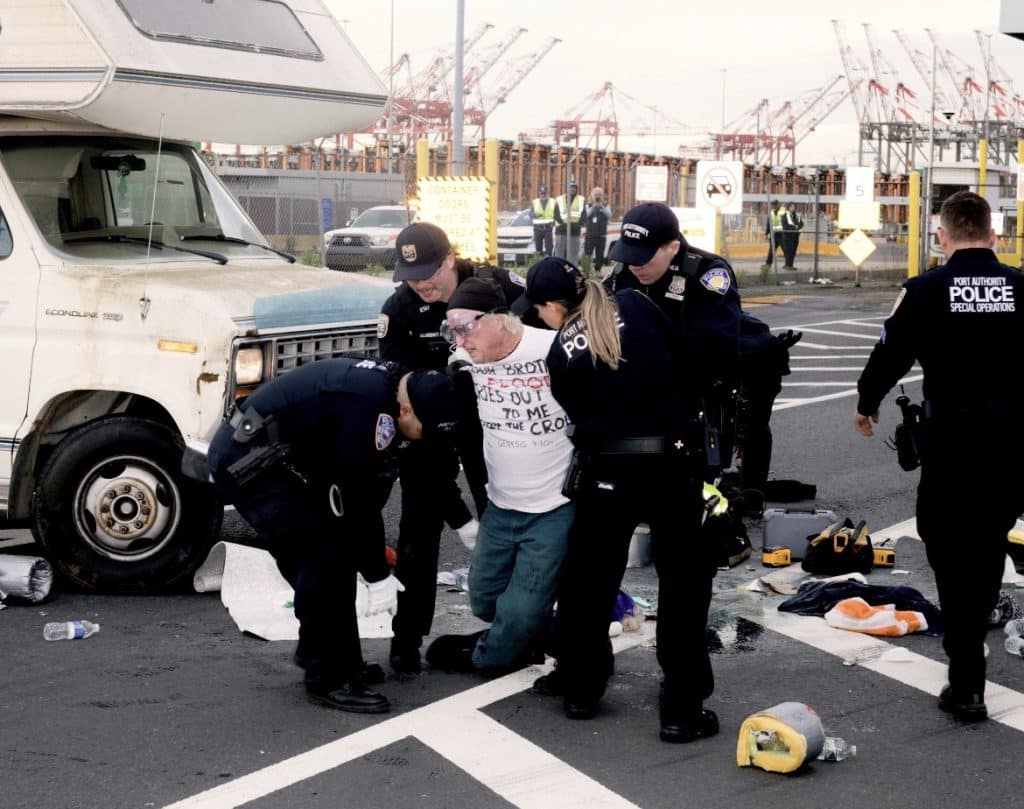
Organizers use publicly available data to plan pickets when ZIM or Maersk vessels are due to be loaded. During a recent picket on the morning of October 4, 2026, Mondoweiss joined activists at the Maher Terminal entrance, right as the ZIM Virginia arrived at the port.
On a strip of grass adjacent the dockworkers entrance, 35 people congregated to wave Palestinian flags and hand out flyers to workers. Umber, an organizer with Port Workers and Communities for Palestine using a pseudonym for security reasons, rallied the crowd with a speech.
“Today, the ZIM Virginia arrived at the Maher Terminal at 8:00 a.m. to load weapons for genocide. Some of the items that have been on this ship include ammunition shells, casing for ammunition… The reason we come out here every time this ZIM Virginia arrives, is to tell the ILA and to tell the truckers who might be carrying items for this shipment that this is not acceptable. This is a crime and it must be stopped.”
Passenger vehicles trickled in the terminal entrance, largely ignoring the protesters. One activist attempted to hand a flyer to a driver whose window was open; the driver threw it back. Fry later told Mondoweiss that these vehicles carried ILA workers tasked with loading the ship and preparing it for departure. The Port Truckers who were absent from the terminal had likely unloaded their cargo a day or two earlier.
At other pickets, Fry said the Port Truckers reacted by “honking and yelling and supporting us, sometimes holding up the line of truckers by slowing down… whereas the ILA workers, the last picket we had there, not a single one even slowed down to take a flyer,” said Fry.
In addition to pickets, Port Workers and Communities for Palestine conducts outreach work that includes flyering at places where Port Truckers congregate between shifts, hosting community picnics to support worker leadership, and passing out Palestinian flags to hang on their rearview mirrors. “We were invited to a mosque by some of the truckers a couple of times, where we made announcements about upcoming activities and handed out our flyers,” said Fry. “They’re eager to support in those kinds of ways. It’s just the major way of actually not carrying [weapons] that’s proving difficult,” said Fry.
The long term horizon for this work is to help the truckers organize themselves. “If they were able to unionize they could say ‘okay we’re not going to carry ZIM or we’re not going to carry weapons,” said Fry.
Climbing the escalation ladder
A few months earlier, and a few feet away from the site of the October 2026 ZIM Virginia picket, POEM executed its second direct action at the Port Newark-Elizabeth Maher Terminal on May 22, 2026.
Jonathan Nault, a South Jersey native who was compelled by the theory of direct action articulated by POEM, was in attendance. “Rather than continuing to march all the time I wanted to get involved in movements that address the problem at the supply chain level,” said Nault. “I honestly felt fortunate to be in a position where this is right in my backyard. I can actually do something about this.”
After the October 2025 action disrupting the Maersk Sentosa shipments, POEM saw an opportunity to turn up the pressure. “In October [2025], the police kicked the cones and shrouds out of the way. So we were thinking ‘what can we do to make ourselves un-pushable?’”
Gone were the traffic cones and bagpipes — this time POEM deployed an RV, a van and a boat to completely blockade the Maher terminal. Activists, including Nault and Creamer, who were chained together, locked themselves to pipes attached to the van, using a method called the “sleeping dragon.”
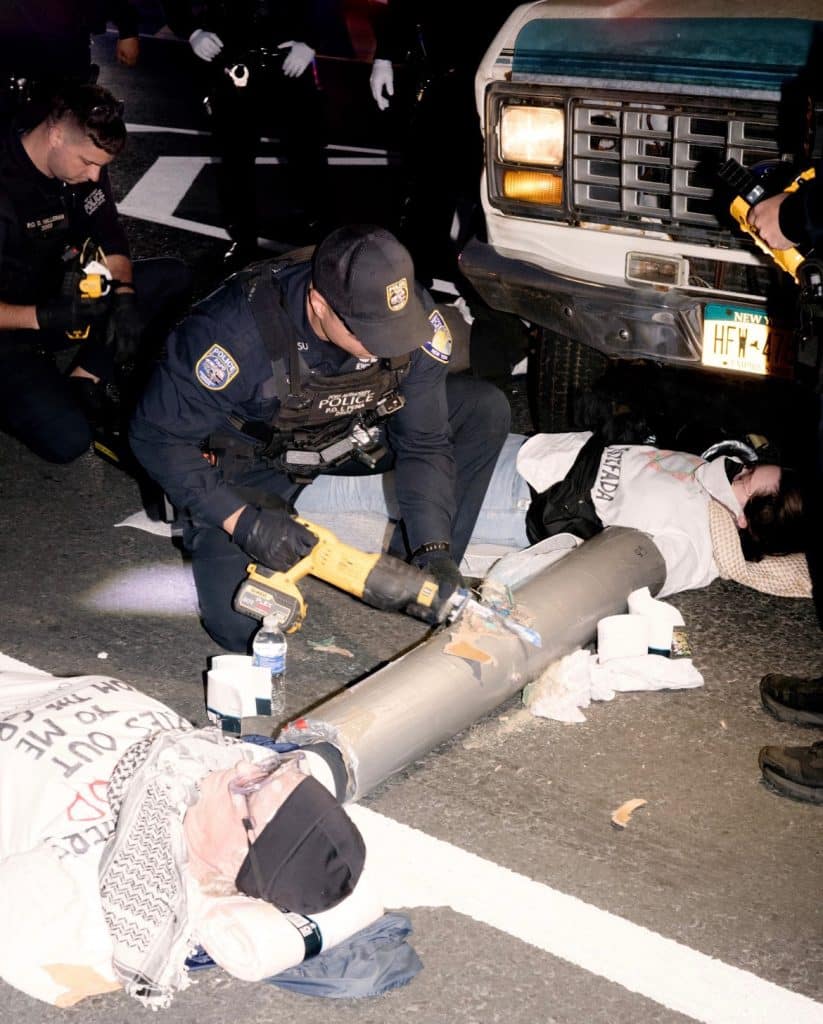
“There was a huge line of trucks that were completely blocked,” said Nault. “We blockaded the port for about three hours. In addition to buying time on the weapon shipment themselves… we may have elongated a Palestinian’s life because the ammunition didn’t get there in time.”
Ten activists including Nault and Creamer were arrested at the action and face ongoing misdemeanor disorderly person charges. But Nault said he wasn’t focused on the responding police officers, instead he was thinking, “this is the direction I hope the broader pro-Palestine movement will go. Prioritizing addressing the problem directly over symbolic marches and rallies.”
While Nault believes that mass mobilizations should also continue, he maintains it is time for a movement-wide paradigm shift. “The horrors that Israel has been inflicting on the Palestinians have been evolving. Our mode of pushback has to grow and evolve too. We have to take our struggle to the supply chain level en masse.”
Port Workers and Communities for Palestine continues the long-term struggle of labor organizing at the port, and Nault said that POEM is focused on “introducing people to the escalation ladder of protest. Our long-term goal is to set precedents about the level of risk the movement will take.”


Thank you to Port Workers and Communities for Palestine and Port of Elizabeth Movement for speaking with me for the story!
Please write to me at josephmogul@proton.me with any tips/leaks pertaining to weapons manufacturers and resistance.