

DON’T SAY PALESTINE
How the Media Manufactured Consent for Genocide
by Assal Rad
242 pp.; Vintage; $20
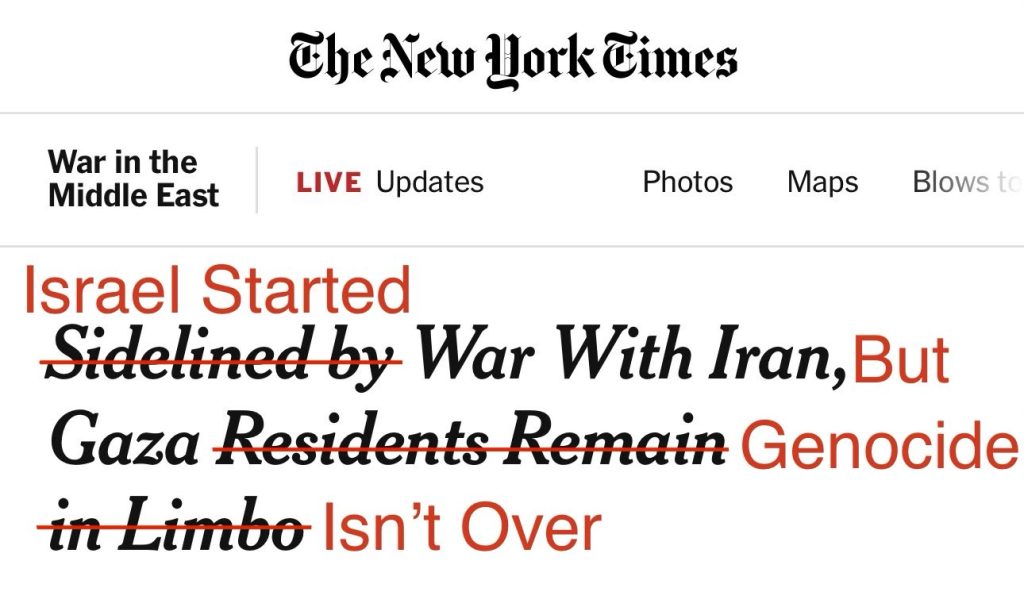
Anyone who has followed Israel’s war on Gaza over the past few years on Twitter/X has come across Assal Rad’s compelling efforts to rewrite the misleading and dishonest headlines in articles from the mainstream media. She started back in May 2021, and this first example set the tone.
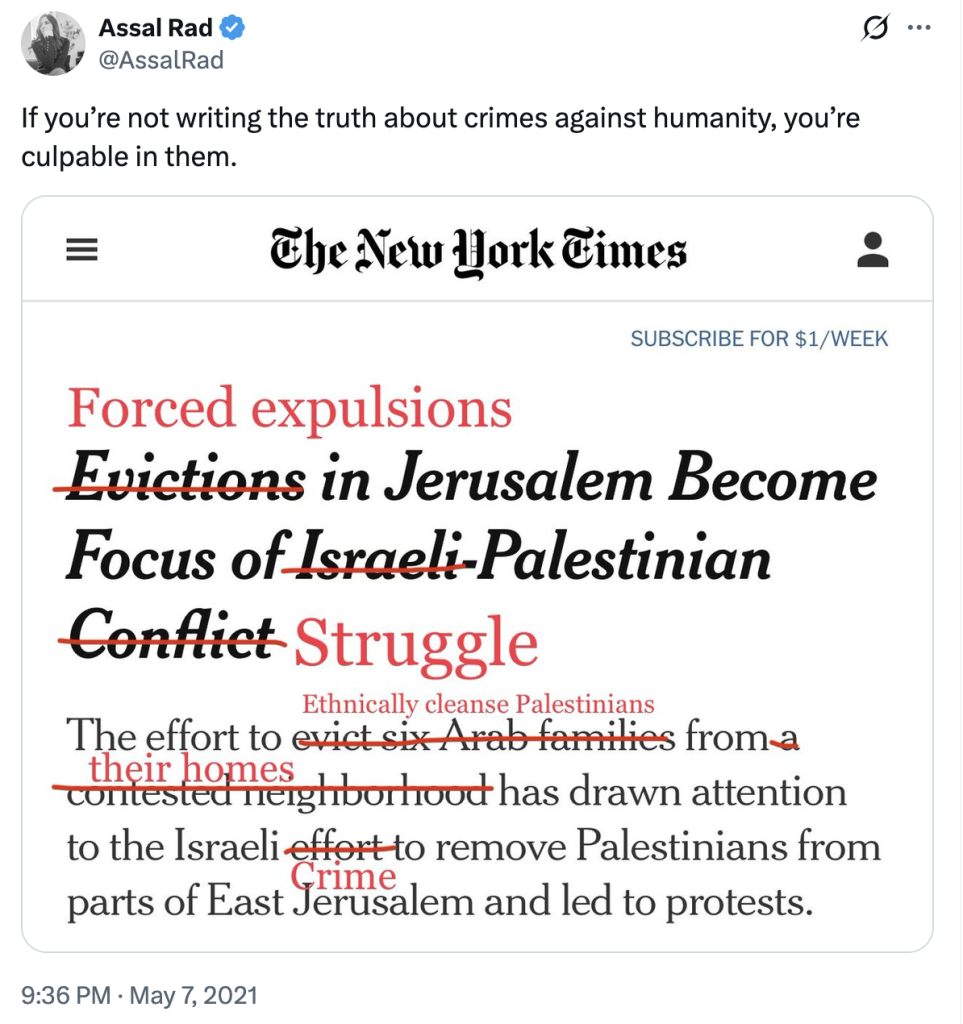
She continued after October 7, 2023, and her work became one of the most effective ways to get the truth to a wider audience. Over the years, she has accumulated 192,000 followers.
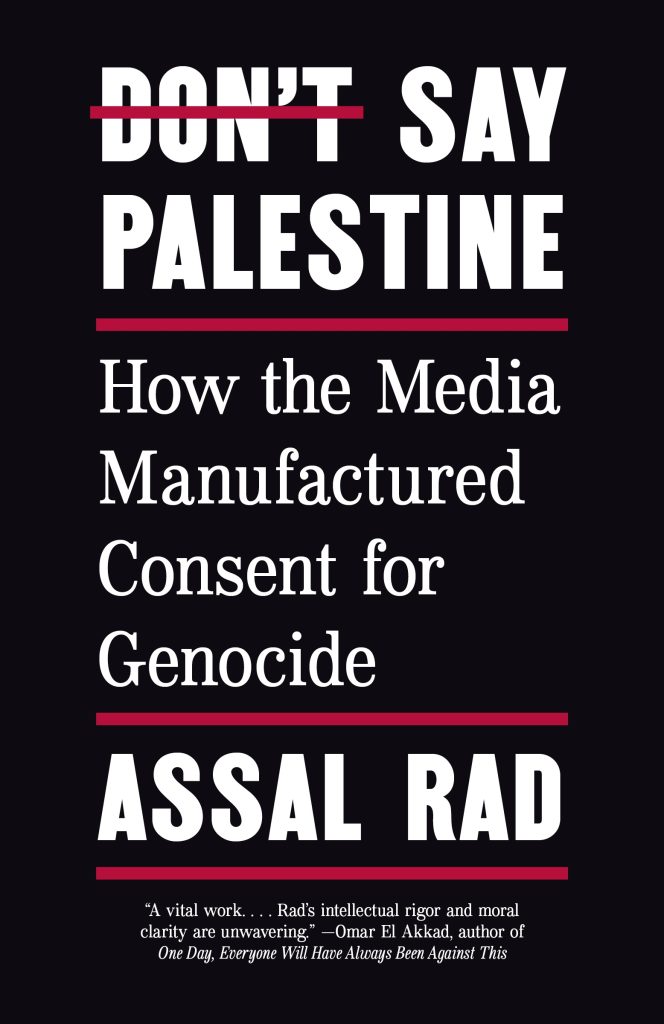
But there is much more to Assal Rad’s work than her correction of headlines, vital as that is. She is an accomplished scholar and historian with a deep understanding of Israel, Palestine, and the Middle East. And now, she has written a masterpiece, a combination of brilliant analysis and searing moral outrage that will become a classic and be read for decades, or even longer. Her work on language distortion and dishonesty can actually be placed right up in the same category as George Orwell’s famous essay, “Politics and the English Language.”
This review cannot fully do justice to Rad’s achievement in Don’t Say Palestine: How the Media Manufactured Consent for Genocide. Let’s start with the corrected headlines. She reminds us that “headlines matter because people often do not read beyond them.” She also points out that many articles are behind paywalls, which gives the headlines added power. And she explains:
“My goal was not to nitpick or play semantic games. It is to show how language is used as a weapon to obscure and sanitize. When indiscriminate bombing is called ‘targeted strikes,’ a policy of starvation is described as a ‘humanitarian challenge,’ and genocide as reframed as ‘self-defense,’ these linguistic choices are not accidental. They are political decisions that determine whose lives count and whose deaths are permissible.”
Rad reminds us that the mainstream distortions and downplaying kept the larger public surprisingly ignorant. Those of us who followed Israel’s genocide on alternative media may be surprised to learn that
1) Even by March 24, 2024, only half of the U.S. public knew that more Palestinians than Israelis had been killed in the war on Gaza, and
2) Even more astonishing — more Americans could identify “Hamas” than knew who “Benjamin Netanyahu” was.
She points out an awful paradox; alternative media did cover Israel’s mass killing, but most people missed it. She writes: “. . . social media accounts were flooded with images and videos recorded by Palestinians in Gaza themselves. For more than two years, anyone with a social media account could wander into a constant stream of unedited glimpses of apocalyptic destruction, mass slaughter and helpless civilians being carpet-bombed with nowhere safe to go.” She reminds us that some 250 Palestinian journalists paid with their lives to report these terrible truths.
Not all mainstream reporters and editors played along with the whitewash. Leaks from people inside CNN, the New York Times, and others did reveal aspects of the self-censorship; other media people resigned in public protest, or were, in some cases, purged.
Throughout, Assal Rad maintains her focus on the mainstream’s distortions, euphemisms and outright lies. Even those of us who followed the bias closely will find plenty to learn in this remarkable new book. Here’s one strong example: “[Israeli air assaults] often came with the phrase ‘targeting Hamas’ to justify the attack, whether it was on a school, hospital or refugee camp with Palestinians in makeshift tents, and no matter how many civilians were killed. The use of ‘targeting Hamas’ became a means to normalize the mass slaughter of civilians by reframing indiscriminate bombing as a precise military campaign.”
Her carefully documented indictment also confirms the Biden administration’s deep complicity in the mass killing, contributing to the growing revisionist analysis that confirms it was even worse than critics charged at the time.
There is even more. Rad points out that some parts of the Israeli media sometimes told truths that the American mainstream ignored (a point also made regularly at this site). She writes: “In September 2024, Haaretz [Israel’s newspaper of record] published a piece on reports from Israel’s Channel 12 News that outlined ‘Netanyahu’s relentless efforts to block hostage deal.’ A report of this magnitude from Israeli sources should certainly be considered newsworthy at a time when the United States was supposedly leading cease-fire talks. But the story did not attract much attention from the mainstream media.”
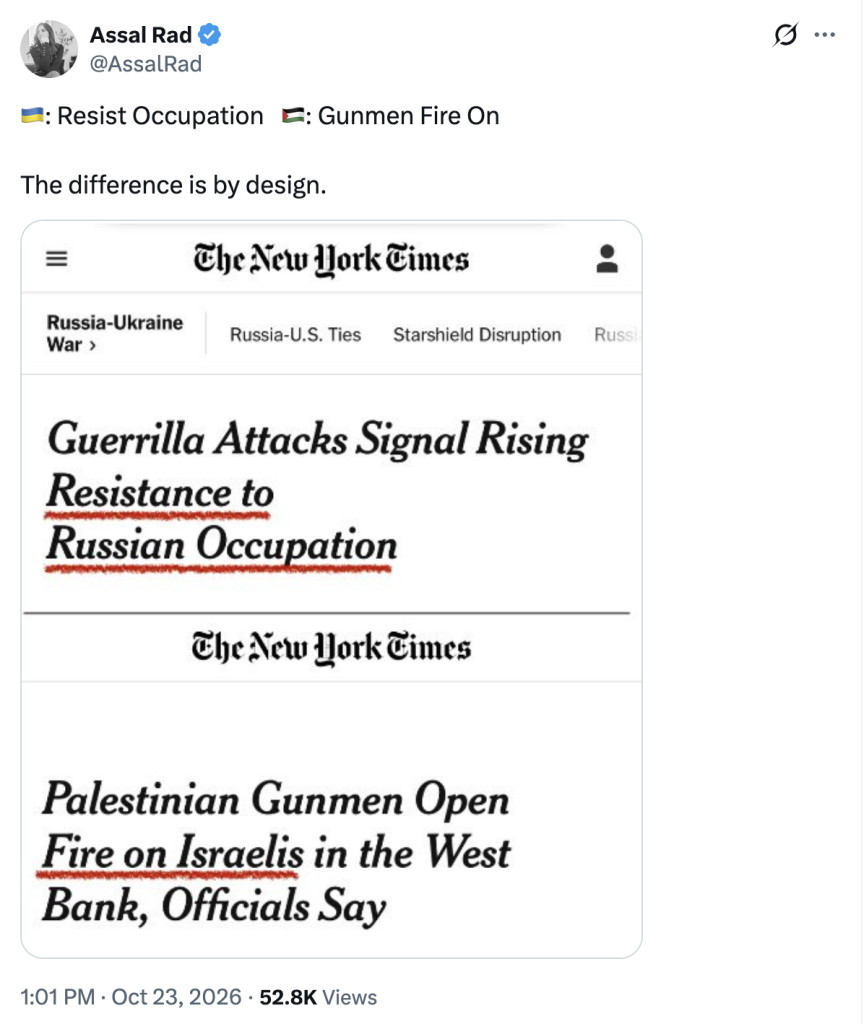
Assal Rad is not stopping. Here, from just a few days ago, are her rewritten headlines contrasting the New York Times coverage of Russia’s invasion of Ukraine with Israel’s crackdown in occupied West Bank/Palestine.
Finally, Vintage, a major mainstream imprint, is publishing Don’t Say Palestine. Will the bigger publications have the moral courage to at least assign the book for review? Allow Assal Rad space to write opinion pieces? Or will the mainstream remain true to form, and hide?

Bravo! The whole Israeli project of eliminating and expelling Palestinians rests on sloppy and misleading use of language. Consider the phrase “Jewish State” – it sure seems like it means something, it evokes sympathy ( even from me – my father was born in Europe before the war and came to the U.S. as an infant. If his family had stayed they would have perished in a concentration camp ) and warm fuzzy feelings, it evokes the horror of the Holocaust, it evokes all sorts of images and thoughts. But when you ask what it means precisely, what it means in the clearest legal sense, it becomes problematic.
Here’s another example of how language drives things: the phrase “a people“, as in “Jews are a people but Palestinians aren’t a people” – I’ve heard this phrase from rabbis and Israeli politicians, as if you can deny human beings the most fundamental rights just by using some linguistic construct.
“No Such Thing as Palestinian People”
‘No such thing’ as Palestinian people, top Israeli minister says | PBS News
Re: Her carefully documented indictment also confirms the Biden administration’s deep complicity in the mass killing, contributing to the growing revisionist analysis that confirms it was even worse than critics charged at the time.
Some of us here pointed out coverage by Declassified UK (including Matt Kennard, Phil Miller, and Alex Morris) which revealed around the clock UK and US military flights operating out of RAF Akrotiri in Cyprus and other bases to support Israel during the Gaza war. See for example: ‘Death run’: New film shot in Cyprus reveals UK military help to Israel during Gaza genocide. Declassified UK’s documentary features first ever footage of a US spy plane leased by the RAF taking off to fly over Gaza
My unit had a permanent detachment there and had deployed fresh teams every 179 days for well over a decade. At the same time Joe Biden was bear hugging Bibi and arranging for the airlift of a record tonnage of bombs, Palestinian-Americans were awaiting evacuation and left stranded at the Rafah crossing. Instead of demanding that Israel reopen it, humanitarian shipments into and throughout the Gaza Strip were delayed while a completely unnecessary “Gaza floating pier” was slowly making its way across the Atlantic ocean as some kind of photo-op.
FYI, in less than 72 hours, standing USAF and Navy teams (with depots in the region) could have driven from their bases and repaired or built several brand new additional runways in Gaza (think The Berlin Airlift). See for example: In 1941, North Carolina engineers laid a 3,000-foot runway from perforated steel mats in 11 days; by World War II, similar runways could be ready within 72 hours | – The Times of India