“Resistance is an idea, and an idea never dies. Even if we die, we remain alive in the hearts of our people. We live in the hearts of all those who love freedom.”
Palestinian activist Anan Yaeesh spoke these words on December 19, 2025, addressing the L’Aquila Court of Assizes from Melfi prison, a high-security facility in the province of Potenza in southern Italy. Less than a month later, on January 16, 2026, he was sentenced to five years and six months in prison for “association with the purpose of international terrorism.”
Born in the Tulkarem refugee camp in the occupied West Bank, Yaeesh has lived in L’Aquila, Italy, close to Rome, since 2017 under a special protection permit. On January 27, 2024, Italian authorities arrested him under a provisional detention order issued by the L’Aquila Court of Appeal, following an Israeli extradition bid over alleged links to the Tulkarem Brigades, a Palestinian resistance group.
In March 2024, the Court of Appeal rejected Israel’s extradition request, recognizing the risk of torture and inhuman or degrading treatment if Yaeesh were handed over. Israel subsequently withdrew its request, but Yaeesh was not released: he remained in prison under a separate pre-trial detention that is still active today.
After the extradition proceedings failed, prosecutors in L’Aquila continued with a separate criminal investigation under Italian law, using the label of “terrorism”. The new inquiry was extended to two other Palestinians, A.I., 31, and M.D., 28. In January 2026, Yaeesh was convicted of international terrorism and sentenced to five years and six months in prison, while the other two were acquitted.
The case is set to return to court in 2027. Yaeesh’s defense is appealing his conviction, while prosecutors are challenging the acquittals of the two co-defendants.
Over nearly two years of hearings, the case has become a reference point for Italy’s Palestine solidarity movement.
From occupied Palestine to Italy and back
The investigation conducted by prosecutors in L’Aquila relied significantly on investigative material provided by Israel. During the trial, the prosecution sought to introduce interrogation records containing statements attributed to Palestinian prisoners held by Israeli authorities. Some of the material was initially admitted but was subsequently excluded, for the most part, following objections from the defense.
Triestino Mariniello, a law professor and a member of the legal team representing Palestinians from Gaza before the International Criminal Court, says that this raises questions about the right to a fair trial as outlined in Article 6 of the European Convention on Human Rights.
“A state governed by the rule of law should not even consider using evidence, documents or any other potentially probative material supplied by countries that, as extensively documented by the United Nations and international organizations, systematically and on a large scale use torture against Palestinian prisoners,” Mariniello told Mondoweiss.
In its judgment in El Haski v. Belgium, the European Court of Human Rights held that when there is a real risk that statements obtained abroad were extracted through torture or inhuman treatment, judges must properly examine their provenance before relying on them.
“The use of torture against Palestinians detained by Israeli authorities has, moreover, been documented for years by Palestinian human rights organizations, including in cases involving children,” Mariniello said.
Since October 7, 2023, Palestinian organizations, such as Addameer and the Palestinian Center for Human Rights, have documented a further escalation. The published reports feature testimonies from former Palestinian detainees, including women and minors, who describe cases of torture, beatings, electric shocks, forced stress positions, and sexual violence.
In the case of Yaesh, investigative cooperation between Italy and Israel allegedly flowed in the opposite direction as well: information was not only passed from Israeli authorities to Italian investigators, but data collected in Italy was subsequently handed to Israeli intelligence. During his closing arguments, Flavio Rossi Albertini, who represents Yaeesh alongside lawyers Ludovica Formoso and Pamela Donnarumma, denounced the transfer of data extracted from his client’s mobile phones to Israeli authorities during the investigation.
Yaeesh said that, during extradition proceedings in February 2024, he had explicitly asked the L’Aquila Court of Appeal and the prosecutor general not to hand his phones’ contents over to Israel because they contained confidential information relating to his alleged activities in the Palestinian resistance.
“I was told that this would not happen,” he said. “I was surprised to learn that in April last year all the information stored on my phones had been handed over to the Israelis.”
According to the defense’s allegations, the data transfer had consequences on the ground. Rossi Albertini claims that the information extracted from the devices helped Israeli authorities identify several Palestinian fighters operating in Tulkarem who were subsequently killed by the occupying army.
Towards the appeal
The initial judgment sentenced Yaeesh to five and a half years imprisonment and acquitted the other two defendants. The defense is now challenging the conviction, while the prosecution is seeking to overturn the acquittals.
At the heart of the case remains the legal distinction between terrorism and resistance to occupation.
Kiran Chaudhuri, of the European Legal Support Center (ELSC), an organization that provides legal assistance and supports the defense of Palestinian rights in Europe, points to a fundamental gap in international law.
“There is no universal definition of terrorism under international law,” she said. “Above all, because of deep political disagreements over national liberation struggles and the inclusion of state violence, UN member states have been unable to reach a common understanding of what constitutes terrorism.”
According to Chaudhuri, the right of peoples subjected to colonial domination and foreign occupation to resist is grounded in the United Nations Charter and international humanitarian law. In the UN General Assembly resolutions on the right of peoples to self-determination and liberation from colonial and foreign domination, Resolution 37/43 reaffirms the legitimacy of struggles for liberation “by all available means, including armed struggle.”
The legal framework also includes the 1977 Additional Protocol I to the Geneva Conventions, which extends the application of international humanitarian law to conflicts in which peoples fight against colonial domination and foreign occupation. Chaudhuri also refers to the 2024 advisory opinion of the International Court of Justice, which found Israel’s continued presence in the occupied Palestinian territory unlawful and reaffirmed the violation of the Palestinian people’s right to self-determination.
“The right of the Palestinian people to resist Israeli occupation, apartheid, and genocide, including through armed struggle, is now incontrovertible,” she said.
Recognizing this right, however, does not mean that every action carried out in the name of self-determination is legitimate.
“All forms of resistance must comply with the rules of international humanitarian law, including the obligation to distinguish between combatants and civilians,” Chaudhuri said.
Palestinian political prisoners in Italy
The case in L’Aquila is not an isolated one, but part of a broader pattern of repression targeting Palestinians in Italy.
Another case is that of Ahmad Salem, a 24-year-old Palestinian who grew up in the Al-Baddawi refugee camp in northern Lebanon and came to Italy in May 2025 to seek international protection.
Salem’s case began when he went to the police headquarters in Campobasso as part of an identification procedure. Having lost his identity documents, he showed officers photographs saved on his phone. During the check, however, investigators examined the device’s gallery and found videos showing scenes of armed confrontations between Palestinian fighters and Israeli forces in Gaza. The prosecution treated the videos as material that could be used for terrorist self-training, and also brought charges of incitement over some of Salem’s posts on social media.
The case involved the new Article 270-quinquies.3 of the Italian Criminal Code, established by the Italian far right government in April 2025. The provision punishes the knowing acquisition or possession of material containing instructions for acts of terrorism or sabotage. On April 14, 2026, the Campobasso court sentenced Salem to four years in prison, six months more than the sentence requested by prosecutors. His lawyer, Flavio Rossi Albertini, challenged the interpretation of the images, arguing that their possession did not establish any connection with the preparation of attacks.
“Salem is being labeled a terrorist only because he is Palestinian,” the lawyer said after the verdict. The defense is preparing an appeal, which will be heard in November.
Mohammad Hannoun, president of the Association of Palestinians in Italy, is approaching his first year in detention, although his trial has yet to begin. He was arrested in Genoa on December 27, 2025. Prosecutors accuse him and other members of a network of charitable organizations of raising and transferring funds to Hamas under the guise of humanitarian donations.
The reliability and provenance of the evidence have also become central points of contention in this case. In April 2026, Italy’s Court of Cassation quashed and remanded the ruling upholding the pre-trial detention of Hannoun and three other defendants, referring the case to a different section of the Genoa Review Court. The Supreme Court called for a comprehensive reassessment of the evidence, including a more detailed examination of the open sources used by investigators. The intervention did not, however, lead to Hannoun’s release.
Meanwhile, on September 18th, prosecutors in Genoa formally concluded their investigation into Hannoun and five other suspects, notifying them of the end of the preliminary investigations.
The preliminary hearing opened in Genoa on November 12, 2026. The Italian government joined the proceedings as a civil party, seeking €18.5 million in damages, including compensation for reputational harm and investigation costs. Israel, also listed as an injured party, did not join the case.
Hannoun remains in pre-trial detention.
A trial that has become a symbol
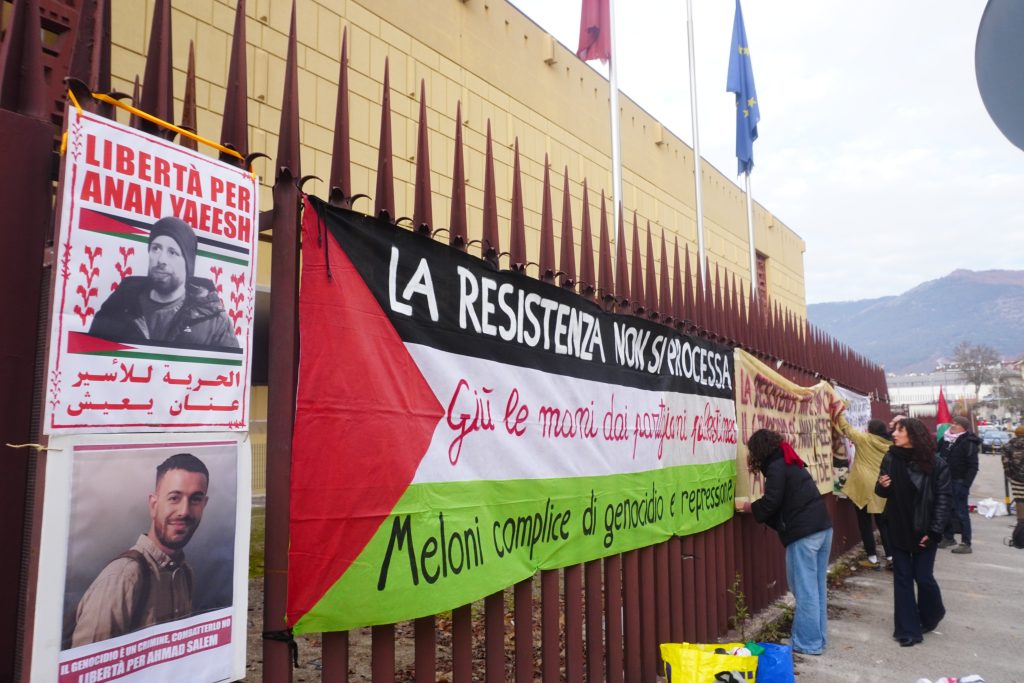
From the outset, Anan Yaeesh’s proceedings in L’Aquila drew supporters from across Italy. Hearings became focal points for demonstrations, public meetings, and solidarity initiatives. Giovani Palestinesi Italia (Young Palestinians of Italy) followed the trial throughout, organizing buses to L’Aquila, mainly from Rome and Bologna, alongside local solidarity networks.
The mobilization reflects a wider contradiction in Italy: a government complicit with the Israeli regime alongside broad popular solidarity with the Palestinian cause. This was evident again on October 10th, when thousands took to the streets in more than 50 Italian cities to demand an end to the genocide in Gaza.
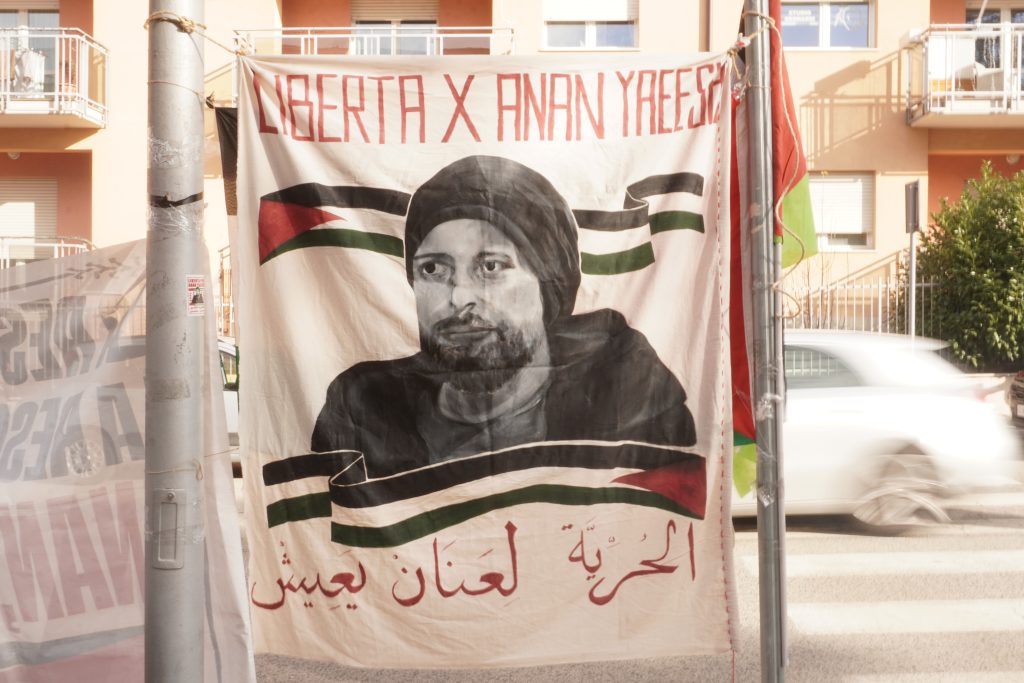
At demonstrations, Yaeesh’s face appeared on large, colorful banners and small black-and-white leaflets, becoming a rallying point for those opposing the criminalization of Palestinian resistance.
When the case returns to court in 2027, Yaeesh will still be behind bars. The appeals will determine the legal fate of all three defendants, but their significance extends far beyond the individuals involved: they will test to what degree the Italian law will allow Palestinians to assert their rights to fight an unlawful occupation and to stop an ongoing genocide.