People in Gaza love to tell our stories. As Mondoweiss’s Gaza correspondent, I find that every door is open for my questions, and it is a true honor to try to faithfully and clearly explain what life is like in Gaza to the rest of the world. Please help Mondoweiss continue to tell Palestinians’ stories with a year-end gift today.
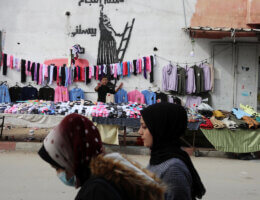
Global consumer inflation has caused food prices in Gaza to hike, making staple products in grocery stores unaffordable and worrying shop owners about the cost of restocking.
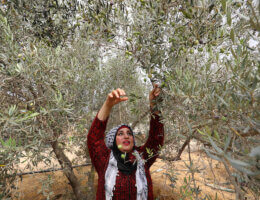
The olive harvest in Gaza was down by 65% this year, leaving many farmers without enough crop to sell. Experts say this dip was due to rising temperatures from climate change.
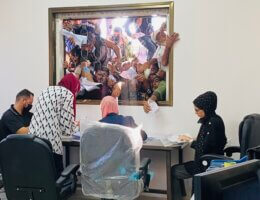
After Gaza’s Chamber of Commerce announced it would begin accepting applicants for work permits to Israel, tens of thousands rushed to apply. One photo of the scene tells the story of the devastation the Palestinian economy is currently facing.
Ibrahim Atta looks out at a dusty field of grasses on a hot Gaza afternoon in early fall and declares this land was once a fertile “piece of heaven.” Twenty years ago, he was earning an income from selling produce grown on this nine-acre family plot, but today Atta is no longer able to safely access the farm. The last time he tried to reach the land was in 2015. Israeli forces positioned on the other side of the fence “fired two tear gas bombs just under my feet,” Atta said. “I left and have not gone again. I just look at it from a distance and can’t get close, they may kill me.”
In late August students in Gaza headed back to schools where many are learning in overcapacity classrooms with up to three sharing a desk, as educators grapple to find places for pupils whose schools were bombed during a recent escalation with Israel.
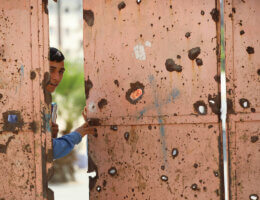
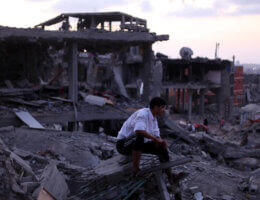
When it rains, it pours—inside Zoher Alsayd’s living room, kitchen and bedroom to be exact. Like many Palestinians, the former house painter’s home was wrecked by airstrikes during the latest escalation between Israel and Hamas earlier this year in May. And this was not the first time his roof was destroyed. Alsayd belongs to a growing group of Palestinians whose homes were damaged to the point of becoming uninhabitable, not once, but multiple times over the course of these four conflicts with Israel over the last 13 years.
Palestinians plan to continue protests at the fence separating Gaza and Israel this week, following clashes over the weekend where 24 protesters were wounded. “We can’t stand doing nothing while our people are suffering death due to Israeli siege,” Talal Abu Zarifa explained.
Reporter Tareq Hajjaj reflects back on the harrowing last few weeks in Gaza where he twice fled his home to escape Israeli attacks, and reveals the trauma of reporters who cover wars that they are also trying to survive.
At least 38,000 Palestinians have fled their homes and sought shelter in schools run by the United Nations as hundreds of houses were completely destroyed in airstrikes since last Monday. Tareq Hajjaj reports from Gaza where Palestinians describe a night of fear, running from their homes barefoot and gripping children in the midst of Israeli airstrikes and artillery fire.