Tag

Shireen Abu Akleh

Browsing

A long-delayed New York Times editorial on the killing of Shireen Abu Akleh bears the insulting headline, “Who Killed Journalist Shireen Abu Akleh?” As if the Israeli government position bears considering, “Palestinian gunmen” had killed her. When in fact, reporting over the past month (although not in the Times) makes clear that the only genuine questions are: Did the Israeli soldier who killed Shireen Abu Akleh target her on purpose? If so, who ordered it? And who in the Israeli chain of command is continuing the coverup?
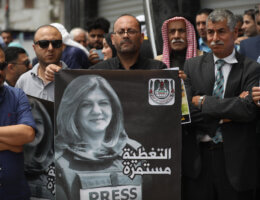
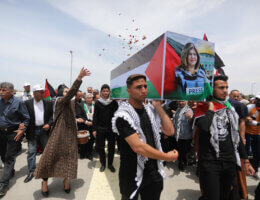
Israeli leaders are going crazy over the display of Palestinian flags– of course, because Israel is a Jewish state not a democracy. And an intellectual leader of the Israel lobby, Michael Koplow, admits the failure of Zionism in the reaction. “If waving a flag threatens Israel’s existence, then not only is Israel in far bigger trouble than anyone understands, but Zionism itself has failed.”

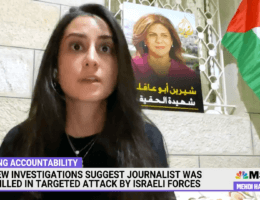
The American government continues to express faith in Israel’s ability to investigate the killing of Palestinian-American journalist Shireen Abu Akleh, but the good news is there is widespread contempt for such credulity. On MSNBC, Mehdi Hasan interviewed Shireen’s niece, Lina Abu Akleh, who said of State Department statements: “How many Americans have to be killed for the Biden administration to act?” While NBC’s Raf Sanchez documented that Israel buried any investigation of its killing of journalist Yaser Murtaja in 2018.

Even as Australia elected a Labor Prime Minister who opposes BDS and rejects the apartheid label for Israel, the country’s Israel lobby is moving further to the right, agitating against PM Anthony Albanese and backing the conservative coalition in politics. No matter what concessions Labor gives the lobby it will always oppose it. This is because the lobby is accommodating new right-wing voices in Australia and ultra-nationalists in Israel.

Palestinian journalists hold posters during a protest against the killing of Al Jazeera journalist Shireen Abu Akleh, who was, shot dead by Israeli troops as she covered a raid on the West Bank's Jenin refugee camp, in Gaza City on May 11, 2022. (Photo: Ashraf Amra/APA Images)

In the weeks after Shireen was killed, and in the face of countless efforts to discredit them, their experience, and their testimonies, these journalists persevered. Amidst all the trauma and grief they were experiencing, from losing a hero and friend, they chose to speak up, and continued telling the truth.

Mondoweiss Podcast, Episode 36: Confronting Antony Blinken over Palestine

Mondoweiss talks to Nooran Alhamdan, a recent Masters graduate of Georgetown University about the action she and other graduates took to confront Antony Blinken, the U.S. Secretary of State, over U.S. support for Israel.

Palestinian journalists hold posters during a protest against the killing of Al Jazeera journalist Shireen Abu Akleh, who was, shot dead by Israeli troops as she covered a raid on the West Bank's Jenin refugee camp, in Gaza City on May 11, 2022. (Photo: Ashraf Amra/APA Images)

A coalition called “No Rugers to Israel” can document over 200 Palestinians killed or injured by Rugers — now including Al Jazeera journalist Shireen Abu Akleh — though it believes the true number to be far higher. “For years we’ve been calling attention to sales of Ruger guns and ammunition to the Israeli military which is a serial human rights violator,” says Stanley Heller.

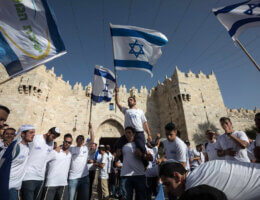
Settlers wave Israeli flags as they enter Damascus Gate as part of a nationalistic flag march in Jerusalem's Old City, June 2, 2019. (Photo: Afif Amera/WAFA)

On May 29th, fascist Zionist settlers held a flag march throughout Palestinian areas of Jerusalem’s Old City. Rotted to the core with colonial racism, this march was intended to celebrate Zionist forces’ seizure of East Jerusalem in 1967. But in the seeming surety of escalating violence, an anxiety about belonging lurks. A state defined by and through the negation of the native, through sanctioned racism and supremacy, is a state running on borrowed time. The settlers may have marched on Sunday. And they may have waved their flags. But their flag, like their state, will fall.