

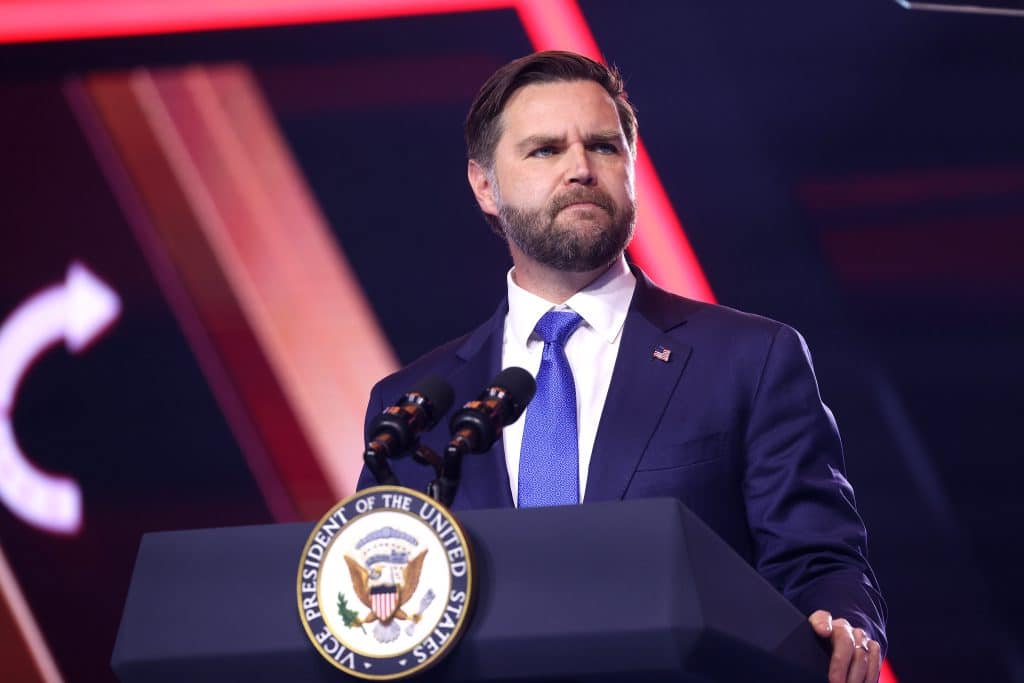
When U.S. Vice President JD Vance took to the podium after a long day of talks to end the American and Israeli war of choice on Iran, he made one thing clear. This had not been a serious attempt to reach a deal.
Although the talks went on for more than twenty hours, it’s just one day of negotiations. The very fact that the headline was that there had been no “breakthrough” in just one day displayed a fundamental lack of seriousness.
Despite Vance’s attempt at drama, neither side shut the door on continuing negotiations. The U.S. has even proposed extending the ceasefire, as Pakistani emissaries have arrived in Tehran to arrange further talks. Washington has even pressed Israel for a ceasefire in Lebanon, something that does not sit well with either Israeli Prime Minister Benjamin Netanyahu or the Israeli Jewish population.
At the same time, the United States has moved to block Iranian ships from using the Strait of Hormuz, a sort of counter-blockade, and has dispatched thousands more troops to the region.
What does all of this mean?
Trump wants a way out of this war, but does he have one?
It seems clear that Donald Trump realizes that this war has been a catastrophe for him, regardless of what he says publicly. As the global economy barrels toward recession, he sees little use in persisting. His only option is to increase pressure on Iran with more destruction, which would only bring more Iranian retaliation and lead to an even greater global economic catastrophe.
In that context, Trump’s move to “blockade Iran’s blockade” in the Strait of Hormuz is best understood as an attempt to appear strong before being forced to accept terms that end this war with Iran in a stronger position than it was before.
Trump even went so far as to force Netanyahu to accept a brief pause in Lebanon. That’s not an easy feat, as Netanyahu is reeling in Israel from the lack of positive results from the wars in both Iran and Lebanon. Israeli Jews support both wars but believe Netanyahu has not handled them correctly, based on the lack of tangible political gains for Israel since they began, in contrast to what they see as military triumphs.
But while Trump may want a way out of the war, finding that exit may still be difficult.
One option is for Trump to simply leave the ceasefire in place without an agreement. That means the Strait of Hormuz remains blocked, whether by Iran alone or by both Iran and the United States. Iran and Israel would continue to fight, but the fighting would likely be limited to those two countries, leaving the Gulf Arab states out.
That isn’t a very appealing option for Trump. He could talk about having “changed the Iranian regime,” but the reality of economic depression, ongoing fighting, and a strengthened Iran would be clear.
Moreover, Israel has been more vulnerable to both Iranian and Hezbollah attacks, as their supply of interceptors has dwindled. The U.S. can replenish them, but probably not at prior levels and not as quickly as Israel would need. The image of Israel getting pounded by Iranian and Hezbollah missiles is not one Trump wants his constituents to see.
Another option is simply to double down on force. Iran has already shown what the result would be if Trump chooses that option. Their recent attacks on Saudi Arabia’s East-West Pipeline, which serves as an alternative to the Strait of Hormuz for the export of oil, were a warning of Iran’s ability to do a lot more damage to oil exports from the region. Iran has also threatened to close the Bab al-Mandeb Strait in the Red Sea. Ansar Allah (the Houthis) in Yemen have shown they can do this at will and that there is little the U.S. can do about it.
The third option is a realistic agreement. This seems to be the one Trump wants to take. The problem he faces is that American demands are unrealistic, and the compromises he would have to make would be extremely hard to sell as anything but capitulation.
According to reports, the talks in Islamabad crashed on the key issues of Iran’s nuclear program, its support of armed non-state actors in the region, and control of the Strait of Hormuz.
That was backed up by the words of a U.S. official who told Axios reporter Barak Ravid that the American red lines were that Iran would:
- End all uranium enrichment;
- Dismantle all major nuclear enrichment facilities;
- Surrender all highly enriched uranium;
- Accept an American peace, security and de-escalation framework that includes regional allies;
- End funding for regional allies like Hamas, Hezbollah, and Ansar Allah;
- Fully open the Strait of Hormuz, charging no tolls for passage.
If the American spokesperson was accurate in calling those “red lines” rather than negotiating points, they’re non-starters.
Iran has offered to suspend all nuclear enrichment activity for five years, countering a U.S. demand that they agree to a twenty-year suspension. Iran had, before the war, agreed not to stockpile enriched uranium, which would make it impossible for them to ever accumulate enough nuclear material for a bomb.
But Iran is not willing to sacrifice what it sees as its national right to enrich its own uranium for civilian use, something permitted them under the Nuclear Non-Proliferation Treaty (NPT) to which they are a signatory, and, notably, Israel is not.
Demanding Iran give up that option is not realistic. Yet that very unrealistic demand has been made more pressing by the war itself. By attacking Iran, Israel and the United States have reinforced the evidence for what happens to countries that abandon the pursuit of nuclear weapons. Iran can look at itself along with Libya, Iraq, Syria, and Ukraine on one hand and North Korea on the other to see this obvious logic.
The path out of that paradox is Iran’s returning to the nuclear monitoring that it agreed to before Trump tore up the nuclear deal, and the U.S. accepting that Iran can enrich its own uranium, within reasonable limits. That creates a mutual deterrence; Iran would have to break off the inspections to even begin enriching uranium beyond its immediate needs, which it wouldn’t do unless the U.S. and Israel continue their belligerence.
It appears that such a resolution would be acceptable to Iran, but it would mean a significant climbdown for Trump. And, obviously, Israel will not accept it and would have to be strictly restrained by the United States. Yet it remains the only reasonable way out.
It is notable that there was no mention of Iran’s missile and drone capabilities among the red lines. That seems to imply that the United States has already backed away from a condition that amounts to convincing Iran to disarm itself in the face of not only American and Israeli aggression but also the understandably renewed hostility toward it from the Gulf Arab states.
That realization by the Americans reflects someone getting in Trump’s ear and making some headway on issues that are just absurdly unrealistic. Similarly, while Vance might have included support for non-state allies in his talks, that has not featured prominently in White House statements or in Trump’s stream-of-consciousness ramblings since the talks in Islamabad.
The nuclear issue seems to have the most prominent position, and that is always better. It is the issue on which Iran has the most flexibility, largely because it is based on Western fears and propaganda more than it has been based on reality until now. Yes, the war has probably made Iran’s nuclear ambitions much more real. The death of Ayatollah Ali Khamenei means his fatwa against nuclear weapons is no longer in effect, and, as noted, Iran has been given much more incentive to pursue a nuclear weapon than ever before.
Still, the fact that they were even willing to offer a five-year suspension of nuclear activity and have not stated any opposition to the idea of international inspectors would indicate that Iran is open to significant compromise on the nuclear issue.
The Strait of Hormuz may be more problematic. Iran has always and will always have the ability to disrupt shipping in the Strait. No American threat or international anger can change that simple fact of geography.
On the other hand, while neither Iran nor the United States has ratified the UN Convention on the Law of the Sea, which guarantees safe and unimpeded passage to peaceful vessels through many waterways including the Strait, most of the world views Iran’s threats to passage in the Strait and to its plan to collect tolls for passage as unacceptable.
Iran wants to use its ability to threaten passage through the Strait to help press for the reparations they need and, more importantly, to ease the sanctions that have restricted Iran’s ability to participate in the global economy, particularly regarding trade with Asia and Europe. It is likely that they would abandon the legally dubious idea of collecting tolls in the Strait if they can re-enter the Asian and European markets and receive reparations for this war.
Again, though, this would be a huge concession from the United States. It would be impossible to sell such a concession as anything but a massive defeat, even to Trump’s most sheepish supporters. Iran would be significantly stronger and economically healthier than it was before the war. There’s no way to dress that up.
Israel’s Lebanon land grab
Finally, there is Lebanon. Trump surely had to exert extreme pressure to get Netanyahu to agree to a ceasefire, even a brief one.
Israel has not tried to hide the fact that this aspect of the war is a pure land grab. Netanyahu intends to extend Israeli control, if not its border, north to the Litani River. He is not about to abandon that goal lightly, even if he is forced to accept that his long-sought war on Iran is a failure.
The talks in Washington between Israel and Lebanon are a farce. No agreement there is possible, because what Israel wants is a permanent presence in Lebanon and the disarmament of Hezbollah.
This Lebanese government would be open to a reasonable agreement with Israel, but those terms are obviously unreasonable. No country, especially not one as small as Lebanon, would simply give up a huge chunk of its territory.
But this Lebanese government wanted to address Hezbollah. They wanted to bring Hezbollah into the Lebanese military, thus disarming them and integrating them into a single, national force. That was never going to be easy, but Israel never stopped attacking Lebanon during the so-called “ceasefire” brokered in late 2024. If they really wanted the Lebanese government to eliminate Hezbollah as an independent fighting force, that was exactly the opposite of what they would have done.
The Lebanese are attending these meetings to help convince Trump to rein Israel in. Israel is doing it to convince Trump that they are willing to cooperate with his effort to end the Iran war. In both cases, the effort is merely a show.
Trump will take the exit from Iran as soon as he can find it, and Israel will find it hard to bring him back in again now that he has seen why all other U.S. presidents didn’t fall for Netanyahu’s “bomb Iran” pitch. But he will have little reason to exert the political influence that would be needed to keep Israel from occupying southern Lebanon permanently. Israel and Iran will also likely continue lobbing missiles at each other, even though Israel’s ability to fight Iran without direct American support is extremely limited.
That’s the best-case scenario for Trump, and it’s not a good one. It is entirely possible that, rather than admit a huge defeat, he will decide to keep fighting Iran to no possible better outcome.
Trump made this bed. He can either lie in it or take one of the less disastrous options to get out of it. Unfortunately for the world, he is not a man prone to making good decisions.

I am wrong and Mr.Plitnick is correct a fatwa in shiism if comes it from your marja is considered binding and upon his death is rescinded, apologies. I asked an al khoei who called for an unrelated reason. it’s not like that in sunni practise, can one never safely assume, i thought it would be ok this time.
“Iran would be significantly stronger and economically healthier than it was before the war. There’s no way to dress that up.” That is also the conclusion of Robert Pape** . From a week ago:
The War Is Turning Iran Into a Major World Power….Roughly one-fifth of the world’s supply of oil and liquefied natural gas moves through the strait. There are no real alternatives to these supply routes in the near term. If Iranian control over the strait persists for months or years, as I believe it may, it will drastically reshape the global order to the detriment of the United States….The United States faces a difficult choice: either commit to a long-term effort to reassert control over the Strait of Hormuz, or accept a new global energy arrangement in which U.S. control is no longer assured….If it chooses acceptance, the outcome is clear: The international system will reorganize with Iran as a fourth center of global power. Yet if the United States chooses to reassert military control, it is in for a long battle, one it could well lose….
Opinion | The War Is Turning Iran Into a Major World Power – The New York Times
Another consideration about this stupid, stupid war:
U.S. intelligence detects signs China is weighing giving Iran advance radar systems…
U.S. intelligence detects signs China is weighing giving Iran advance radar systems – CBS News
**
professor of political science at the University of Chicago, where he directs the Chicago Project on Security and Threats.
“The death of Ayatollah Ali Khamenei means his fatwa against nuclear weapons is no longer in effect”
Np, no Fatwa is ever in effect it is an opinion a scholars considered opinion, that is all, look it up if you don’t believe me it is advice for those who wish to act according to fiqh or deep understanding, you can ignore any futawa should you so choose they have no force and there are always a variety of scholastic views on any and everything.
The fatwa prohibition on both the production, possession, and use of nuclear weapons remains in effect until a qualified Mujtahid or Marjaʿ al-Taqlid issues a new ruling through ijtihad that revises or replaces it, for example someone like Grand Ayatollah Naser Makarem Shirazi. Mojtaba Khamenei is not qualified to change the fatwa, as he is not a Marjaʿ or authoritative Mujtahid with independent legal authority, and his role is political rather than jurisprudential.
However, changing the fatwa under today’s religious consensus and power structures is unlikely.
At least it has more guarantees than any US or Israeli ceasefires or treaties from their expansionist “crazy bastards” and civilization-annihilating terrorists, given their complete disregard for international law and humantiarian law.
It looks like Trump pretended to began a ceasefire to manipulate the US stock market before the weekend. Then he and Israel reversed course with the blockade and more violence in Lebanon.
This has been the same game for years.