There is a long history of the U.S. opposing ceasefires when Israel wants to continue bombing.


There is a long history of the U.S. opposing ceasefires when Israel wants to continue bombing.

It is not a coincidence that Israel decided to remind us of its original sin, namely, the Nakba, by celebrating its “independence” in Sheikh Jarrah and Gaza. By committing the Wehda Street massacre, it has taken the so-called “conflict” to its origin.

Over 100 leaders in the Democratic Party call on the Biden Administration to end support for Israeli human rights abuses in Palestine. “Otherwise,” the letter says, “any and all Eid greetings ring hollow.”
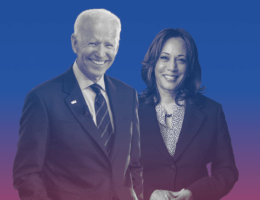
“If anything, Biden is simply picking up where Trump left off when it comes to Israel.”
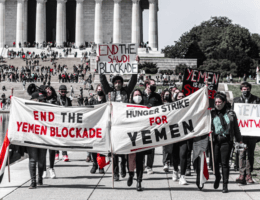
On March 29, activists with the Yemeni Liberation Movement (YLM) launched a hunger strike in Washington DC to demand that the United States end its support for the Saudi-led blockade on Yemen. Michael Arria spoke with spoke with YLM organizer Monica Isaac about the strike, the Biden administration’s response, and how activists have pushed ending the Yemen blockade into the political conversation.
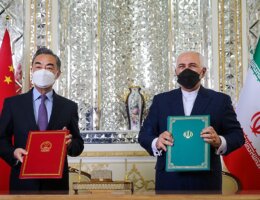
This weekend, Iran and China signed a 25-year cooperation agreement which will cover economic, political, and cultural relations. Juan Cole writes that China’s entry into Iran is the most consequential change in the geopolitics of the Middle East since the the collapse of the Soviet Union.

Joe Biden and his associates appear demonstrably incapable of exchanging the history that they know for a history on which our future may well depend. As a result, they will cling to an increasingly irrelevant past. Under the guise of correcting Trump’s failures, they will perpetuate their own.

Dropping bombs on the Middle East is a rite of passage for modern Presidents and last week Joe Biden officially joined the club.
Based on initial statements from the Biden Administration it appears the president has told his State Department he is not spending any political capital to fight the Israel lobby.
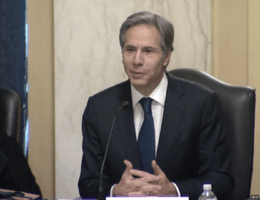
The Biden administration may be looking to overturn many of the Trump administration’s policies — but not when it comes to Israel.