David Shulman‘s December 4 report from the Sheikh Jarrah evictions in East Jerusalem ran a few days ago at Ibn Ezra. His story is upsetting and important. It is worth noting that the our press has done a lousy job of covering this continuing outrage, at a time when liberal forces in Israeli and Palestinian society are crying out for help against intolerance and human-rights abuses. (Though I believe the family with which Shulman begins his account was documented by Rina Castelnuovo at the Times.)

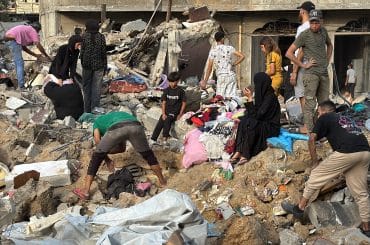
Exhibit A. Kindly examine the attached photograph. Let’s make an inventory. Three stuffed animals, two face up, one face down. The yellow-and-red one, half animal half cushion, has an inscription: "I love you." One school bag. Two unidentified red toys. Five pieces of yellow lego. One armless, legless doll. One yellow brush with blue bristles. An Arabic newspaper. A broken pole wrapped in red cloth. A broken flower, perhaps freshly cut, probably thrown out with the vase it sat in.
I don’t want to overload your inbox, so I won’t add more pictures of this patch of ground in front of the al-Kurd family’s house in Sheikh Jarrah. I can tell you what’s there. A kitchen stove, its glass top shattered, green splinters everywhere. Broken microwave lying on its face. Pieces of bicycle and a children’s tractor. Shoes, mostly children’s. Many more pieces of lego. A few pots and pans. Some sheets. Boxes of odds and ends—cellphone, cords, electric wire. Plastic shovel for playing in the sand.

Exhibit B. See attached photograph. Immediately adjacent to the above: Border Policemen outside the door of the house, now inhabited by Israeli settlers. The police are there, needless to say, to protect them. Note the Israeli flags strung over the windows, just to rub it in. The people taking photographs and milling around are Israeli peace activists who came for today’s protest march: ordinary people, shocked by what is happening in Sheikh Jarrah and angry enough to spend this Friday afternoon on the long walk through downtown Jerusalem, then along Road Number One which divides east from west—the future border between the Israeli and the Palestinian cities– past the American Colony Hotel and the neighborhood mosque to this street where, as of Sunday, a third Palestinian family has been violently expelled from its home.
We’re riding a wave of such expulsions.
Last Friday we were here, Eileen and I, in this very courtyard, before the court ruling; we spoke at some length with the eloquent, moderate father of the al-Kurd family, who told us the story in gentle Arabic. He had told it many times that day.
"We were refugees from Haifa in 1948. Everyone in this neighborhood is a refugee, some from Lydda and Ramla, some from Jaffa. After the 1948 war, the Jordanian government gave us these plots of land to build on, in exchange for our UNRWA cards. The cards were worth a lot of money, but we wanted to live normal lives in our own houses, so we gave up our status as refugees. We have lived in this home since the 1950’s. The Israeli settlers claim the land belongs to the Jews and they went to court, for years we were in the courts. But this is my house, it is our home, I built the annex in the front and planted the fruit trees. Now the court has ordered the annex to be sealed off and they forced us out. Settlers came with the soldiers in the night and started throwing our possessions outside, just like that, and they hit us, one of them grabbed my daughter by the throat and tried to strangle her. They are very violent. We cannot live with them. They hurt us and they insult us and they are thieves and the soldiers help them. The court has left us, for now, with the back part of the house; the front is locked and sealed. On Sunday the court will decide finally. I don’t believe they will force us to leave. I don’t believe they can be so unjust. Come meet my mother, she will tell you."
We peeked through the window: his mother was sleeping, the afternoon receding into night. We sat with him for a few moments in the tent he has put up in the courtyard across from what used to be his front door. His wife, a handsome, modern woman, rushed into the back of the house and emerged with a box of baklava to offer us; it was ‘Id al-Adha, the Feast of Sacrifice, when guests are especially welcome.
Then on Sunday the court ruled in favor of the settlers, and they moved in immediately with the soldiers to back them up, as is normal in East Jerusalem these days. That’s how the lego and the stuffed animals landed up in the courtyard.
This is the third recent eviction in Sheikh Jarrah—after the al-Hanun and al-Ghawi families lost their homes to settlers– and six more families have already received court orders preparing them for this same fate. We’ve tried our best to stop it, we’ve run an international campaign, we’ve kept volunteers in the houses and protesters outside, we’ve done what we could in the courts and the press, and we’ve failed and will no doubt fail again unless some of you who read this report find a way to bring effective pressure to bear. Let me say at once: the legal situation in Sheikh Jarrah is complicated, but it’s also largely irrelevant. The settlers, through what is called the Sephardic Community Committee, have produced documents to support their claim that these plots of land belonged to Jews during the Ottoman period, over a century ago. Ergo, they must be restored to Jewish hands (like all the rest of Palestine? And what about the hundreds of Palestinian houses in West Jerusalem now inhabited by Jews? No Israeli court is about to return them to their original owners.). All the Palestinian families who live here received the land from the Jordanian government, as Mr. al-Kurd said. They are large families; two generations have been born and grown up in these houses. The whole question has been in the courts for decades, and the rulings have sometimes favored the Palestinians, at other times the settlers. I’m not about to make any judgment relating to the legal niceties.
But make no mistake: these expulsions are first and foremost political acts. They are part of a sustained, constantly ramifying campaign to plant colonies of fanatical Jewish settlers in the heart of Palestinian neighborhoods all over East Jerusalem, at the same time driving out whatever Palestinian families happen to be in the way. The courts merely provide the fig leaf (and the municipality and the government provide the soldiers). If you have any doubt, you have only to look at the settlers who have moved in; you can watch them any evening, gloating from the rooftops at their victims, some of whom now live in ramshackle tents they have put up on the street across from their homes. The police have cruelly demolished even the al-Ghawi tent at least five times. I’ve sat there with the family on cold winter nights, and I think I won’t try to describe how it feels. The settlers also have a habit of viciously attacking the Palestinians whom they’ve displaced; sometimes fist-fights develop, as happened earlier this week, with the unsurprising result that the Palestinians—in this case two young men from the al-Kurd family and a third from another family—were arrested and sent to jail. Not only have they been evicted from their home; they also get to spend time in prison, for good measure. When the Channel 2 news reported on events in Sheikh Jarrah on Wednesday night this week, the mainstream announcer offered his Israeli audience a one-line moral to the story: "Palestinians in East Jerusalem don’t obey the orders of the court."
Would you?
Marching through the city this afternoon was a lot like old times—say the days of the first Lebanon War in 1982, when to join a peace demonstration was like running a gauntlet of hostile, jeering crowds, who would often punch you or spit at you as you passed. Today we were sixty or seventy, maybe a bit more, hardly a vast horde. One happier thought: a good half of the group was made up of young people (early 20’s), committed, lucid, fearless, full of life and energy. They are the future of the peace movement here, if it has a future. I saw four or five of my honors students, and also two children, now fully grown, of veteran activists I have known. People emerged from their shops on the Ben-Yehudah pedestrian mall to curse us, and someone on a high balcony over the street tried to blast us with water from a hose, and there were some who tried to hit us as we moved through town, beating our drums, crying out old, rather useless, weather-beaten words like "Thou shalt not steal" and "Thou shalt not murder" and "You can’t build a democracy on murder and theft" and then, in Arabic as we moved east, "No to the Occupation," and so on.
As we passed the hospice near Notre Dame, the male nurses in their white caps—all Palestinian—came out onto the roof to watch us, and when they read the Arabic signs we were carrying they suddenly broke into smiles and raised their thumbs to cheer us, so maybe it was worthwhile just for that. A little farther along, deep in East Jerusalem, religious Jews poked their heads out of the windows of the huge hotel they inhabit to yell "Death to Arabs!" So it goes in the Holy City. We filled the courtyard of the al-Kurd house and spilled over into the street outside it; I can’t help wondering if the settlers inside the house felt at least a little uneasy listening to our cries urging them to get out, to return the theft; or if a tiny seed of doubt took root in the mind of, say, just one policeman. It’s not totally impossible, is it?
A Friday afternoon, pre-solstice, just before Shabbat comes in, the cold sun slowly sinking. "Are you glad you came today?" I asked Eileen, and she answered, "It took a long time, and I had so many things to do. But next to this, everything else seems less important."