

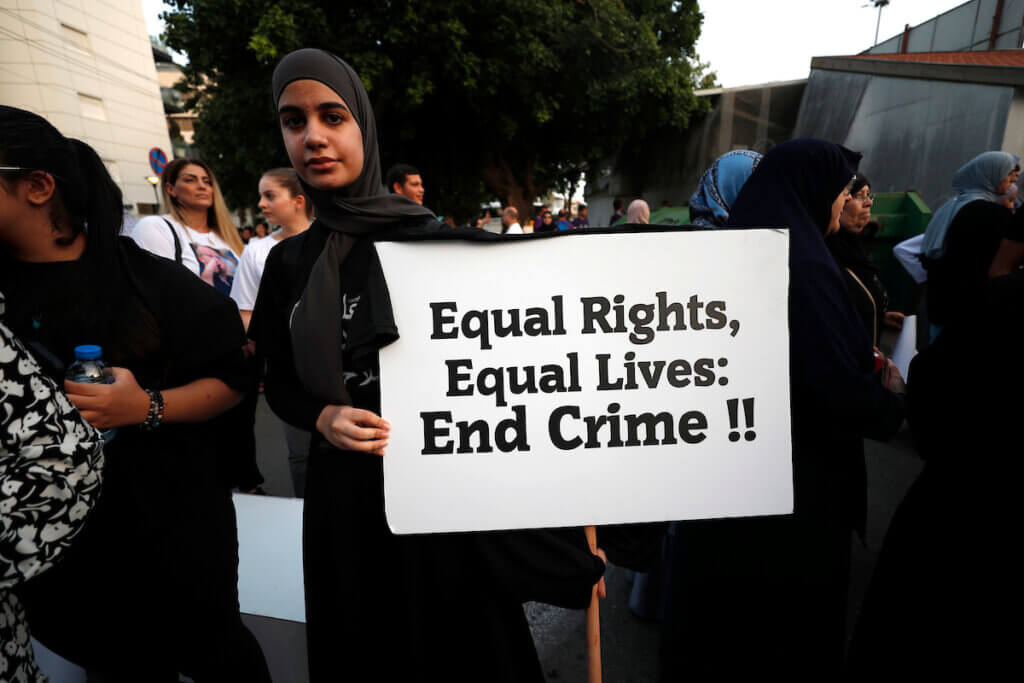
In mid-July, the Israeli government gave its final approval to allocate more than half a billion shekels to establish a special unit within Israel’s internal security agency, the Shin Bet, with the aim of integrating it into efforts to combat organized crime among Palestinians who hold Israeli citizenship.
In doing so, the government has effectively transformed what should be a simple matter of criminal law enforcement — which falls under the responsibility of the police — into a national security issue requiring the intervention of the same intelligence agency that forms the security backbone of Israel’s occupation of the West Bank and Gaza. This shift has taken place without any serious examination of why the police have failed to address the problem of endemic crime and intra-Palestinian violence, which has reached catastrophic levels among Palestinian citizens of Israel over the past several years.
Since the beginning of the year and through June 28, 131 people have been killed, alongside hundreds more injured, due to organized crime in the communities of Palestinians who live inside “the 1948 territories” — the term Palestinians use to denote Israel proper, since it is the land where Israel established its state after the 1948 Nakba.
The decision to involve the Shin Bet became the subject of debate among Palestinian citizens of Israel, commonly referred to as “the ’48 Arabs,” or “the ‘48 Palestinians.” Most Arab political parties and civil society organizations overwhelmingly opposed the move due to the political risks posed by the security agency’s involvement in a strictly civilian matter. But some voices also supported and welcomed the decision.
The very fact that a debate is even happening is itself a huge shift in the ‘48 Palestinian community, after decades of refusing any Shin Bet involvement in the efforts to combat the Palestinian crime epidemic. That some are even receptive to the idea underscores just how far the crisis has escalated.
Nearly every day, at least one person — and sometimes more — is killed in gang violence inside the ‘48 communities. Entire families have been torn apart, towns have been destabilized, and many people have been forced to leave their homes in search of security in an environment that is no longer safe.
More importantly, the receptiveness to the Shin Bet shows the profound sense of helplessness among many Palestinian citizens of Israel, which has led some to call for any solution to the crisis, even if it means voluntarily allowing the Israeli surveillance state to further penetrate their communities.
But this inflection point has been years in the making. In 2025, the homicide rate for “Arabs” in Israel was 16 people per 100,000 residents, whereas for Jews it was 1 per 100,000. According to official police data, 76% of the 961 victims of homicides (recorded across 891 incidents in Israel) were Palestinians, while only 19% were Jewish, and 6% were classified as “Other.” Yet Palestinians only make up about 21% of the Israeli population, amounting to approximately 2.2 million Palestinian citizens.
In the context of this huge disparity, Palestinians organized a wide wave of protests across the ‘48 territories in February 2025, erupting in response to the conditions that the Israeli state had created for its “Arab” citizens.
The protests were monumental, culminating in a largely successful general strike and a demonstration that drew tens of thousands of Palestinians. Given the fact that the protests emerged on the heels of a two-year genocidal campaign in Gaza, a comprehensive assault on the West Bank, and a merciless crackdown on Palestinian citizens of Israel — who entered a period of unprecedented political quiescence as a result, with hardly any significant mobilization or large-scale protests to speak of — considering all this, the turnout was impressive. It was also the first time the ‘48 territories witnessed a movement of this scale against crime and social violence.
But it ultimately did not amount to anything, and the reason it didn’t is a reflection of the political and social paralysis that has gripped Palestinian society in the ‘48 territories, rendering them unable to formulate a political project that can both address the social ills of organized crime and tie it to a broader political program that links up with fellow Palestinians across the Green Line.
If anything, what came after the protests only further put Palestinian communities at the mercy of the Israeli surveillance state, with the Shin Bet poised to expand intelligence operations under the guise of combating crime. But this is only a symptom of the isolation of Palestinian citizens of Israel from the broader Palestinian political project.
Two decades of social and political disintegration
Palestinian political parties in the ‘48 territories largely base their political action around the demands for citizenship and equality within the Israeli state. The problem is that such demands have continued to be made of a colonial project that defines itself as an exclusively “Jewish state,” and which has continuously narrowed the margins of legal citizenship in favor of what is called the state’s “Jewish character,” exemplified by the 2018 Nation-State Law. Over the past two years, this trend has escalated into the criminalization of freedom of expression, political activity, and even the expression of national identity.
But the question remains how we got here.
Many consider the year 2000 as a pivotal turning point in understanding the spread of organized crime and internal social violence. That year marked a decisive moment in the relationship between Palestinians inside Israel and the Israeli state, as well as in their relationship with their fellow Palestinians on the other side of the Green Line.
For the first time in years, Palestinian citizens of Israel clearly and explicitly declared their political belonging when they rose up alongside the rest of the Palestinian people at the outset of the Second Intifada. In the ‘48 territories, it was called “the Jerusalem and Al-Aqsa Uprising,” or the “October Uprising,” and was one of the key historical moments in which Palestinians in the ‘48 territories reconnected with the broader Palestinian consciousness after the Nakba of 1948.
But when state security forces went out and killed 13 young men after they protested in solidarity with Palestinians in the West Bank and Gaza Strip, a parallel rupture emerged. The state effectively began to regard Palestinians as enemies after years dominated by a discourse of rights, citizenship, and integration that accompanied the signing of the 1993 Oslo Accords and the founding of the National Democratic Assembly party, which advanced full citizenship as a political project.
This change coincided with Israel’s neoliberal shift, widespread privatization, and a boom in the high-tech sector, and within this transformation, Arabs were structurally marginalized, leading to a further widening of disparities. Arab towns — prevented from expanding and hemmed in by settler highways and Jewish localities — became pockets of poverty and unemployment.
The result was a fierce retaliatory assault by security services on political activity and political parties, which also intersected with a broader decline in the Palestinian political scene following the end of the Second Intifada in the mid-2000s.
This led to a weakening of central political forces represented in parliament and a general retreat of political action. Almost in tandem, crimes rates started to climb, a trajectory evident in the steadily rising number of crime victims from 2000 onwards. While the annual number of Arab victims between 1980 and 2000 never exceeded 34, in the following years, it began to jump — sometimes reaching 80 victims, and never falling below 56.
The trend continued to increase in the following decades. After 2020, the numbers began to exceed 100, and during the years of the genocide in Gaza, the number more than doubled — reaching 244 victims in 2023, 230 in 2024, and 252 in 2025.
It wasn’t just a quantitative increase either. The nature of the crimes, their motivations, and their dynamics also changed. What were once considered red lines were being regularly crossed, such as the killing of women, children, and the elderly, or the killing of innocents simply for being in the wrong place at the wrong time. This is compounded by a process of social disintegration in which traditional social structures have lost their power and control over younger generations.
How crime families became part of the system
But the more profound transformation was the integration of organized criminal gangs into the very system of control. They started to dominate some centers of local governance, such as municipalities, which have historically functioned as social and economic power centers in the lives of Palestinians inside Israel, receiving budgets from the state. These gangs also became a parallel market for lending and debt collection within a society whose towns sit at the top of the poverty scale. It is important to note that, according to the 2025 data, Arabs have the highest proportion of families living below the poverty line (37.6% of Arab families).
Over the past two years, a new form of organized crime known as the khawa — a kind of local protection racket — has spread. This involves payments made by business owners or high-income employees to criminal gangs or groups in exchange for “protection.” If payments are not made, shops or individuals are shot at.
These payments have become a heavy burden on businesses already struggling financially, leaving shop owners unable to protect their employees, property, or family members, who are threatened by the owner’s refusal to pay criminal organizations. The spread of this form of organized crime across nearly all Palestinian areas ultimately drove the recent wave of protests.
It began when the owner of a bakery in the Galilee city of Sakhnin announced a strike and closed down his shop of his own volition, refusing to pay the khawa. He could no longer make a profit, and the business’s very existence had become a danger to his family. A large wave of popular solidarity followed, initially led by business owners who joined the strike and closed their shops after the khawa had effectively become a silent “business partner,” taking a share of their profits and creating a fully integrated parallel economic system in which millions of dollars circulate annually.
This is compounded by the spread of the black market, which has become a parallel lending system in which debts are collected through killing, intimidation, and exorbitant interest rates, forcing people to sell their shops and homes to get out from under it. A report issued by the Aman Center for monitoring violence in Palestinian society in Israel confirms this, noting that 25% of crimes in 2024 were due to social, familial, and economic reasons.
Symptoms of political collapse
Under occupation, national liberation movements, or social structures such as clans and families — or an alliance between those holders of political and social legitimacy — typically prevent colonized societies from sliding into crime. The former organizes and builds an overarching identity that supersedes local identities, creating the social cohesion necessary for a safety net; the latter exercises control through family hierarchies and customary laws that make crime socially and economically costly, effectively serving as a civil law in the absence of a just state under occupation.
But for Palestinian citizens of Israel, this model no longer exists. Because they are citizens, the Israeli government is ostensibly tasked with combating crime as the party that holds a monopoly over violence, but as a colonial state that views its non-Jewish citizens through an orientalist lens, treating killing and death as inherent traits of Arab and Eastern culture, that part of the social contract between that state and its non-Jewish citizens falls apart. On the contrary, the Jewish state continuously exercises violence against its Palestinian citizens by criminalizing the very political activity that has curbed internal violence among them, while refraining from exercising the “normal” violence of the state to enforce order, despite having the capacity to do so.
This is made all the worse by the fact that the political and national movement representing ‘48 Palestinians does not today present itself as an alternative to the state.
This was clearly evident in the 2025 protests and general strike. Rather than showcasing a kind of political revival, it actually represented the political fragmentation and social disintegration of ‘48 Palestinians, which could be gleaned in how the protests began: with an individual initiative from a business owner who had exhausted all other options, only to be belatedly joined by political forces such as the Higher Follow-Up Committee of Arab Citizens of Israel, an umbrella organization representing ‘48 Palestinians outside of Knesset.
In other words, the leadership followed the street, rather than the strike being part of a pre-planned strategy.
The protests were also unique for a number of other reasons. First of all, they were directed inward, toward Palestinian society itself. The main slogan called for the protection of Palestinian children in the community, while the discourse toward the police — representing the state — accused them of complicity and of a failure to fulfill their role.
Secondly, there was a complete absence of a clear political discourse or a national position that situated crime within the framework of occupation and colonialism. Instead, the protests were framed as a civic grievance, with calls not to politicize the protests. Often, this was justified by the claim that politicization would grant the state the pretext to escalate its crackdown on Palestinian citizens, especially in the context of a resurging Israeli hostility to any expression of Palestinian identity, which would treat protesters as the enemy.
Such calls are ironic, because it was the very crackdown on political organizing and nationalist sentiment that caused the meteoric rise in crime and violence among ‘48 communities. And then, when crime rates skyrocketed, agents of the Israeli state said that crime was just a part of the “Arab mentality,” as voiced by Israel Police Commissioner Kobi Shabtai in April 2023.
In the end, the same reasons that drove tens of thousands to take to the streets and participate so widely are also what limited the protests’ continuation. They had emerged spontaneously as a reaction to pain, exposing the deep problems facing ‘48 Palestinian society. One of those problems is the absence of a vision capable of transforming mobilization into a sustained plan for confronting a criminal system that itself doesn’t separate between the political, the social, and the economic. Masses without structures or clear visions find it difficult to persist on their own, especially amid a moral collapse that is one of the primary drivers of violence.
At the same time, the protests brought to the surface important political debates about the movement’s identity, the question of politicization, the public sphere, and who controls it: organized crime, political forces, business owners, or local government. They thus became a clear expression of a political-social condition without a compass.
That lack of a political compass has now led some Palestinian citizens of Israel to welcome the Shin Bet into their midst.
Razi Nabulse
Razi Nabulse is a writer and researcher at the Institute for Palestine Studies

Inequality and Diverting Budgets from Arab Society | Association for Civil Rights in Israel
Investment in Palestinian communities in Israel lags far behind investment in Jewish communities; it’s one of the signs of apartheid
Given the backing Israel has given to armed gangs in Gaza, this sounds like an attempt by Shin Bet to find out who they need to talk to to repeat the exercise.
It seems as though Trump’s DHS/ICE is using the same tactics in America.
There are reports this week that the FBI will no longer investigate ICE violence. The DHS/ICE will self-regulate themselves.
The IDF and extremist settlers now operate in the West Bank and elsewhere with no oversight or consequences. The same seems to be true with ICE in the United States.
The rule of law has been discarded for people of color and the “others” in these two fractured Democracies.
As is glaringly obvious, Israel’s racist strategy is to foment poverty and despair amongst Palestinian Israels which predictably leads to a rise in organised criminality (modelled on the organised criminality of the Israeli state and its agencies) which leads to Palestinian Israelis demanding more Israeli state policing of their own communities. The same happened in the USA amongst poverty-ridden Black communities. The only solutions lie in working class solidarity leading to socialist overthrow of the Israeli state.
This incisive article reminds me of the situation during the Spanish Civil War when the Stalinist betrayal of the people, the lack of a revolutionary vanguard party led to the workers’ defeat to the fascist Franco. I know the situations of the Spanish Civil War and the Palestinian rebellion against Israeli occupation and genocide are very different, but there is a similarity in the action of the people and the lack of leadership. As Trotsky wrote “Only on the basis of a study of political processes in the masses themselves, can we understand the role of parties and leaders, whom we least of all are inclined to ignore. They constitute not an independent, but nevertheless a very important, element in the process. Without a guiding organisation, the energy of the masses would dissipate like steam not enclosed in a piston-box. But nevertheless what moves things is not the piston or the box, but the steam.” The article states: The protests were monumental, culminating in a largely successful general strike and a demonstration that drew tens of thousands of Palestinians. … But it ultimately did not amount to anything, and the reason it didn’t is a reflection of the political and social paralysis that has gripped Palestinian society in the ‘48 territories, rendering them unable to formulate a political project that can both address the social ills of organized crime and tie it to a broader political program that links up with fellow Palestinians across the Green Line.
This is made all the worse by the fact that the political and national movement representing ‘48 Palestinians does not today present itself as an alternative to the state. … Secondly, there was a complete absence of a clear political discourse or a national position that situated crime within the framework of occupation and colonialism. … One of those problems is the absence of a vision capable of transforming mobilization into a sustained plan for confronting a criminal system that itself doesn’t separate between the political, the social, and the economic. Masses without structures or clear visions find it difficult to persist on their own, especially amid a moral collapse that is one of the primary drivers of violence. … That lack of a political compass has now led some Palestinian citizens of Israel to welcome the Shin Bet into their midst.” Thank you for this analysis.