A search of the archives show how little has changed

Yousef Munayyer's post earlier today have highlighted the weakness in Ethan Bronner's version of the events in 1947-49, quoting from the reports of the time from the New York Times itself. Similarly refreshing insights can be found in the archives of other publications. I am currently working on my second book, which will focus on the Palestinian citizens in Israel. Consider this article from Time magazine in 1979, and ask yourself whether extracts like these would be printed today:

Last week the Israeli Cabinet proposed a harsh plan that would empower the government to seize 37,500 acres of Bedouin lands, with limited compensation but without right of judicial appeal, and to impel the displaced tribesmen to resettle into new industrial townships...

Abhorring the very idea of living in industrial townships, the Bedouins argue instead for the creation of their own moshavim, the model agricultural cooperatives that have been especially successful in the northern Sinai. But Israeli government officials have long insisted that the tribesmen are needed as a labor force for new industries that are planned for the Negev. Moreover, the well-equipped, high production moshavim require large tracts and expensive irrigation. And, as one senior official bluntly told TIME's Lesley Hazleton, "I'm not giving good Jewish land and water to Arabs."

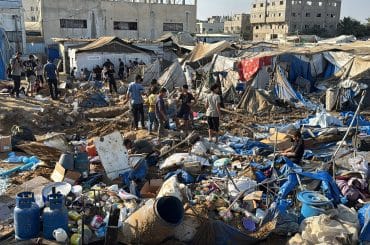
The evacuated Bedouins could well have nowhere to go at all for some time. The four new proposed industrial settlements have yet to be built, and the government has no plans for temporary housing. Shrugs Benjamin Gur-Arieh, Premier Menachem Begin's adviser on Arab affairs: "They can double up in their tents until the villages are ready. They're used to it."

About Ben White

Ben White is author of 'Israeli Apartheid: A Beginner's Guide' and 'Palestinians in Israel: Segregation, discrimination and democracy'. Follow him on twitter at @benabyad and on his website www.benwhite.org.uk.
Posted in Israel/Palestine

{ 7 comments... read them below or add one }

  1. llama lady says:

    Absolutely nothing has changed. It would be helpful to work on a map showing the “unrecognized villages” and tell the story of the widow’s house in Alsira which was demolished because it was unrecognized. Water is a real challenge for this village.

  2. annie says:

    the government has no plans for temporary housing……. “They can double up in their tents until the villages are ready. They’re used to it.”

    the nyt no longer exposes the blatant racism of israelis, ethan wouldn’t admit to it either. tsk tsk, it’s not pc.

    • Citizen says:

      The current obfuscation of news regarding Israel by the NYT will continue so long as the control of the Company scontinues to reside in the Class B shares held by the Ochs-Sulzberger Trust? Since the NYT is head over heels in debt, how long will this continue, 2015? After it sells off its pro base ball team, then what? How’s its subscription base doing these day?

    • Hostage says:

      The 1979 article said:

      The 10,000 Bedouin tribesmen of the region, who are Israeli Arab citizens, have extracted a primitive livelihood there for hundreds of years, tending small flocks of sheep and raising meager harvests of wheat.

      In 1947 the UNSCOP subcommittee that was tasked to work on the plan of partition with the Jewish Agency fell victim to the popular myths about the nomadic lifestyle of the Bedouins and decided to deliberately exclude them from the “settled population” figures for the proposed states. The members of the UNSCOP commission were sent to Palestine as a “UN fact finding mission”, but they were unaware of the important fact reported in this 1979 Times article, namely that the Bedouins had been settled on the land “for hundreds of years”.

      The British government subsequently reported to the General Assembly Ad Hoc Committee on Palestine that the Bedouins had nearly two million dunams under cultivation for grain production alone, at a time when the entire Jewish community owned less than 14 million dunams of its own land. An aerial photographic survey conducted by the the British Royal Air Force counted thousands of Bedouin homes. The updated population figures were included in an Ad Hoc Committee report, A/AC.14/32, dated 11 November 1947. It noted that, from the outset, Arabs would constitute a majority of the population of the proposed “Jewish” state – 509,780 Arabs and 499,020 Jews. See page pp41 (pdf file page 42 of 69).

  3. pabelmont says:

    Yes, a real indictment of the USA media (today — it was better in the thrilling days of yesteryear) and quite an indictment as of Israel as well.

    The NYT has often been accused of not reporting on the Holocaust. Well, I don’t recall this personally, having been rather young at the time and not a NYT reader. Here’s one take on NYT coverage of Holocaust:

    And yet, at the end of the war and for decades afterward, Americans claimed they did not know about the Holocaust as it was happening. How was it possible for so much information to be available in the mass media [PAB: NYT had many stories on it] and yet simultaneously for the public to be ignorant?

    The reason is that the American media in general and the New York Times in particular never treated the Holocaust as an important news story. From the start of the war in Europe to its end nearly six years later, the story of the Holocaust made the Times front page only 26 times out of 24,000 front-page stories, and most of those stories referred to the victims as “refugees” or “persecuted minorities.” In only six of those stories were Jews identified on page one as the primary victims.

    Nor did the story lead the paper, appearing in the right-hand column reserved for the day’s most important news – not even when the concentration camps were liberated at the end of the war. In addition, the Times intermittently and timidly editorialized about the extermination of the Jews, and the paper rarely highlighted it in either the Week in Review or the magazine section.

    I guess the USA media is just so imperialist in outlook that it ignores human-rights stories even when there would be large propaganda value to such stories against an avowed enemy, as Germany was in 1940s.

    As to Israel/Palestine reporting, I suppose that the drift from SOME coverage in times past to NO coverage today is a sign of “progress” or “going forward” or whatever it is the American culture is doing these days.

  4. Les says:

    To help them appreciate the positive experiences in the four camps, Israel should have put up signs in Arabic at their entrances, Work Makes Us Free. Also useful in Palestinian villages in the West Bank that serve as work camps for Israel’s corporations.