I have spent much of the past two years reporting on the systematic destruction of Gaza’s healthcare system. Since the beginning of the war, I have documented repeated Israeli attacks on hospitals, the closure of medical facilities, the detention of doctors, the deaths of healthcare workers, and the steady dismantling of a system that once sustained more than two million people. Each time I retell the story, it reveals another layer of collapse.
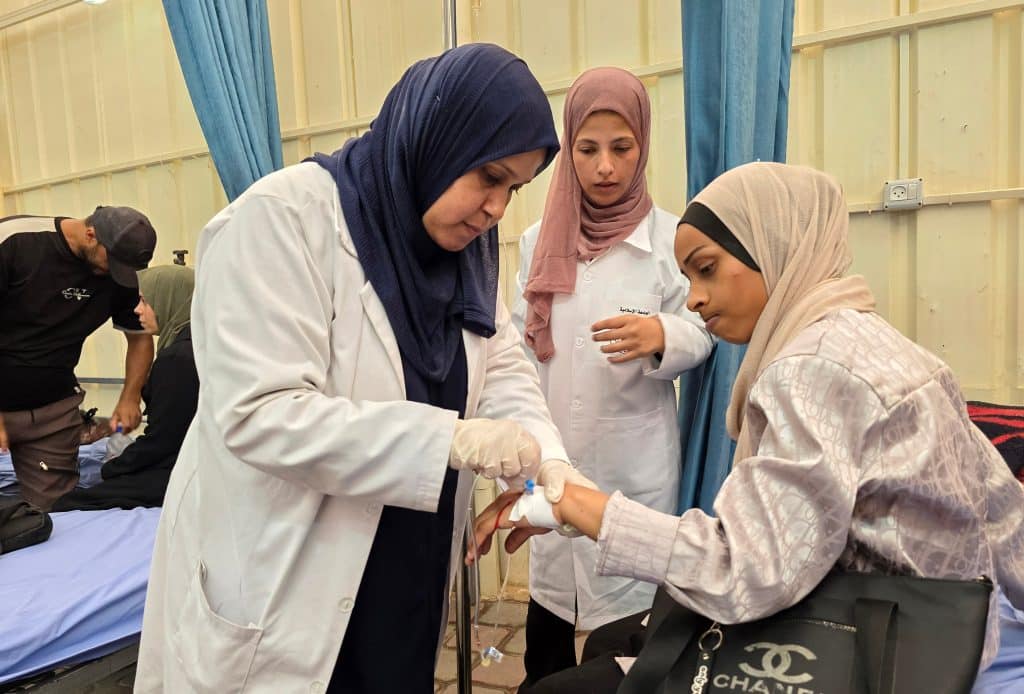
Yet none of those stories prepared me for what happened while reporting my latest one on the Israeli strike on the pharmaceutical and medical warehouse at al-Aqsa Martyrs Hospital in Deir al-Balah. The attack destroyed supplies intended for cancer and dialysis patients, along with vital medical equipment. During my reporting, I spoke with Gaza’s Ministry of Health and with Dr. Khalil al-Daqran, a spokesperson at the hospital, who told me that the attack was not an isolated incident but part of a long-standing policy aimed at eliminating what remains of Gaza’s healthcare system.
Health officials repeatedly stressed that cancer patients and kidney patients would bear the heaviest consequences of the destruction. To understand what those consequences looked like beyond official statements, I wanted to speak directly with someone living through them.
A colleague sent me a list of cancer patients in Gaza. I began dialing the numbers one by one. The first call went unanswered, so I tried another. The name beside the number was Jihad Abu Hamida, an older man with cancer who was still believed to be in Gaza.
A man answered.
I introduced myself, explained that I was a journalist working on a story about cancer patients, and asked whether I could speak with Jihad about his experience seeking treatment and the obstacles he faced.
There was a brief silence.
Then the man sighed and said quietly, “I’ll spare you the details. May God have mercy on Jihad Abu Hamida.”
I froze.
For a few seconds, I could not speak. I did not know how to respond, how to apologize, or how to conceal the wave of grief and shock that suddenly overwhelmed me. I had called to ask a man to tell me how he was surviving cancer, not knowing he was already dead.
In that moment, I felt the weight of journalism in a way I never had before. Reporting on suffering is one thing. Calling someone only to discover that the person you hoped to interview had died while waiting for treatment is something else entirely.
I apologized over and over. I explained that I had no idea he had died and that I would never have called if I had known.
The man on the other end of the phone, his son Ali, responded with extraordinary grace.
He did not blame me. He did not express anger. He told me that they had tried everything to save his father, but nothing had worked. His father died before his eyes.
I thought that was the end of the story, but I was wrong. Ali then told me that he was now watching his own son, Abdulaziz, die before his eyes.
Abdulaziz, 14, was born with serious heart and kidney conditions. Before the war, he regularly traveled to hospitals in Jerusalem and the occupied West Bank, where he received treatment funded by the Palestinian Ministry of Health in Ramallah, a system that no longer exists for him.
Since Israel closed the crossings, the boy has been unable to continue his treatment. His father cannot obtain the care he needs inside Gaza, nor can he take him to Jerusalem or the West Bank. Sending him to Egypt or another country is financially impossible. The family now lives in a displacement camp in Khan Younis, struggling to secure food and the most basic items while caring for a 14-year-old boy whose life has been defined by illness.
As Ali spoke, my grief deepened. I felt an overwhelming sense of helplessness, and I wished that the ground would open beneath me.
I have rarely encountered resilience like Ali’s. After watching his father and son die before his eyes, he does not blame fate or circumstance. He blames only Israel.
“This is the occupation,” he told me. “These are the consequences of occupation.”
Quiet consequences that rarely make headlines. These people die not because their illnesses are untreatable, but because an occupation has deprived them of something as basic as the right to medical care.
And, ultimately, the right to live.
Tareq S. Hajjaj
Tareq S. Hajjaj is the Gaza Correspondent for Mondoweiss and a member of the Palestinian Writers Union. Follow him on Twitter/X at @Tareqshajjaj.