One of the things that drew me towards journalism since my school years is my passion for researching, intimately understanding, and explaining the inner layers of any subject. I did this in every school assignment, to the point that teachers had to remind me to limit myself to the title they gave me. Years later, I learned in college that this is called “depth”, and it is a core principle of journalism.
Journalistic depth is supposed to provide analysis, background, and a closer understanding of a subject. It requires approaching sources as much as possible to have a direct understanding of their outlook, in detail, and let them explain it. The most effective way to do so is to reach the sources closest to the subject with the richest information, and then remove yourself from the middle. As a journalist, you would ideally have enough “deep” material to limit your role to orchestrating different inputs from different sources into a cohesive narrative.
But what happens when the subject you are reporting on is the reality you are living yourself? What happens if you yourself are experiencing a level of depth that you know can’t be seen from the outside? In that situation, how do you remove yourself from the middle when you and the subject are one?
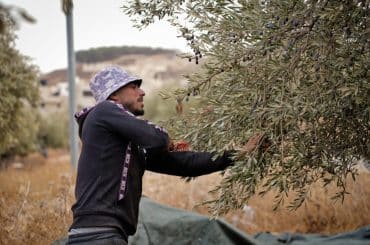
Days ago, I was asked to write a story about the Israeli settlers’ attack on the Palestinian olive harvest in the West Bank. I understood that I needed to give it depth, but at the same time, I knew the story’s depth couldn’t be captured through the lens of a mere journalist looking in from the outside.
As I was trying to figure out how to do this story, another journalist from abroad was trying to get as deep as possible into the olive harvest story. Heidi Levine, the photojournalist of the Washington Post, was in the village of Abu Falah, six kilometers from my home village of Taybeh. She wanted to be as close as possible to the story, in the middle of the olive groves, among Palestinians trying to harvest their trees. She was so deep into the reality that she found herself in the middle of an assault by a group of Israeli settlers who beat her to the point that she told her colleagues who evacuated her to “let me die.”
Levine, just like many other journalists, probably understood that the story was deeper than political analysis, historical narratives, and stacks of data. She probably sensed it in that moment: that what she went through revealed to her a whole new level of the reality she had been documenting with her camera up until that point. A whole new level of depth, which she could only tap into by experiencing it first-hand.
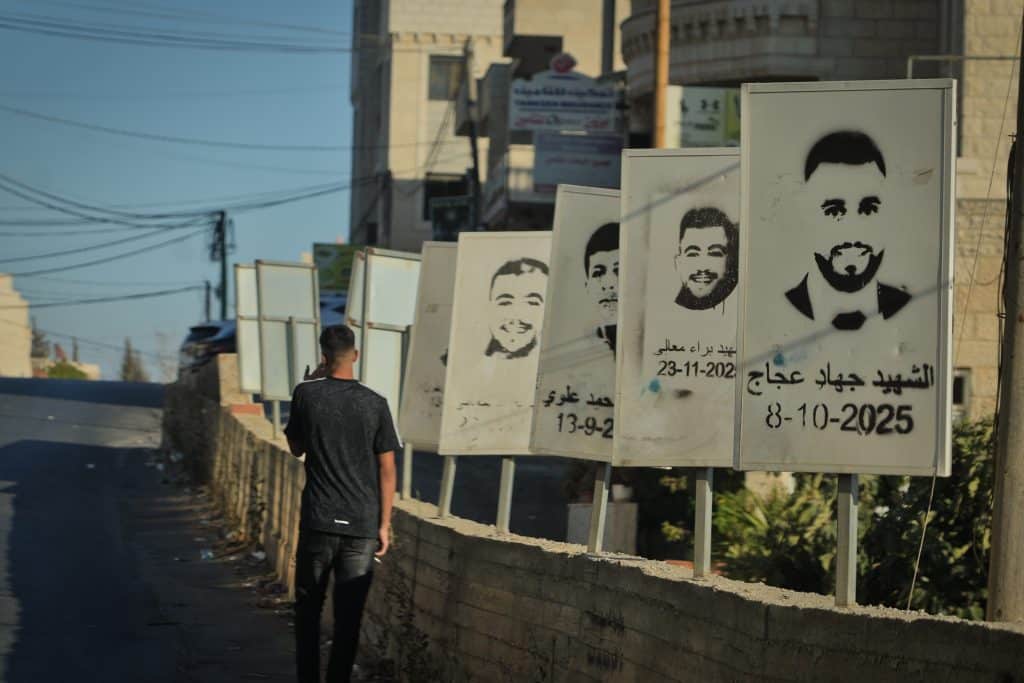
The incident left me wondering what kind of depth I should cover, and how. The violence poured on the Palestinian people is something I live through everyday. My own community, my family, and myself, have to live our daily lives through the fear, the uncertainty, and the restrictions imposed by this violence. The prolonged tension between extreme violent events is a deeper layer of that violence in itself. But there is something else besides the violence.
The wave of attacks on the olive harvest targets something that can’t be quantified or described in technical terms. It targets the link between Palestinians and their land, their heritage, their shared culture, and their livelihood. It is the thing that makes Palestinians indigenous to Palestine, and the material and cultural basis for their collective life, which they have been building for centuries as a society.
The attack on the olive harvest is about a level of “depth” that no society should ever be forced to explain, because it is a self-evident part of being a society. Any person who belongs to any culture is supposed to understand it without explanation. That is, if they see Palestinians as equal humans, and an equal human society that they can relate to. And yet, here we are, as Palestinians, forced to explain to the rest of the world how we are more than just a group of individuals living around some olive trees, and that we have an identity and a bond like anybody else. How do I treat the concept of journalistic “depth” in this case, then?
At some point, I understood that the absurdity of this reality, and the experience of it by Palestinians, is the depth that my job is to cover, and since my understanding of it is personal, I need to step away from the classic Western journalistic handbook. If I come to this story from the outside and remove myself from it, I would be telling a story very similar to many other stories about the olive harvest, and it would be fairly informative, but it wouldn’t need to be done by me. I have to tell this story from the “deepest” point possible I can, and that is the point where I stand, as a person, as a Palestinian, as the son of a family and a community of farmers who can’t harvest their own olive groves because violent settlers prevent them from doing so, and who shares their pain and anxiety as a result of it.
But then, another question rose: How to make a story that is also informative, journalistically “objective” in the sense that it tells the reality outside of my own impressions, and not just write a literary lamentation instead? Here, I need to become a journalist again and look outside of my “deep” spot in this story, and work my way up to the surface, through the analysis, the data, the hard facts that can give context to the personal experience I am starting from, and the other personal experiences I bring on the way. It sounds easier than it is done, but it is worth it, because at the moment I put the period at the end of the last line of the story I eventually wrote, I could have an eagle’s eye to a more full picture: that of a large-scale reality, lived by an entire people, inside which I am just an individual trying to open a window to the outside, so that people out there can look “deep” into our world.
It might sound romantic, except that this “deep” reality is violent, ruthless, and dystopian. A reality that nobody should be forced to narrate when they narrate their life. But it needs to be told. We need to tell the story of how we, as Palestinians, have a common identity, a heritage, an existence like every other society in the world, and how it is being subject to a relentless attempt to erase and uproot it. We must, as Palestinian journalists, expose our humanity on a level deeper than our professional role, so that the rest of the world can relate to our reality and therefore understand it.
For a foreign journalist, especially a Western one, being subjected to a violent attack, like Heidi Levine was, makes their story immediately relatable. For us, Palestinians, the daily violence we live through is not enough. Chronicling it and explaining it is not enough. Therefore, as Palestinian journalists, we need to rewrite the journalistic practice handbook and reinvent journalistic concepts in order to expose our wounds in a professional manner. But if we don’t do it, then who would?