A fresh breeze makes its way around the porch as my father looks up at the cloudy sky. He zips up his jacket, turning to look at me with his eyebrows raised, and says, “Autumn is here.” In Palestine, especially in the annual calendar of villagers like my father, autumn already started a month ago, in mid-September, with the first rain of the year known as “the rain of the cross.” My father taught me this himself. But on this day, his comment was hinting at something else. “We should already be in the middle of the harvest,” I reply, shrugging my shoulders and looking down.
It is the third year in a row that we can’t harvest our olive groves in Taybeh, my village on the outskirts of Ramallah in the West Bank, due to the threat of Israeli settler attacks. This year, however, the municipality, with the help of local religious leaders, asked the Israeli army for a few days of “coordination”— permission for villagers to access their lands safely. The Israeli army offered “coordination” for three days. It was an indirect admission of their capacity to control settler mobs, if they wanted to. “They start on [October] 16th, but we don’t know if our land will be included or not,” my father says. After three years of waiting, he wishes to see the land he grew up farming. At his age, this disappointment affects him deeply. Although I didn’t grow up farming the land like him, I understand how profoundly personal that famous bond between Palestinians and their land is.
Mine was seeded in many little moments throughout my childhood. One of them was in the summer of 2006. I remember watching the sun set over the hill, while a water tank pulled by a tractor was stationed in the middle of a plain. Little olive trees, planted about a year earlier in rows across the plain, needed to be irrigated until they had grown strong roots. Two teenagers walked back and forth between the trees and the water tank with plastic buckets, dropping a bucket of water at the base of the furthest tree in that row, then the next, and so on, before the tractor pulled the water tank down to the next row of trees.
The man driving the tractor was my uncle. One of those two teenagers was my brother, and the other was me. That land where we had planted those olive trees belonged to my grandfather, and is still collectively owned by all his children and grandchildren. Every year, the extended family reunited in the plain for long days of harvest, gathering beneath the trees for a picnic, and at the end of the season, we celebrated this feat before taking our shares of olive oil home, enough for the rest of the year. That was until October 2023. Last summer, when my uncle risked going to the plain to check on the olive trees, an armed settler told him that our land wasn’t part of Taybeh anymore, and that he shouldn’t return.
My family’s story of the ongoing Israeli settlers’ offensive on the Palestinian olive season is far from being unique, or even one of the most violent. Across the West Bank, Israeli settler groups have been attacking Palestinian villagers harvesting their olives since September of this year. The attacks have been concentrated in the regions of Nablus, Salfit, and Ramallah. In the village of Burqa, near Nablus, one Palestinian was killed, and 16 were injured during a settler raid that erupted into confrontations, before the Israeli army intervened and opened fire. In other Nablus villages like Jaloud, Beita, Beit Umrin, and Ausarin, and in Salfit villages like Zeita and Jamaain, settlers have been violently blocking Palestinians on their way to their groves. In various Ramallah villages, including Turmusayya, Abu Falah, Birzeit, and Aboud, as well as in Burin, near Nablus, settlers have been reportedly stealing the olive either by picking the trees themselves or by assaulting Palestinians carrying their harvest and taking it for themselves.
Friday, October 16 was the first day of harvest in the village of Abu Falah, north east of Ramallah just six kilometers from my village of Taybeh. Since the early morning, villagers were going to the eastern groves of the village to participate in the harvest, whether they own olive groves there or not. It is a centuries-old Palestinian practice called “auneh”, which roughly translates to “group help”. The village sets a date for all residents to help harvest in one part of the village, and then move to another. Those who helped by working in their neighbors’ groves know that they will receive the same help when their turn comes. In the central hills of Palestine, where land ownership was historically based on small family properties, and paid labor was almost absent until the early 20th century, this was how villagers organized the shared labor. Today, Palestinians are bringing this tradition back to life, but for new reasons.
“It has become very risky to go harvest the olives alone, and we have no protection at all, so the best way of doing it is to go in large numbers,” Sameer Shouman, a resident of Abu Falah tells me. Shouman explains that the villagers in Abu Falah decided to go together to each part of the olive groves for mutual support and protection. On Friday, they were in the hundreds, accompanied by journalists covering the harvest.
“Shortly after the harvest had started, Israeli settlers began to arrive in large numbers,” said Shouman. “Dozens of settlers at the same time, armed with clubs, all very aggressive, and they began to threaten us out of the land, but young men from the village confronted them with stones, and clashes erupted.”
According to Shouman, settlers stole several bags of harvested olives from an old man in his own grove. “They injured many people, including two women, and although the Israeli army came supposedly to evacuate the settlers, they were really there to protect them, as they opened fire at the young men who confronted the settlers, but did not treat the settlers who assaulted us in the same manner,” he said.
The Israeli settlers’ assault on Palestinian harvesters in Abu Falah made headlines, as one of its victims was the Washington Post photographer, American journalist Heidi Levine, who was beaten by several settlers while documenting the olive harvest, despite wearing a blue vest clearly marked with “PRESS.”
Levine told the press, from a Palestinian hospital where she was transferred via ambulance, that Israeli settlers stole her passport, her phone, and her gear during the assault. The office of Israel’s Prime Minister was quoted by Israeli media saying that it “unequivocally condemns violence against anyone,” while referring to dubious reports that “some 200 Arabs and far-left activists confronted approximately 40 Israeli youths” and that they had footage showing violence “from both sides.”
But the violence was, of course, mainly directed at Palestinian harvesters. “Settlers want to terrorize us to force us to leave our land, but we won’t,” Shouman said. “The importance of olives to us is much more than just economic, because these are our lands, our heritage, and our identity.”
None of this is new. Since October 2023, Israeli settlers’ attacks on the Palestinian olive harvest have escalated every year, from attacking farmers to destroying groves. Sameer Shouman himself says that he lost 54 olive trees last year, which he found cut down upon arriving to his groves. Furthermore, this year’s olive harvest is a crucial one, according to Jamal Jumaa, coordinator of the grassroots Stop The Wall campaign.
“The settler groups, emboldened by the current Israeli government, have imposed a status quo of terrorizing Palestinians out of their own spaces, but the olive harvest is about much more than just spaces,” Jumaa said. “It is about economy, culture, social fabric, and eventually what holds Palestinians bound to their land, and this year’s harvest might determine whether there will be olive harvests in the coming years or not.”
Jumaa compares the effect of these settler attacks to the Israeli settlers’ expulsion of Bedouin communities from grazing lands after October 2023. “The expulsion of families who raised livestock severely impacted the market of fresh meat in the West Bank, because 85% of meat consumption in the West Bank depended on local production, much of which came from these communities,” notes Jumaa. “The targeting of the olive harvest will surely have a similar impact on the market of olive oil, a central ingredient for Palestinian families,” he said.
The price of fresh meat did in fact double since October 2023, reaching 120 shekels (~$38) per kilogram. Although many Bedouin families were forced to sell their livestock after losing their grazing lands, it is unclear whether this was the main reason for the rise in fresh meat prices. But olive oil is different. According to Fayad Fayad, the head of the olive press owners union, around 100,000 Palestinian families depend partially or entirely on the olive season for their yearly income. This figure includes 70,000 families who own olive groves and 30,000 families who rely on seasonal jobs in picking, transportation, marketing, and other harvest-related work.
“Olive production has always satisfied the local demand in the West Bank, and we exported olive oil to other countries, but the main factor threatening this entire economy is Israeli settlers’ violence and land grab,” says Fayad. According to his figures, Palestine’s production of olive oil has dropped dramatically in the past three years, from 36,400 tons of olive oil produced in 2022, including 5,000 tons produced in the Gaza Strip, to only 7,300 tons in 2025, from the West Bank alone.
“Olive oil production in Palestine has always depended on small properties, which means that thousands of families are directly affected at their micro-economic level, every time the season is disrupted for whatever reason,” Fayad said. He explained that olive press owners buy directly from farmers, store the pressed oil as a form of payment, before exporting it to companies who package and sell the olive oil abroad. “The macro-economy of Palestine’s agricultural and exporting sector and the micro-economy of farming and other working families are directly connected, and they are being severely shaken by the offensive on olive lands in these recent years,” he said.
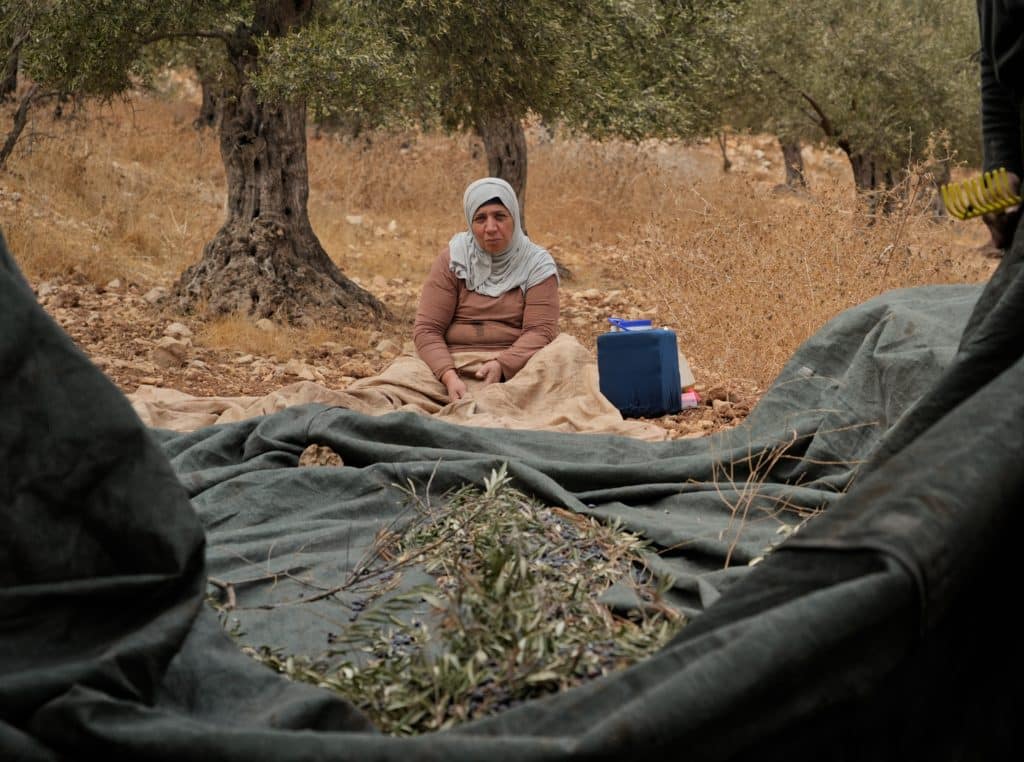
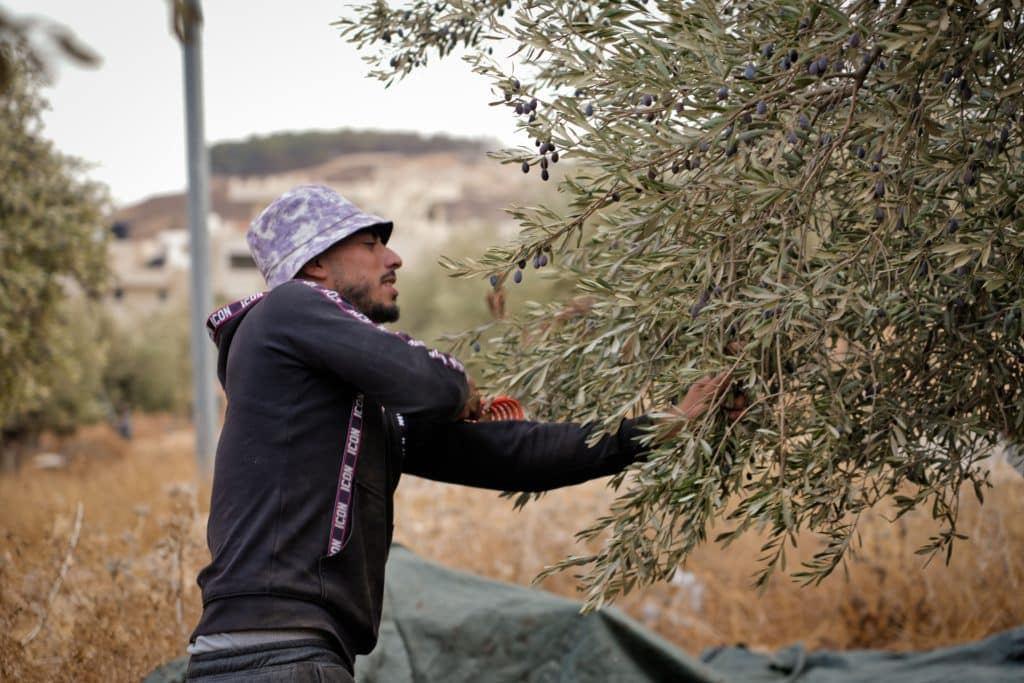
This crisis is visible in the northern groves of my village of Taybeh, which haven’t yet been occupied by Israeli settlers and where some families can still harvest their trees. In the groves trapped between the village’s urban area and a valley where Israeli settlers established an outpost, a handful of farmer groups are scattered between olive trees.
Munjid Abu Ali, a Palestinian man in his mid-twenties, is there with his parents and brother, harvesting olive trees that belong to an elderly couple from Taybeh, who can no longer perform the physical labor of the olive harvest themselves. Munjid and his family came from far away to work in Taybeh’s olive groves. “We are from Yatta, in the south of Hebron, and we have been working with the owners of these olive groves for seven years,” Munjid tells me. Every olive season, Munjid and his family stay in a small house in Taybeh’s old town that belongs to the elderly couple who owns the grove.
“The deal is that we take half of the oil after pressing the olives, which usually gives us enough for our yearly consumption, and some extra oil to sell,” Munjid explains. “Before 2023, we harvested all the groves of our employers, but most of them are now controlled by the settlers,” he said. “Our produce has been cut by more than the half, and even now, we don’t feel safe while working.”
Munjid and his family don’t feel safe because the day before, a group of Israeli settlers drove a four-wheel mountain moto-car up the valley and reached the edge of the olive groves. All workers in the area ran away towards the town before the settlers arrived, which is why nobody was hurt.
I walk down to the edge of the valley from where the settlers had come to find a young couple from Taybeh. Mousa Khoury, in his late thirties, and his wife Renad, are also harvesting somebody else’s groves.
“These olive trees here belong to a wealthy man from Ramallah who bought them some years ago, and he gave this year’s harvest to us,” explains Mousa, who works as a blacksmith. Mousa also inherited his father’s olive groves, most of which are in the east of the village, now made inaccessible by settlers’ violence.
“We have the same deal as all other harvesters, where we get to keep half of the pressed oil,” explains Renad. “It helps us secure our oil for the year and make some extra income,” she said.
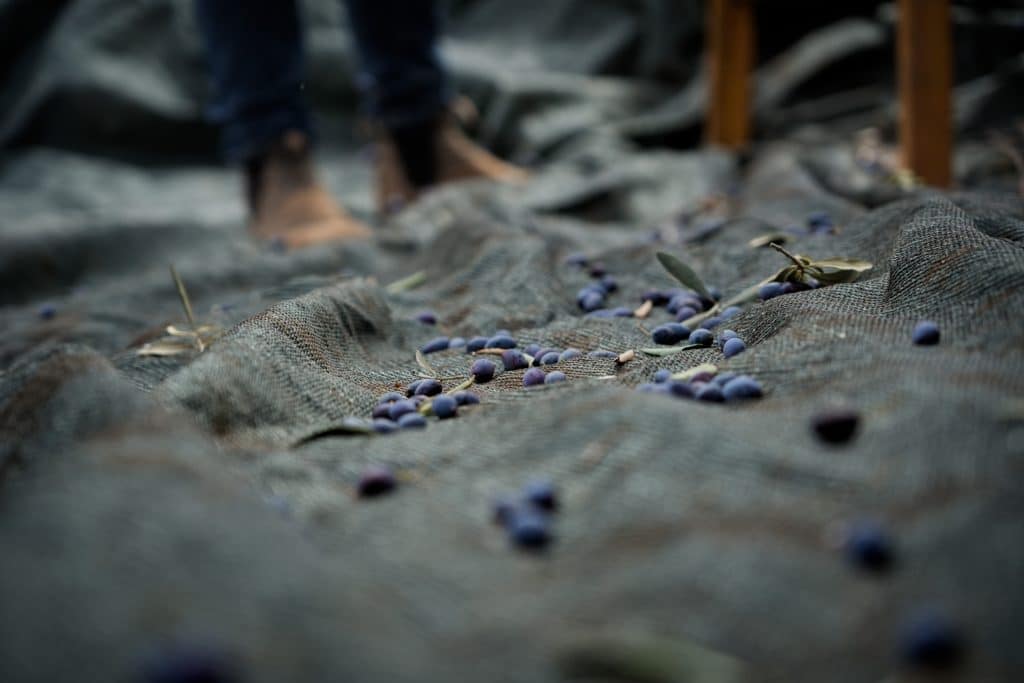
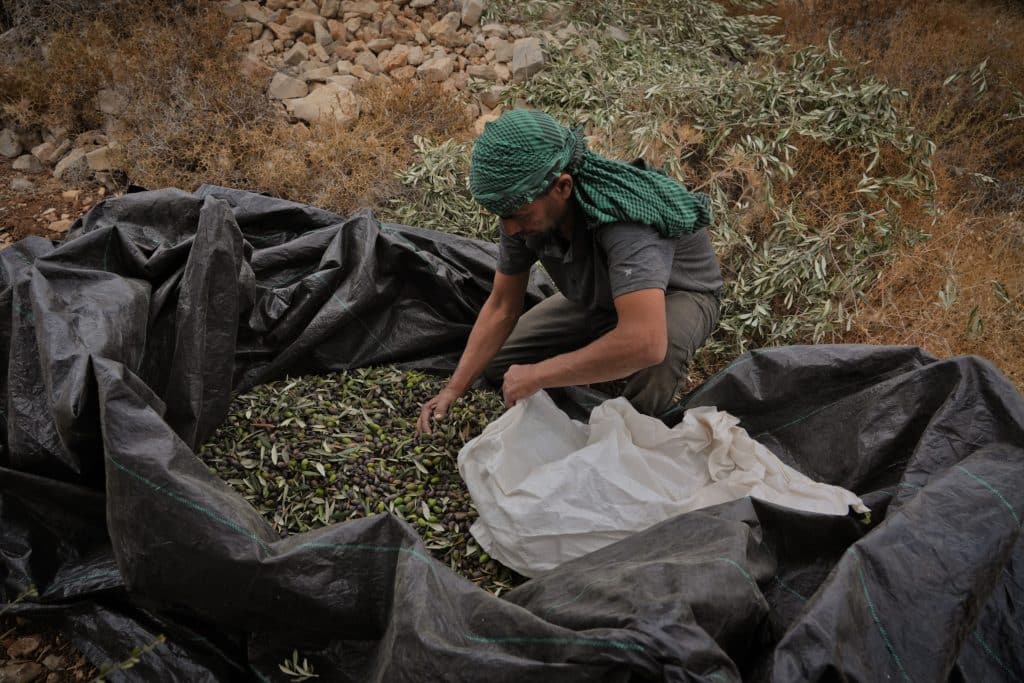
Not far away, another group of harvesters are also working someone else’s land, when one of them, a young man, hangs up his cell phone and announces loudly: “The settlers’ motorbikes are nearby, they could be here in any moment.” The word spreads, and workers begin to load large sacks of harvested olives into their vehicles. I walk back to Munjid Abu Ali’s family and find them loading their olives to the back of an old Hyundai Getz. “If we have to run, at least we won’t leave the produce behind for settlers to steal,” Munjid said.
Despite the looming threat of settler attacks, the day ended without incident. I went back home to find my father, as always, sitting on the porch, expressionless, looking at his phone screen. That morning, he had gone, once again, to the road leading to our inaccessible olive groves, hoping that the “coordination” given by the Israeli army would allow him to reach them. For the second time, the mayor of Taybeh informed him that the area under the army’s “coordination” didn’t include our groves that day.
I could sense that my father was not up for talking, so I kept my encounters with the other harvesters to myself. I sat beside him and put my arm around his shoulder, sneaking a look at his phone screen. He was watching a video taken days ago by somebody near our unreachable groves, showing the gate that we installed many years ago at the entrance of our plot. It was wide open, and a group of Israeli settlers were inside, between our olive trees, harvesting them.
I tried to say something while choking on my words, but my father was not up for talking. He put his phone in his pocket, gave me a tired smile, and got up from his chair. He stopped at the door to glance at the cloudy sky again, before silently walking into the house, leaving me outside thinking: autumn is here.