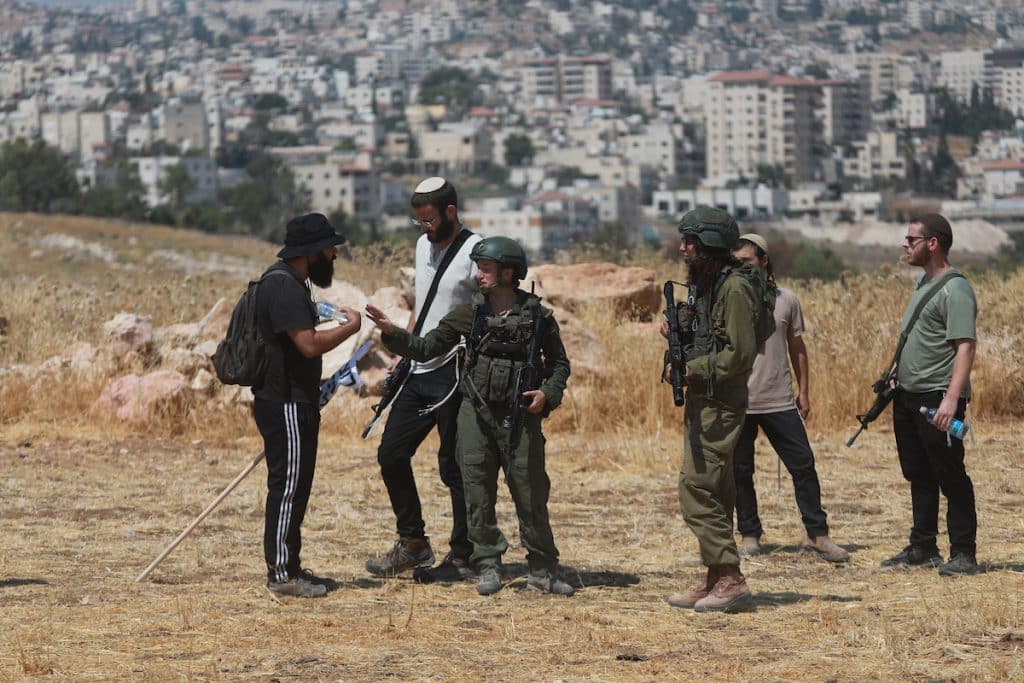
The third anniversary of October 7 was a bloody one for Palestinians in the West Bank, with a Palestinian killed and 16 injured amidst a spree of attacks by Israeli settler mobs, as well as raids and road closures by the Israeli army.
Settler attacks targeted Palestinians harvesting their olives in the villages surrounding Nablus, including Beita, Beit Imrin, Sebastia, and Al-Lubban ash-Sharqiya, where settlers planted Israeli flags along the entrance to the village. In the Ramallah area, settlers torched a car used by Israeli-Russian journalist and activist Andrei Kharzhanovsky and American journalist Jasper Nathaniel. In Aqraba, east of Nablus, Israeli settlers beat the AFP photojournalist Jaafar Ishtayeh, seriously injuring him and requiring him to receive hospital treatment.
The wave of settler attacks turned fatal in the town of Burqa, northwest of Nablus, when settlers opened fire on Palestinians harvesting their olives in the village groves and in the neighboring Ramin plain on their privately-owned lands, killing 44-year-old Ali Hassan Bazzari and injuring and wounding nine others. Bazzari was the father of four children, the oldest aged 17, and the youngest only 18 months old. He served as an officer in the Palestinian security forces and volunteered in the local emergency committee in Burqa.
Abu Bilal Bazzari, a Palestinian man in his fifties, was one of the wounded in the attack and an eyewitness to the killing of his cousin, Ali Hassan Bazzari. He told Mondoweiss that “the family had gone to the Ramin plain early in the morning, as we do every year.” That was when they encountered the group of settlers on their land.
“Without any context or warning, they began to threaten and harass us,” Abu Bilal said, adding that his family did not leave the groves despite the settlers’ harassment, but the settlers did not back down.
“They made some calls, and soon another group of around eight settlers arrived, and they started to assault us violently. One of them hit me with a club on the head, and my brother, his wife, and another cousin were injured, too, but more settlers kept arriving.”
According to Abu Bilal, Israeli forces arrived at the scene after more Palestinians showed up to fend off the settlers. Ali, Abu Bilal said, was among those who responded to the calls for help, only to be shot by an Israeli soldier upon his arrival. “He was wounded, but the Israeli forces blocked access to anybody from the village trying to reach the location, including the ambulance, and eventually Ali bled to death,” he said.
Israeli media said that one Israeli settler was injured during the clashes, quoting the Israeli army saying that a soldier “neutralized” Ali Hassan Bazzari after he ran at him carrying a “suspicious object.”
Palestinian anti-settlement activist and resident of Burqa, Ghassan Daghlas, told Mondoweiss that people in the villages surrounding Nablus, including Burqa, have historically relied on income from working inside Israel, but after October 2023, Israel revoked all work permits for Palestinians in these areas. “For them, the olive harvest is their only opportunity to secure some extra income to sustain themselves,” Daghlas said. “They will continue to try to go to their groves despite the threats by settlers, because they have no other choice.”
Ahead of the third anniversary of October 7, the Israeli army announced a complete closure of the West Bank between the fifth and seventh days of the month, while Palestinians reported settlers rallying online group chats to storm Palestinian roads and villages. Checkpoints connecting Ramallah to the surrounding villages and to the northern West Bank were closed in both directions. Many Palestinians reported waiting for hours at the checkpoints of Atara, north of Ramallah, Nabi Saleh, west of the city, and Deir Jarir, in the villages east of Ramallah.
This is the fourth year in a row that the Palestinian olive harvest season is disrupted in the West Bank, exacerbated by the over 150 new settler outposts that have been established on Palestinian lands, dozens of which continue to be legalized by the Israeli government. According to the Palestinian Settlements and Wall Resistance Commission, Israel has confiscated over 64,000 dunams (6,400 hectares) of Palestinian land in the West Bank since October 2023.