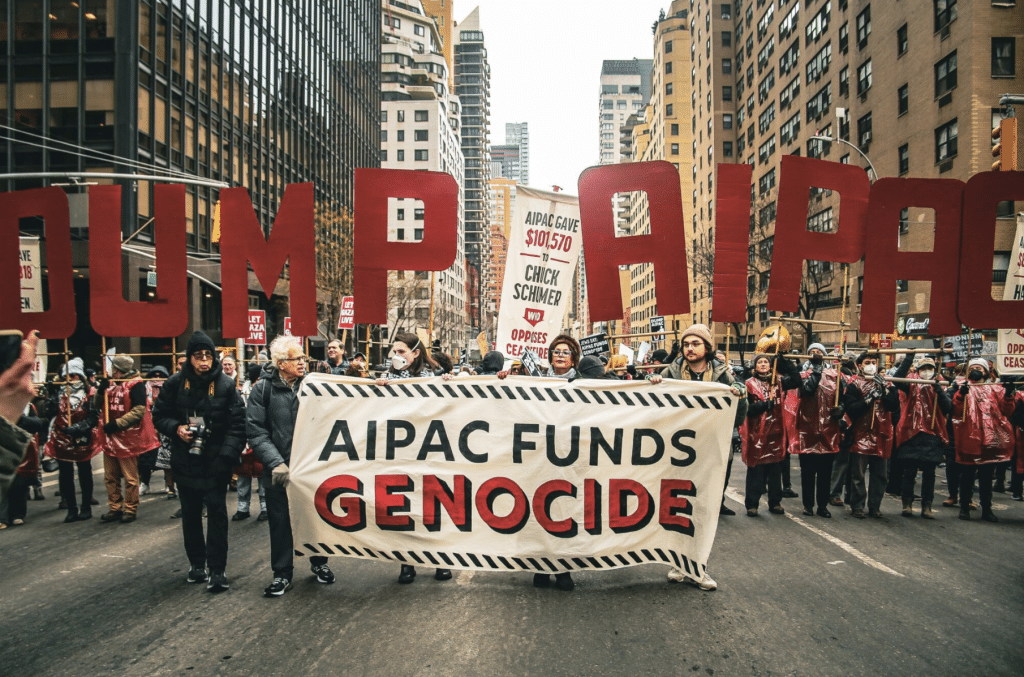
Some big AIPAC news.
Jewish Insider reported that the pro-Israel lobbying group is recalibrating its approach and “will no longer issue endorsements or directly earmark contributions to candidates.”
The move comes just 5 years after AIPAC launched a Super PAC and began endorsing candidates.
The JI article quotes a letter from AIPAC leadership to its member states:
“To win the fight for the future of the country and the U.S.-Israel alliance, we must build a more strategic, consequential, and nimble political operation. We will prioritize increasing direct, organized contributions from individual Americans to candidates — expanding upon our current efforts — and maximizing the emerging political fundraising tools. Endorsements, direct PAC contributions, and earmarking will no longer be part of our approach so we can expand individual giving and utilize new tools to help our friends win.”
This word salad can’t obscure the obvious. AIPAC has grown deeply unpopular in recent years, and the group’s support is actually hurting candidates, so it can’t afford to publicly endorse candidates any longer. The group spent millions on the primaries and still suffered multiple losses.
“What’s different from 2024 isn’t AIPAC’s capacity,” explains a report from the campaign finance website Inside Political Money. “It’s the opposition. Until 2026, AIPAC contested Democratic primaries without organized counter-PAC opposition or a revolt among the party’s voters. This year’s results increasingly suggest that AIPAC’s involvement can itself become part of the argument against the candidate it is trying to help.”
AIPAC says it will continue to rely on its United Democracy Project super PAC, but it’s urging members to donate directly to candidates. In other words, AIPAC’s involvement must be more secretive.
On the same day that the group announced its new strategy, the New York Times reported that the organization is planning to dump another $9 million on the Michigan Senate race. Of course, this isn’t being donated directly; it’s being funneled through something called the Great Lakes Conservatives Fund, a PAC that is exclusively focused on electing GOP candidate Mike Rogers.
AIPAC made the donation after the October 14 deadline, which means that the public wasn’t supposed to learn about it until after the election, but two people aware of the move informed the paper anonymously.
Rogers has consistently attacked Democratic candidate Abdul El-Sayed over his criticisms of the U.S.-Israel relationship. In the race’s final debate, Rogers claimed that Jewish people were fearful of an El-Sayed victory.
“Jewish Democrats who are afraid for their children when their daughters can’t wear their Star of David walking across Michigan’s campus, these are real,” he told the crowd. “My opponent’s rhetoric, his vitriol, is having consequences.”
Dem presidential contenders remain committed to Israel
“The 2028 Presidential ‘Shadow Primary’ Descends on the Midterms,” declares a New York Times headline.
“In the final stage of this year’s midterms, prospective presidential candidates are parachuting into battleground states to rally support for candidates on the ballot this fall, road-test their stump speeches, and introduce themselves to voters and activists,” the paper explains.
Atop the list sits California Governor Gavin Newsom, who recently said that U.S. military aid to Israel should be conditioned.
Newsom provided no details about what should be conditioned or what criteria should be applied in conditioning. He also made the usual distinction about “defensive” systems like the Iron Dome and framed the issue as one specific to the current Israeli government.
“Bibi Netanyahu has done a remarkable job of really isolating himself from the rest of the world and increasingly from the American people…the damage he’s done is incalculable,” he told the conservative Washington Examiner.
The door is purposely left open here. Maybe Netanyahu loses the election, and the subject of military aid need not be broached.
You’ll recall that earlier this year, Newsom said military support for Israel should be reconsidered because it looked like an apartheid state. Days later, he publicly recanted the comments and expressed regret about his phrasing.
“That’s a word you may hear others use,” he explained.
Newsom certainly isn’t alone, as a number of potential 2028 Democratic contenders refuse to break from Israel.
Former Transportation Secretary Pete Buttigieg, who ran for the nomination in 2020 and has spent the past month campaigning with Democratic candidates, recently told Fox News, “Iran is our enemy, Israel is not. They’re an ally.”
In a televised debate with GOP challenger Rep. Mike Collins, Sen. Jon Ossoff (D-GA) refused to refer to Israel actions as a genocide.
“The question of genocide is a question of whether a government has the specific intent to destroy a national or ethnic group,” said Ossoff, responding to a question from the moderator on the issue. “There is no doubt in my mind that Israeli forces prosecuting the war in Gaza violated the law of armed conflict and international humanitarian law.
“I care deeply about the security of the Israeli people, among whom are members of my family,” he added. “I also care about innocent Palestinian life and make no apology for my votes.”
This all feels completely disconnected from reality, even by the standards of U.S. politics. Every poll on the subject shows that support for Israel is crumbling and that voters want to see action on that front. The latest survey from IMEU shows that the majority of likely voters in six “swing states” support Senate measures to block the sale of bombs to Israel.
Odds & Ends
- Mondoweiss: Can AIPAC stop an El-Sayed victory in Michigan?
- Mondoweiss: Inside the fight to stop Israel-bound weapons at the East Coast’s biggest port
- New York Times: U.S. and Israel Draw Up Plans for Renewed Strikes on Iran After Elections
- Responsible Statecraft: Most voters in key states want to block US arms transfers to Israel
- The Intercept: Dems Have an Opportunity to Force an End to the Iran War. Will They Take It?
- Zeteo: First Draft: Why Is Israel Running TV Ads in Iowa Ahead of the Midterms?
- Counterpunch: Decoding Pro-Israel Buzzwords in a Time of Genocide
- Drop Site: The War Tehran Believes Is Coming
- Al Jazeera: Rashida Tlaib demands arrest of Israeli soldier tied to Hind Rajab killing
- Jewish Currents: Emory Hillel Fired its Rabbi Over Her Fiancé’s Criticism of Israel
- Haaretz: Kushner Shares WSJ Article Urging Israel to Cooperate With Gaza Board of Peace Before Election
- SCOTUSBlog: The Mahmoud Khalil and Badar Khan Suri cases: an explainer
- Common Dreams: ‘Flat-Out Lying,’ Israel Claims Palestinian Farmers, Brad Lander Entered Restricted Area Before Detention