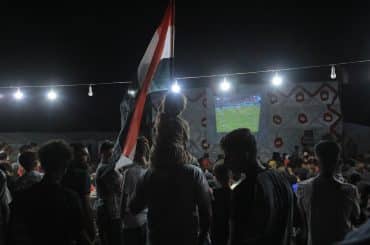
At +972, excerpts of a truly beautiful letter by young Israeli Mizrahi Jews to Arabs across the Middle East expressing solidarity with their uprisings. The signatories’ names are at the link, it looks to be about 60 of them. Really a fabulous manifesto. Note the inclusion of their brothers in the occupied territories. This is the anti-rough beast slouching from Jerusalem, a great healing. Excerpt (thanks to Peter Belmont):
We are a part of the religious, cultural, and linguistic history of the Middle East and North Africa, although it seems that we are the forgotten children of its history: First in Israel, which imagines itself and its culture to be somewhere between continental Europe and North America. Then in the Arab world, which often accepts the dichotomy of Jews and Arabs and the imagined view of all Jews as Europeans, and has preferred to repress the history of the Arab-Jews as a minor or even nonexistent chapter in its history; and finally within the Mizrahi communities themselves, who in the wake of Western colonialism, Jewish nationalism and Arab nationalism, became ashamed of their past in the Arab world.
Consequently we often tried to blend into the mainstream of society while erasing or minimizing our own past. The mutual influences and relationships between Jewish and Arab cultures were subjected to forceful attempts at erasure in recent generations, but evidence of them can still be found in many spheres of our lives, including music, prayer, language, and literature.
We wish to express our identification with and hopes for this stage of generational transition in the history of the Middle East and North Africa, and we hope that it will open the gates to freedom and justice and a fair distribution of the region’s resources.
We turn to you, our generational peers in the Arab and Muslim world, striving for an honest dialog which will include us in the history and culture of the region. We looked enviously at the pictures from Tunisia and from Al-Tahrir square, admiring your ability to bring forth and organize a nonviolent civil resistance that has brought hundreds of thousands of people out into the streets and the squares, and finally forced your rulers to step down.
We, too, live in a regime that in reality—despite its pretensions to being “enlightened” and “democratic”—does not represent large sections of its actual population in the Occupied Territories and inside of the Green Line border(s). This regime tramples the economic and social rights of most of its citizens, is in an ongoing process of minimizing democratic liberties, and constructs racist barriers against Arab-Jews, the Arab people, and Arabic culture. Unlike the citizens of Tunisia and Egypt, we are still a long way from the capacity to build the kind of solidarity between various groups that we see in these countries, a solidarity movement that would allow us to unite and march together–all who reside here–into the public squares, to demand a civil regime that is culturally, socially, and economically just and inclusive.
We believe that, as Mizrahi Jews in Israel, our struggle for economic, social, and cultural rights rests on the understanding that political change cannot depend on the Western powers who have exploited our region and its residents for many generations. True change can only come from an intra-regional and inter-religious dialog that is in connection with the different struggles and movements currently active in the Arab world. Specifically, we must be in dialog and solidarity with struggles of the Palestinians citizens of Israel who are fighting for equal political and economic rights and for the termination of racist laws, and the struggle of the Palestinian people living under Israeli military occupation in the West Bank and in Gaza in their demand to end the occupation and to gain Palestinian national independence.
In our previous letter written following Obama’s Cairo speech in 2009, we called for the rise of the democratic Middle Eastern identity and for our inclusion in such an identity. We now express the hope that our generation – throughout the Arab, Muslim, and Jewish world – will be a generation of renewed bridges that will leap over the walls and hostility created by previous generations and will renew the deep human dialog without which we cannot understand ourselves: between Jews, Sunnis, Shias, and Christians, between Kurds, Berbers, Turks, and Persians, between Mizrahis and Ashkenazis, and between Palestinians and Israelis.