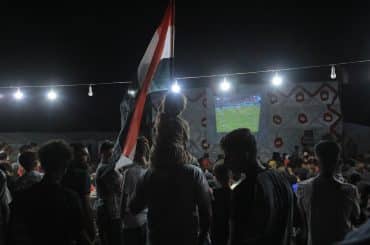
Just discovered this: Sean Lee’s post from May 16 on Nakba Day at Maroun al-Ras in Lebanon.
When we arrived, the youths, or shabaab, had already made it to the fence. Some were waving Palestinian flags, while others were throwing rocks over the fence. It should be noted here that the other side of the fence was empty except for a line of trees behind which the Israeli soldiers were stationed. The youths chanted their slogans, waved their flags and threw their stones. In response, the Israeli soldiers would periodically open fire. At no point were the Lebanese youth on the Israeli side of the fence. It’s unclear to me what kind of ammunition the Israelis were firing, but the high death toll (reported at ten so far) leads me to believe that at least some of it was live ammunition, although rubber bullets have also been known to be fatal.
In the end, more Lebanese soldiers were called in, and by firing in the air managed to push the crowd back from the fence. On the long walk back, we saw the same mixture of families, elderly folks and groups of teenagers coming back, only this time, some of the teenage boys had blood on their clothes from helping others who’d been wounded or killed by Israeli fire.
In a nutshell, protesters amassed at the border armed with flags, slogans and rocks from the ground, and Israel responded by opening fire and killing nearly a dozen youths.
When I finally returned home to Beirut last night after a night ride along the border by the Gates of Fatima and the old crusader castle, Beaufort, I was disappointed to see the news that others had died in Syria and Gaza during similar protests. I was also really disappointed in the responses that I saw on twitter and online from American commentators.
One post that really rankled me was from my friend Andrew Exum:
“The Lebanese, Palestinian, Syrian, Palestinians and Israeli peoples are all getting played right now. If you’re a Palestinian marking the Nakba on the border with Israel right now, that’s all fine and well, but you should be aware of those actors for whom this distraction is most welcome and who have every interest in using the Israeli-Palestinian conflict and your own suffering for their own cynical purposes right now.”
This sentiment has also been voiced by the Israeli government, which has claimed that this has all been drummed up by Iran and Syria in order to move attention away from Syria’s brutal crackdown of domestic protests. There is no concrete evidence for this, of course, except what Andrew calls the one rule he follows for Levantine politics: “just be cynical about the motives and actions of everyone, and you will never go wrong.”
Without even getting into the fact that Levantine politicians hardly have a monopoly on cynical motives, this strikes me as more than a little hypocritical. That Arab states have capitalized on the Palestinian issue for domestic point-scoring is a truism, but that doesn’t make the issue any less salient for Arabs across the region, and to imply that such non-violent protests are just tools for Damascus, as opposed to genuine reflections of public feeling, is problematic for several reasons. Likewise, for the idea that protesters are “getting played.”
First, it mirrors the sclerotic official discourse seen in Cairo, Tunis, Damascus, Sana’a and Tripoli during the Arab Spring: “these protesters are either foreign provocateurs or are just being naively used by America and Israel to undermine Arab governments and take attention away from the occupations of Iraq, Palestine and Afghanistan.” This, of course, is roundly and immediately dismissed as “conspiracy theory” by Western analysts, despite (for example) clear evidence that the US has been funding Syrian opposition groups.