Helena Cobban has a long, moving account of her visit to Gaza at her site, Just World News. An excerpt:
One first fruit of the May 3 [unity] agreement: As you drive along the Strip, within or through the sprawling cities, towns, and heavily built-up refugee camps that cover most of its surface, you often see Fateh’s distinctive, bright yellow pennants raised high over residential blocks. Yes, Hamas’s green flags still strongly out-number them. But the green flags have been flying longer and many now have a slightly grungy look to them.
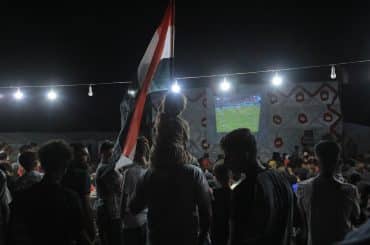
The choice of flags has been a key decision made within all the popular uprisings that have made up the Arab Spring. In both Tunisia and Egypt, participants in the mass demonstrations made a point of carrying only their respective national flags on the demonstrations, leaving their party affiliations at home. Back in late February, after Mubarak’s toppling, young social activists in Palestine decided that they wanted to organize a mass popular action. Their main slogan was “The people want an end to the division.” Not surprisingly, as they organized for what they designated their #mar15 action in both the West Bank and Gaza, they argued strongly that participants should carry only the Palestinian flag.
In both Gaza and the West Bank, the status quo powers viewed the young people’s activism as posing a worrying challenge to their own control, and the ruling powers in both territories moved swiftly to co-opt and dominate the movement.
Brilliant young Palestinian blogger Sameeha Elwan, a recent graduate of the Islamic University of Gaza’s English-language program, blogged movingly about the dismay she felt when she saw many participants in the Gaza City march carrying Hamas flags as well as Palestine’s four-color emblem.
She wrote,
- I could see nothing but the Palestinian flag, hear nothing but Palestine’s name, I could not but be totally involved as everyone else who like me were chanting, walking proud, holding up their Palestinian flag, their voice at its highest, their hearts hopeful for a unity that this demonstration proved every Palestinian, regardless of his favourite colour, is eager to have back…
Amidst the beauty of the scene rose that unusual green flag tied to the Palestinian… [H]onestly, I think of it as an absurd attempt to prove the Hamas presence while none has denied them the right to. The demonstration was aimed at calling to end division. It aimed not at ending the presence of any party.
In Gaza, Hamas’s well coordinated mass organizations easily outnumbered the intentionally non-partisan demonstrators on March 15. Prime minister Ismail Haniyeh and other Hamas luminaries came to the city center’s Square of the Unkown Soldier to address them. The independents moved elsewhere to continue holding their notably smaller demonstration.
In the West Bank, meanwhile, the pro-Fateh security forces succeeded in limiting access to Ramallah’s Manara Square to only a small proportion of the would-be demonstrators. A low-level Fateh official addressed the crowd, coming hand-in-hand with a Hamas official. But soon after the speeches the Palestinian gendarmerie cleared the square, fearing that if the protesters stayed too long their movement might, as in Tahrir Square, gain momentum.
Since March 15, there have been few signs of the Palestinian “youth” movement undertaking any further similar demonstrations. But the leaders of Hamas and Fateh had both gotten some important messages: from the March 15 action; from the pro-reconciliation diplomatic activism of Egypt’s new government; and also– in the case of Fateh, whose leaders have long pinned all their hopes on getting some real from Washington in pushing for an Israeli withdrawal from Palestinian lands– from the evident failure of that strategy, including the derailing of that previously long-running (but never arriving) roadshow, the “peace process.”