

As a fresh ceasefire continues to hold (for now) and the rest of the Middle East bleeds, the media can be forgiven for turning its attention away from the battered Gaza Strip. If the indirect peace talks in Cairo are successful and the ceasefire extended, then once again Palestine will be momentarily forgotten. The well-oiled Israeli PR machine will take a much-deserved rest. The solidarity marches will come to a standstill. The hashtags will tweet for other causes.
If the previous shellings in 2009 and 2012 are anything to go by, until Gaza is bombarded once more it will almost completely disappear from public consciousness. For the optimists, this time around, something seems different. Support for Israel, particularly across Europe, has wavered. Generally, many, if not most, have found Israel’s actions to be indefensible. Even Israel’s staunchest supporters have found it hard to put a spin on the 1,900 Palestinian casualties. What seems to be the targeting of Palestinian civilians, coupled with the chilling images that continue to stream out of Gaza have turned the tide of support strongly against the Israeli government.
So, for the optimists, there is hope. There is hope that this time, discussions will turn, seriously and earnestly, to the future of the Israel-Palestine conflict. Prime Minister David Cameron has done little to warrant much praise over his stance on the Gaza crisis over the past five-weeks. Yet, his words rang true on the 31st of July when he claimed that a two-state solution to the conflict is ‘beginning to look impossible’.
David Cameron is not alone with his concerns. His statement echoed the sentiments of former-Foreign Secretary William Hague, US Secretary of State John Kerry, and believe it or not even Middle East Peace Envoy Tony Blair.
Whilst they are not quite yet propagating one-state solution, what were originally voices of dissent are starting to become more popular in the general public consciousness. Many Palestinians and their supporters have long advocated the one-state solution. Until recently however, these voices were accused of diminishing Israel’s legitimacy by denying the Jewish people’s dream of national self-determination.
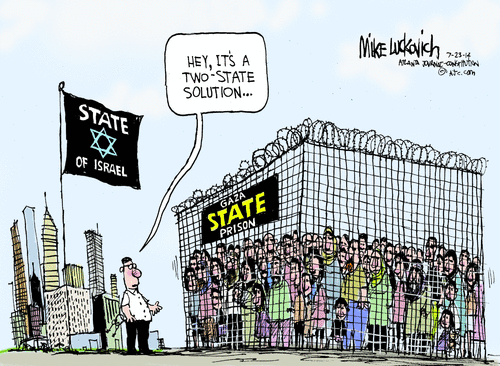
The shift in opinion represents a coming-to of the sad truth that there is no foundation to build an independent Palestinian state on. The hope that Israel would retreat back to its 1967 borders, allowing for the establishment of an independent Palestinian state, is far removed from the current reality. Instead, the illegal settlements have steamrolled ahead under Prime Minister Netanyahu’s tenure, calling into question Israel’s devotion to a two-state solution.
And yet, if Israel is not committed to a two-state solution, it certainly does not support the notion of a one-state solution, which threatens the fabric of its Zionist ideology. Palestine’s swelling population (reaching approximately 4.5million last year), not including the 5million Palestinian refugees, has been the source of some concern within Israel. So, for the state of Israel to exist, a one-state solution is simply impossible. A one-man one-vote system within a unified state would tilt the demographic scales away from Israel’s favour and destroy its mandated Jewish identity.
It leads many to wonder what exactly is Israel’s long-term strategy, as quite clearly the current situation is unsustainable. The most-recent offensive on Gaza has brought to light the systematic ill treatment of Palestinians within their own territories. For the 1.8million Palestinians living in the hundred and forty square mile refugee camp called the Gaza Strip, Israel still has dominant control over their water supplies (of which only 5.5% of piped water reach World Health Organisation quality standards), their power supplies and continue to impose restrictions on agricultural and fishing access.
Beyond the Gaza Strip, the restriction of movement Palestinians face in their own territories continues to serve as a daily source of humiliation and incarceration. According to the United Nations, as of 2012 there were 540 “obstacles blocking Palestinians movements in the West Bank”, all of which flout international law. These obstacles, be they it through staffed check points or the now infamous West Bank wall, cuts Palestinians off from schools, hospitals and in many cases their own agricultural land.
The clarity of the unsustainability of the status quo has never been so apparent. A one state solution is by no means an easy solution, as extremists on both sides will not be happy until they see their nemeses wiped off the face of the planet. However, the concept of a two-state solution is floundering. And whilst many remain uncomfortable when it comes to a one state solution, now is the time to discuss. The recent crisis had shed light on the ghettoisation of the Palestinian territories, and we would be foolish not to seize this opportunity to go beyond the two-state consensus and look towards a new, more hopeful, possibility.


Who’s afraid of Israetine?
They say they’re not afraid of Israetine, and yet they’ll lie, steal, murder, torture, exclude, expel, massacre and maybe nuke, too, before they’ll let it happen.
And they’ll say civil rights are…oh…politically unfeasible.
Who’s afraid of the big bad wolf, oh the breakdown of Zionism, oh the end of the fun and games.
I can tell you what the israeli upper class‘ long term strategy is: keep partying in the levant for as long as possible, then implement their exit strategy and migrate to Western Europe and the US where they’ll be able to maintain their lifestyle, leaving their middle and working class “compatriots” facing the fallout alone.
@Leena —
OK Leena let’s discuss a one state solution. First off on the refugees if you are joining Israel in a one state solution then creating the refugees is something you in a national sense did not something you in a national sense were a victim of. That’s what a one state solution really means that you agree to become Israeli in a national sense, “For wherever you go, I will go; wherever you lodge, I will lodge; your people shall be my people, and your God my God. Where you die, I will die, and there I will be buried.” If you don’t mean becoming part of the Israeli nation then the question becomes of what value is your nation to the state of Israel? How does your nation intend to serve the interests of the state?
I love a the discussion of a one state solution. But a one state solution will never be a Palestinian state with Jews living in it which is what I think most Palestinians picture.
JeffB can you agree to become an Israeli in the democratic or Isratinian sense?
“……which is what I think most Palestinians picture”.
Indeed Palestinian voices are a bit stifled (what with your boots on their back, and all), and so they’re lucky Zios are on cue to represent them.
“It leads many to wonder what exactly is Israel’s long-term strategy, ”
I think it has two aspects – the Zionist vision, and the Micawber method. The vision is Greater Israel with only a few Arabs to do the menial work. The method is simply to take advantage of whatever turns up.