

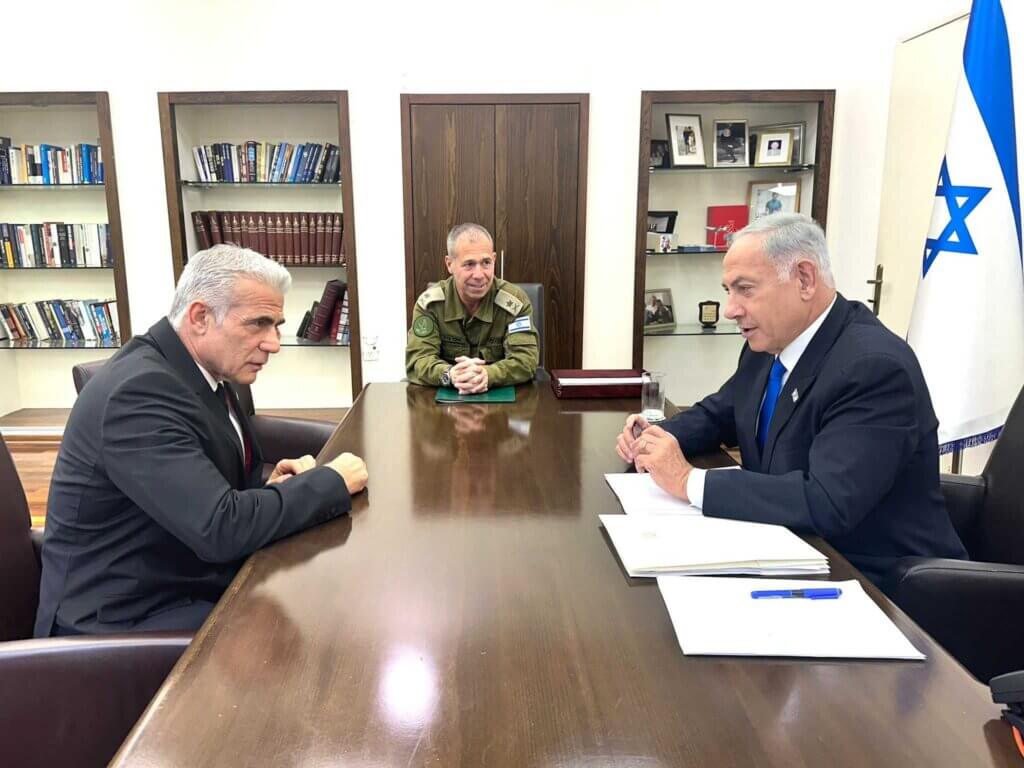
“There has never been a more complete failure than the diplomatic failure of Netanyahu on the Iranian front”, said Israeli opposition leader Yair Lapid Monday, in response to reports of a deal having been reached between the U.S. and Iran, waiting to be signed on Friday in Switzerland.
Lapid was expressing a sentiment shared by many Israelis, that Israel would be ‘giving in’ to Iran if it stopped its own aggression, also on Lebanon.
“The state of Israel won the battle”, Lapid said, but “Netanyahu lost the war”.
Lapid was expressing a mainstream Zionist Israeli perception, which was prevalent in a poll conducted by the Israel Democracy Institute in April, measuring that 90% of Jewish Israelis gave the Israeli military a “positive performance rating”, while only 38% rated the government’s performance positively.
The summary of this duality is that many Israelis feel Netanyahu doesn’t go hard enough.
Lapid’s partner in the new party ‘Together’, Naftali Bennett (who vies to be premier again), boasted of what he would do different. “You ask me what I would do different? Everything”, he wrote in a long post on X.
Bennett suggested military bravado: “Returning to the security concept of fast, strong and quick wars, rather than Netanyahu’s ‘spreading-it strategy’.” Bennett suggested even more hasbara (beyond the dramatically increased budget of $730 million this year), promised to conscript everyone to the army, and then offered his vision against the Iranian “axis of evil”:
“We will renew with full might our ‘octopus doctrine’ which we had begun to apply under my government. With the one hand prohibiting Iran from erupting into nuclear (capability), on the other accelerating collapse of the regime with diplomatic, economic, technological and military means”.
It is assumed that the ‘octopus doctrine’ has no intent of arousing any antisemitic tropes. In any case, Bennett appears like a child who is sure he can do it better if he only got the chance.
Even Yair Golan, from the furthest left The Democrats (merger of Labor and Meretz), charged at Netanyahu for giving in:
“With a single stroke of a pen, the enormous military achievements, achieved by the courage of our brave pilots and the blood of our fighters, are erased, as Netanyahu stands on the sidelines – weak, ill, isolated and without influence”.
That was the opposition. From inside the government, critique was more in the nature of vowing to stay put in Lebanon and elsewhere.
Israel vows to stay in Lebanon, defying ceasefire
Pakistan’s Prime Minister Shebaz Sharif, who announced the deal on Sunday, said that the deal would include “the immediate and permanent termination of military operations on all fronts, including in Lebanon”. But Israeli government officials completely rejected that. Defense Minister Katz said that Israel will keep its gain on all fronts (which amount to about 386 sq miles): “Israel will not withdraw from the security zones in Lebanon, Syria and Gaza.”
Finance minister and de-facto governor of the West Bank Bezalel Smotrich, confirmed:
“In Lebanon we are being tried. It is our war, our fighters and the immediate security of our residents of the north. I will continue to work so that we may stand firm on that which is ours and enable IDF complete freedom of action towards the continued expelling of Hezbollah.”
Minister of National Security Itamar Ben-Gvir was even more clear about rejection of any commitment:
“Trump’s deal does not bind us. Israel is not subject to [the] USA and we are an independent and sovereign country!”, he wrote. “My position is clear”, he added, “We are not part of this deal which does not support our security, and it does not commit us in any way. We may not compromise on less than the dismantling of Hezbollah, we may not retreat from any territory which our fighters conquered and cleansed from terror infrastructure…”
So that’s a lot of rejection from across the Israeli Zionist political spectrum. Netanyahu stayed quiet for nearly a day. But then, Monday night, he promised at a press conference that “we will stay in the buffer zone [Lebanon, Syria Gaza] for as long as necessary in order to defend the state”. He used the occasion to boast of having saved Israel from an Iranian “immediate existential threat”, which is of course nonsense.
We have yet to see what happens until Friday. Trump is eager to present a deal, which he says is “now complete”, in which the opening of the straits of Hormuz is probably the most important part. “Let the oil flow”, he cried with impatience, only to correct that it would first be on Friday. Meanwhile, it looks like the Israelis will do what they can to sabotage the deal.
Jonathan Ofir
Jonathan Ofir is an Israeli musician, conductor and writer based in Denmark.


Gideon Levy in Haaretz:
https://www.haaretz.com/opinion/2026-06-18/ty-article-opinion/.premium/israels-defeat-in-iran-isnt-a-disaster-its-an-opportunity-to-face-the-truth/0000019e-d712-d6a3-a5be-f77252200000
Mahmoad Ahmadinejad called for regime change in Israel.
Today, nearly all agree.
If Donald Trump and Bibi turn out to be the dynamic duo, the anvil and hammer which sever Israel from the US, that’ll be funny.
Trump is always more constant in his retribution and constant in his dislike, than he is in partnership.