

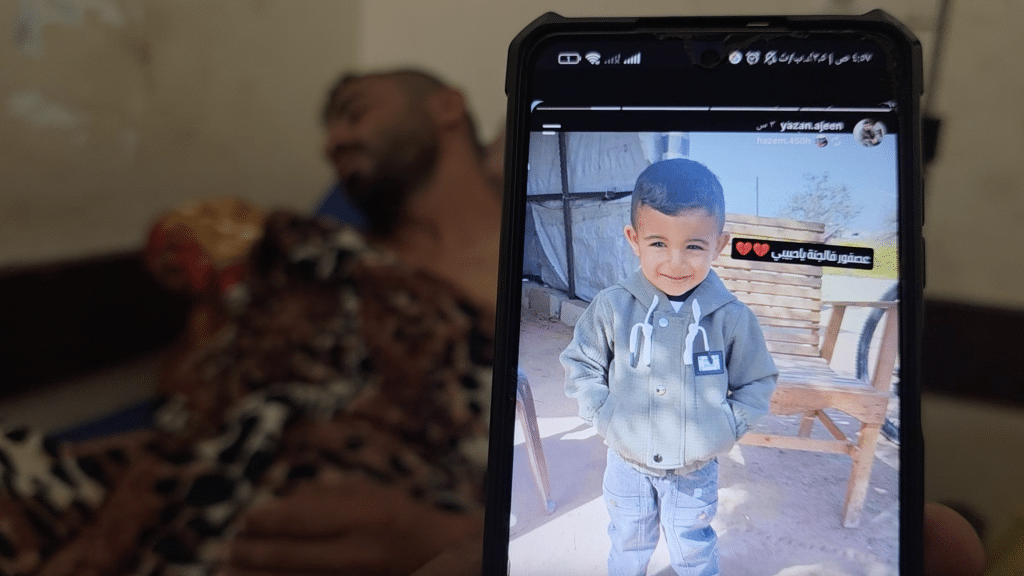
On the evening of June 14, the Israeli army shot and killed three-year-old* Rayyan Abu al-Ajeen in his father’s arms.
Bahaa Abu al-Ajeen, the boy’s father, set out that evening with his son, alongside his friend and relative, Khaled Abu Ghrab, to check on farmland they owned in Deir al-Balah in central Gaza. While they were in what they described as a safe area, far from the so-called “Yellow Line” dividing Gaza into two, the two men and the child were surprised by an Israeli force hiding inside a Palestinian house within the designated safe zone. When they approached the house, the soldiers suddenly emerged and surrounded them, Baha Abu al-Ajeen said.
“If we had known there were Israeli soldiers there, we would never have gone,” he told Mondoweiss. “We were walking inside a safe area and heading to another location in the same zone. We had no idea soldiers were hiding there.”
Speaking from a hospital bed at al-Aqsa Martyrs Hospital in video testimony for Mondoweiss, Abu al-Ajeen recalled that when the soldiers confronted them, his relative told him to sit on the ground. “We sat down to show them that we were unarmed and posed no threat. We regularly use this road inside the safe zone. Then my son started crying loudly out of fear. He had never experienced anything like that before,” he said.
Abu al-Ajeen said he then picked up his son and moved about 50 meters back to calm him down. “As I began walking, the soldiers shouted at me to stop and fired beneath my feet. I stopped immediately. And the moment I stopped, two soldiers pointed their guns at us, and one of them shot my son while he was in my arms. The bullet entered the back of his head and exited through his left eye while he was in my embrace. Then they shot me in the leg.”
The father recalled the moment of the killing when the Israeli soldier aimed before shooting. “The soldier got down on one knee, aimed at my child’s head, and killed him. One bullet,” he said. “I wish they had killed me instead.”
Since Hamas and Israel entered into a ceasefire in October 2025, dozens of Palestinians have been killed near the Yellow Line, a boundary that has progressively expanded to annex more parts of Gaza as the months have gone by, and which now brings over 65% of the Strip under Israeli control. Killings such as these began in the first days of the ceasefire.
According to the Abu al-Ajeen family and journalists on the ground, the killing on June 14 took place far away from the Yellow Line, in an area widely regarded as safe and routinely used by civilians.
“When the army advances, there are usually signs, like gunfire or intensive drone activity,” Bahaa Abu al-Ajeen said. “We avoid those areas. But everything was calm that day. There were no signs of military activity. We go there regularly. This was the first time Israeli forces had been in that location.”
Three-year-old Rayyan’s grandfather, Jaber Abu al-Ajeen, said that he had been in contact with his son before the incident, and people had been using that same route only half an hour earlier. “It was more than 500 meters away from the Yellow Line,” he explained. “We know where the Yellow Line is, and we do not approach it.”
“My son is a farmer like me,” he added. “We cultivate our land and live from it. The Israeli army knows who we are. It knows we are farmers. It monitors the entire area where we live and work and has all the information it needs about us. Despite that, they killed a child in a safe area, far from their positions.”
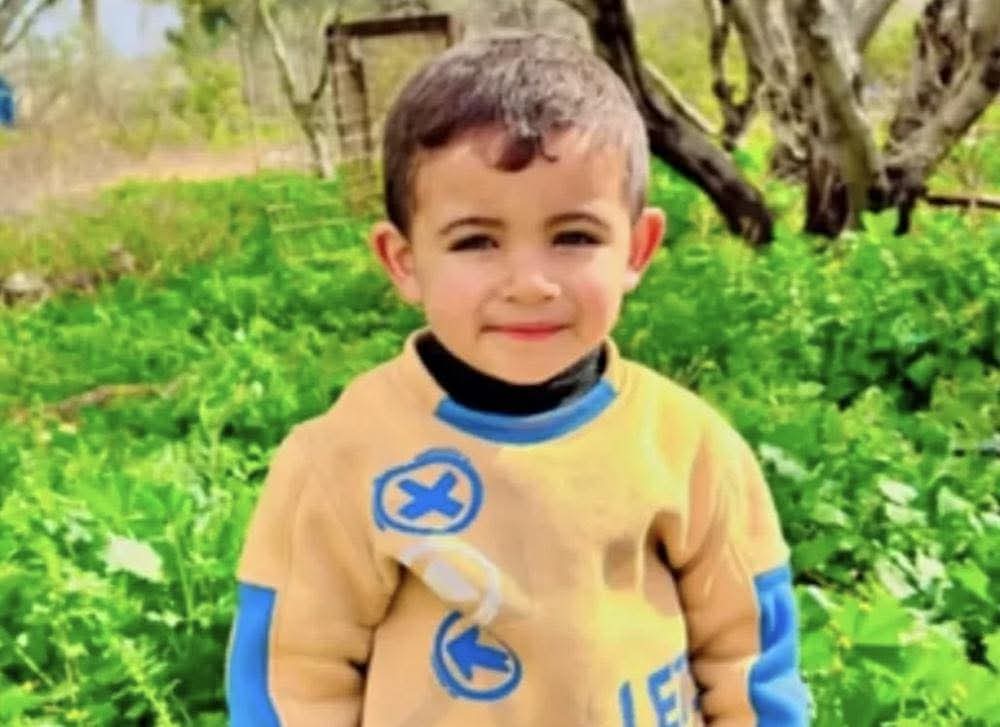
On either side of the Yellow Line, ‘Palestinians die’
After three-year-old Rayan was shot, Abu al-Ajeen said that he immediately began screaming, “My son, my son.”
“My leg was bleeding, and my child was dying in my arms, taking his final breaths. I begged them to let me die but to save my son. They refused and offered no assistance,” Abu al-Ajeen recounted. “The soldiers told me, ‘Leave your son.’ I told them I wanted to save him, but they kept ordering me to leave him.”
The father also said that while soldiers discussed his leg injury, he heard some of them speaking Arabic amongst themselves. “Leave him. Cut off his leg,” they said, according to Abu al-Ajeen.
Abu al-Ajeen recounted that the soldiers did tie his bleeding leg in the end, after which they placed him in a military jeep with his son’s body beside him. “They drove off at high speed over bumps and potholes while I sat in the back, handcuffed.”
“Every time I spoke or asked for help, the soldiers shouted at me, ‘Be quiet.’ They would not allow me to make a sound, even if I were crying from pain,” he said.
The father said that while he repeatedly pleaded for help for his son, some soldiers mocked him. “Are you so worried about your son, calling out ‘Aboud, Aboud’ all the time?” they told him, according to Abu al-Ajeen. “They left me bleeding for six continuous hours.”
They drove him and his son from one place to another inside the vehicle while he bled, Abu al-Ajeen continued. Close to midnight, they abandoned them near Kissufim, a crossing point between Deir al-Balah and Khan Younis in southern Gaza.
As the soldiers dropped him off, Abu al-Ajeen lost track of his son and kept asking them where he was. “And they answered me, ‘your son is next to you,’” he said. “I was shocked to discover that they had wrapped him in a black plastic bag and thrown him beside me.”

In a report published by The Associated Press based on testimonies from Israeli soldiers who have served in areas near the Yellow Line, one reservist said that he saw soldiers “relishing the chance” to go after those who passed through or even just approached the Yellow Line. The army’s standing orders, according to the testimony, called for direct gunfire against anyone approaching the area. Mondoweiss has repeatedly reported on similar incidents, where live fire often served as the only warning given to civilians who were unable to see where the boundary was located.
“There was a general feeling that human lives are not valuable,” one soldier told AP. Another soldier said that Israeli forces were frequently positioned far from the individuals they targeted and acted “too quickly.”
But in Abu Al-Ajeen’s case, the Israeli force had itself infiltrated the Yellow Line and was inside an area that civilians use.
Despite the ceasefire remaining formally in effect, Palestinian fatalities in Gaza have not stopped for a single day. Between June 13 and June 16 alone, 17 Palestinians were killed across different parts of the Strip, according to the Gaza Health Ministry’s daily reports, while nearly 50 others were injured following separate shelling incidents and targeted airstrikes. Since the October 2025 ceasefire went into effect, over 1,000 Palestinians have been killed in Gaza.
The AP report quoted Israeli soldiers who described the ceasefire as “nothing more than a joke.”
Jaber Abu al-Ajeen, the slain child’s grandfather, said that they are not safe in the areas designated as safe zones. “There is no safety. Inside the Yellow Line or outside of it, Palestinians die,” he said.
* Editor’s note: An earlier version of this article incorrectly stated that Rayyan Abu al-Ajeen was seven years old. The article was corrected on June 18, 2026, at 4:59 p.m. ET.
Tareq S. Hajjaj
Tareq S. Hajjaj is the Gaza Correspondent for Mondoweiss and a member of the Palestinian Writers Union. Follow him on Twitter/X at @Tareqshajjaj.

Back to In landmark case, UK judge sentences pro-Palestine activists as terrorists – Mondoweiss , the story of four activists convicted of terrorism for destroying military equipment sent to Israel:
The question the story raises is whether or not it’s moral to destroy physical property. Well, we can all think of cases where we believe it’s morally justified to destroy physical property – no need to discuss examples, we can all provide our own, it’s the sort of thing everyone has thought about at one time or another.
This story, and hundreds like it, should shed some light on the moral issues of the Elbit case.
When I was in college and I studied how European Zionists destroyed Jewish Arab communities to populate stolen Palestine and to block us Palestinians from returning home, I was sympathetic to Jewish Arabs, who were so mistreated by white racial supremacist European Zionist colonial settler invaders. The Zionist leadership had arguably committed genocide against Jewish Arab communities.
White racial supremacist European Zionist colonial settler invaders offered Jewish Arabs higher status in Zionist colonial settler society if Jewish Arabs were willing to act with hatred toward us Palestinians and other Arabs. Since the 1990s, the Zionist school system has taught Israeli students that Palestinians are Nazis and the main problem that the Zionist state faces.
https://www.youtube.com/watch?v=FznWDOYLy2k
In destroying Gaza and brutalizing Palestinians, Zionist soldiers expect praise for irreversibly eliminating the problem of Palestinians.
Already, in 1947-1948, by the legal standards of the Nuremberg Tribunals, the Zionist militias and the IDF should have been criminalized as the SS was criminalized. Today the IDF acts far worse than the SS did.
I no longer have much sympathy with Israeli descendants of Zionist-destroyed Jewish Arab communities.
UN: 30% of Gazans Israel Killed Were Children
June 24, 2026
The U.N. inquiry finds that Israeli forces’ widespread shooting and killing of children and destruction of neonatal and maternity-care facilities is key to establishing genocidal intent, Stephen Prager reports.
By Stephen Prager
Common Dreams
“About 30 percent of those killed by Israel in Gaza since Oct. 7, 2023, have been children, according to a United Nations inquiry, which found the “deliberate” targeting of kids to have furthered a genocide against Palestinians.
The report, authored by the U.N. Independent International Commission of Inquiry on the Occupied Palestinian Territory, follows a previous finding in September that Israel’s actions in Gaza constituted genocide.
“The deliberate targeting of children is one of the key elements establishing genocidal intent of the Israeli authorities and security forces to destroy the Palestinian group, in whole or in part, in Gaza,” the commission said on Tuesday.
Between the start of Israel’s military campaign in October 2023 and the “ceasefire” agreement in October 2025, the report found that more than 20,000 children were killed, while more than 44,000 were injured. Among those killed, more than 5,000 were under the age of 5, more than 1,000 were under the age of 1, and more than 400 were newborn babies.
The report highlights documented instances in which Israeli forces directly fired upon children, with medical professionals testifying that they treated kids with “direct gunshot and sniper wounds, often to the head and abdomen.”
One sample of 168 children killed by gunshots found that 73 were shot in the head and 22 were shot in the chest, which the commission argued was evidence of intentionality.
‘Target Practice’ on Teens
“Based on the clustering of injuries and the targeted body parts, I assess that the Israeli soldiers have been deliberately shooting teenage boys in a game of target practice — a different body part being targeted on different days… There is a very clear pattern that suggests this is a deliberate aiming of different body parts [of children],” one doctor told the commission.” “
https://consortiumnews.com/2026/06/24/un-30-of-gazans-israel-killed-were-children/
2/2 “I have three questions today for Israeli people. Through this press conference, I want to speak to them directly.
What kind of people are your soldiers who would allow a 14-year-old child to bleed to death over a 40 45 minute period?
What kind of people are your military leaders that would inculcate a culture that soldiers feel free to do this acting [clears throat] with total impunity?
What kind of people are your leaders when they give orders, they make statements that encourage this kind of conduct, not merely permit it, but encourage it?
I saw a couple of weeks ago that Israeli President Herzog made a statement about some extremist Israeli settlers. He described, and I I quote the report of what he said directly, a wave of terrible violence that is being carried out by an anarchist mob. acts that defile and violate every basic moral, legal, and Jewish norm.
Herzog was speaking about a handful of extremist settlers and he was right in the way in which he described them. But he should have gone on to describe the key institutions of Israeli society, the government, the Knesset, the political parties and the military in exactly the same terms. and a anarchist mob committing acts that defile and violate every basic moral, legal, and Jewish norm.”
I’m puzzled that he quoted the genocidal president that makes no difference between combatants of the Palestinian resistance movement and Palestinian childrens at all.
According to the UN, Gaza now has the highest number of child amputees per capita in modern history, with estimates reaching up to 4,000 cases.
Reports from Save the Children and the WHO reveal that an average of 10+ children have lost limbs every single day. Due to strict blockades and a collapsed healthcare system, doctors have been forced to perform these traumatic amputations without anesthesia or basic antibiotics. Many of these limb losses were medically preventable but became unavoidable due to the lack of surgical resources.
Beyond the immediate horror, these growing children face a lifetime of complications without access to necessary follow-up surgeries or prosthetic care.
“Most moral army of the world.” according to what ‘moralilty’? Biblical genocidal?