Eamon Murphy offers the definitive analysis of what has come to be knows as “Chickenshitgate.” He writes: “In light of the predictable response to Chickenshitgate — in Israel, indignation on the right and exasperation on the left, pearl-clutching and tongue-clucking here at home — Goldberg’s warning about “unsurprising, post-November” changes to US policy seems like a case of saying it to keep it from happening. Publicly presenting a map with borders and withdrawing diplomatic cover for Israel in the UN would be positive steps for the Obama team; but letting their ostensible pet journalist put them on the defensive against Netanyahu is representative of the wisdom with which they manage the special relationship.”
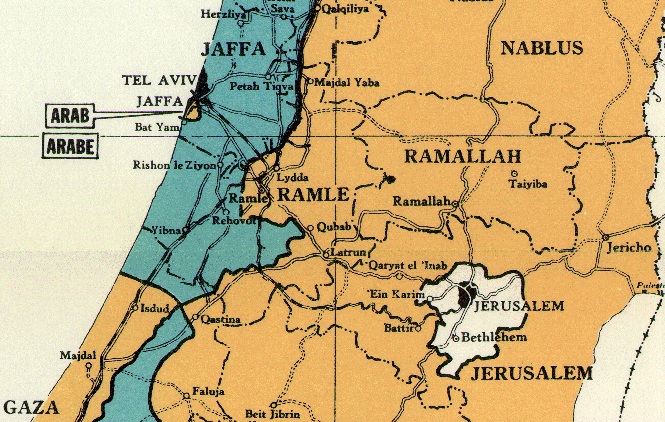
Israel gained recognition in 1948 by accepting the UN Partition borders of 1947, but has negated those borders since. But any partition of the land must reflect that division, explains scholar David Gerald Fincham. This post has been updated with an explanation from Prof. Francis A. Boyle clarifying the advice he offered Palestinian leadership on borders.
Jean-Jacques Surbeck, Israel apologist, speaks at Santa Cruz university and leaves a listener enraged by his mythology. Katie Miranda takes a lesson from the prophet Muhammad, channel your rage.
Menachem Zivotofsky was born in Jerusalem in 2002 to American parents. His lawyers are currently arguing before the U.S. Supreme Court that his passport should designate “Israel” as his place of birth, but Supreme Court Justice Elena Kagan responds that’s absurd. Zivotofsky’s case has received much attention and several stalwarts of the Israel lobby are hoping for a ruling that essentially grants Congress the authority to overrule the White House when setting policy on Jerusalem. Described as both “a proxy war for U.S. foreign policy toward Israel” and “foreign policy minefield,” the implications of the Supreme Court’s decision could have lasting repercussions not just to US politics and national interest, but for the Middle East.
Alia Alrosan’s parents were once PFLP fighters for Palestine in Lebanon. They came back to Palestine because they believed in Oslo. The young actress relates how living under occupation, she felt herself “a fighter for freedom who loses the war,” till she found the Jenin Freedom Theatre.
Lena Dunham had lifechanging experience in Israel, and David Mamet’s embrace of Asperger’s as an example of Jewish supremacy
Struggles in Gaza continue although it seems to many Gazans that much of the international community, including activists, have moved on to other issues.
About 80 Israelis rallied last Wednesday night outside of Jerusalem mayor Nir Barkat’s house, chanting and banging drums in protest against the intensified attack on East Jerusalem that has taken place over the last week and to demand an end to what they call the policy of collective punishment toward the residents of East Jerusalem. Protesters chanted “There’s no such thing as illegal houses, there is such thing as racist laws,” and “Arresting children does not bring security,” and held signs such as “Discrimination and marginalization in East Jerusalem = Apartheid.”
The growing momentum of the Boycott, Divestment, and Sanctions movement since last year has drawn a great deal of media attention to the issue of Israel-Palestine, and the cause of Palestinian rights. Unfortunately, this often has produced more confusion and obfuscation than illumination and clarity. Even one of the mainstay journals of American academia, the Chronicle of Higher Education, is not immune from inaccuracies and misstatements. Even when it claims to be setting the record straight. This points to an inability, and perhaps unwillingness, of the mainstream media to treat the issue of the academic boycott of Israel in a fair-handed manner.
“Friends” of Palestine – the churches, NGOS and the UN – will go out on the Palestinian limb – up to a point. The dance that follows is what Marc Ellis calls “ritualized solidarity.” Is BDS any different? At this point, he believes it is – to some extent. But there are unexpected dangers ahead. In the end, BDS supporters may have no choice in the matter. Those driving the peace train are much more powerful than movements of dissent, including BDS.