

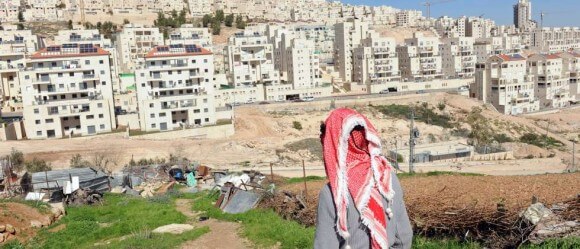
Another conference devoted to One Just State in historic Palestine is about to convene in Dallas in March, 2015. The backdrop is a resurgence of futile individual acts of violence in the last few months by Palestinians enraged by racism, deprivation and occupation. In a search for a viable strategy for resistance and change, small groups of Palestinians, along with a few Israeli and international allies, have held a series of such conferences since 2007.
The one state rationale comes from the clear unwillingness of the Israeli government to pursue any policy except continued expropriation of Palestinian land and an apartheid policy, while obfuscating its aims by claiming to seek a two state solution. The outlook is to build international consciousness through BDS and other means, but also to enlist the support of world governments. At a recent such conference the author attended in Ramallah in September, 2014, the BDS movement and an international petition were proposed by one speaker, with the other emphasizing a need for popular struggle uniting Arabs and Jews, such as mass attacks on the separation wall.
What is absent from much of the discussion of one state is how this just state is to be structured economically and politically. South Africa is seen as a model to emulate because ANC members were able to take political control in a non-violent manner, and the international anti-apartheid boycott is given much of the credit. However, there was a long history of mass, violent struggle, and more to come, that gave the ANC its major clout. Moreover, the ANC declined to make any economic demands as it accepted a victory in terms of civil rights, which allowed the white corporate elite to maintain its pre-eminence and profits and largely explains the non-violent nature of the transfer of “power”. Today, the black population still largely lives in dire poverty in a segregated society despite the end of apartheid laws.
The world is full of single states that call themselves just and democratic, but even in wealthy ones like the US, racism and inequality are rampant. The populace can vote every four years, but the choice is between candidates who support the profit-driven system that requires inequality to maintain itself. The wage differential between black and white workers in the US is equal to one third of corporate profits, a difference the system could not afford to do away with. Electoral candidates only differ in their tactics over how to run this same system. As the fate of Salvador Allende has illustrated, elected as a socialist but murdered in a CIA backed coup, fundamental change cannot be voted in and maintained if not backed by an armed movement.
Despite being occupied, Palestine is by law a free market economy. This means that a small group owns the means of production, to use a Marxist term, and others are to be employees or independent farmers, service workers or professionals. As in all free market societies, the owners of industry are also closely tied to the political elite. Palestine ranks second to last in the world in the ratio of management to unskilled labor incomes. [1] Senior government agents earn 24 times more than lower paid workers, and unemployment is about 25%. [2] Even in devastated Gaza, up to 1000 have become millionaires through control of the tunnel trade. [3] Although the individual GDP in the West Bank rose by 35% under PA Prime Minister Fayyad from 2007-2010, unemployment and poverty remained the same. [4]
Israel, although far richer, has the same economic structure, a capitalist one. Although super-exploitation is reserved for the Palestinian Israeli citizens and immigrant workers from Africa and elsewhere, there is also a Jewish underclass, made up disproportionately of darker skinned Jews of Arab or African heritage. In Israel, the wealthy earn 14 times more than the poor, a ratio lower only than the U.S., Mexico or Chile. [5] Income inequality is growing faster than in other developed countries, and inequality by ethnicity is especially severe. [6] The poverty rate in 2013 was 20.9%. [7]
Any movement which is going to enlist masses in the call for a single just state must address the needs of the non-owning majority of Arabs and Jews on both sides of the wall. There must be a demand for an egalitarian state, where production is owned and operated by the majority based on their needs, which is very different from demanding equal access to employment as put forth in the founding Munich Declaration of the One State movement. Such a society cannot be attained by negotiations among the rich and powerful, not the leaders of Israel, the Palestinian Authority, or any other nation in the world today. Such groups never cede their economic, political and military hegemony willingly. It is a goal that must be fought for with a militant mass movement that can unite workers, students and professionals of all nationalities because it is in all of their and only their interests.
At the moment there is little mass struggle in either Israel or the West Bank. Many Israeli Jews have been won to such virulent anti-Arab racism that they are easily led to blame their economic problems on those they occupy. Many Arabs are not anti-Semitic, only anti-Zionist, but are discouraged by the corruption and malfeasance of their so-called leaders, the defeat of prior uprisings, and the struggle to survive.
A multi-racial struggle for a non-profit-driven egalitarian society could inflame the passions and militancy of all those from the “river to the sea”. There is no doubt that mass anger exists. Hundreds of thousands of Israelis demonstrated for weeks in 2011 for housing and better wages, a struggle limited by its failure to address the nature of power in Israel or the role of the occupation. It is incontrovertible that the vast majority of Palestinians are enraged at the oppression and deprivation under which they live – only leadership and organization of struggle is lacking. At this time the need is to build rank-and-file-led struggles on both sides of the wall, fights which expose the traitorous misleaders on both sides and how nationalism can be used to build false loyalty to them. Struggles must expose the pernicious nature of racism and build the leadership skills of ordinary people. In the course of many such uprisings, the idea of non-racial non-capitalist society can grow.
To build a multi-ethnic movement for an egalitarian society is a difficult but necessary task. That movement would be a beacon for the world. It is also true that if any such radical struggle occurred in isolation in Palestine, or anywhere else, it would be mercilessly attacked. However, around the world, the disenfranchised are waking up once again. Although the surge of struggle is always uneven, there will be allies around the world for anti-racist, anti-exploitation movements wherever they take hold.
Footnotes.
[1] Ola Naguib, Palestinian Authority Second Worst for Wealth Disparity, 10/26/13
http://www.bbc.com/news/business-24673789 (accessed 1/20/15)
[2] Yolanda Knell, Could Peace in the Middle East Bring Palestinian Prosperity, 6/27/13, http://www.bbc.com/news/business-23079623 (accessed1/20/15)
[3] Omar Shaban, New Class of Palestinians Get Rich on Gaza Tunnel Trade, Palestine Pulse, http://www.al-monitor.com/pulse/originals/2013/01/gaza-tunnel-millionaires.html, (accessed 1/20/15)
[4] Ben Hattem, Palestine’s Other Land War, Middle East Eye, 9/18/14, http://www.middleeasteye.net/in-depth/features/palestine-s-other-land-war-1213915354 (accessed 1/20/15)
[5] Zeev Klein, Israel Amongst Countries with Highest Income Gaps, OECD Reveals, IsraelHayom,12/6/11,http://www.israelhayom.com/site/newsletter_article.php?id=2090 (accessed 1/20/15)
[6] Moti Bassok, Study: Income Inequality Growing Faster in Israel than in Other Developed Nations, 3/28/12, Haaretz, http://www.haaretz.com/business/study-income-inequality-growing-faster-in-israel-than-in-other-developed-nations-1.42127 (accessed 1/20/15)
[7] Richard Silverstein, Israel Poorest of OECD Countries, 5th Largest Income Gap, 5/14/13, Tikum Olam, http://www.richardsilverstein.com/2013/05/14/israel-poorest-of-oecd-countries-5th-largest-income-gap/


“It is incontrovertible that the vast majority of Palestinians are enraged at the oppression and deprivation under which they live – only leadership and organization of struggle is lacking. ”
Ellen Isaacs’s group is chasing too many butterflies at the same time. Before convening these conferences on how the 2 groups would work together, it would be more productive to first work out what the Palestinians want and at this point their voices are not unified. Palestinians have no effective leadership and even worse, there is no organization in place that could assume either a partnership with Israel or to go it alone in a 2-state situation. Other than a massive police force devoted to the protection of Israel since 20 years, the Palestinians do’t have much in way of infrastructures. The only way of getting through to the Israelis is by hitting them with a 2×4 between the eyes by collapsing the redundant PA.
What basically happened in South Africa is that a deal was brokered between the ANC and the white corporate and landowning elites (and behind them the institutions of global capitalism) by which formal political equality was established but existing property relations were left untouched. The abolition of apartheid could be regarded as a first step toward a just solution; the problem was that the first step was made strictly conditional on no further steps being taken.
At a certain stage in the Palestinian struggle something similar might happen in Palestine/Israel. Those Palestinians who do not have formal political rights would receive them, but subject to built-in constraints on their use — for instance, severely limiting the restoration of former Palestinian land rights. These constraints might be justified in terms of partly preserving the Jewish character of the state (a sort of minimal or watered-down Zionism). The formal right of return might even be ceded, in the knowledge that only a few Palestinians would have access to the means of livelihood (land, capital, jobs) needed to exercise the right of return and actually resettle in Palestine.
An example of such a constrained right of return is the situation of the Crimean Tatars deported from Crimea in 1944. They were eventually allowed to return to Crimea but not to their old houses and lands, which remained in the possession of the families (mainly Russian) that took their place after the deportation. They are still confined to marginal land and eke out a bare subsistence.
So it would make sense to work out an alternative to this scenario in advance — some arrangement that would be a little less unjust while still not hopelessly unrealistic.
Ellen’s position statement has the flavor of the PFLP party line – that liberation of land is insufficient. Working toward a liberated, egalitarian society, whether in Palestine, or here in the U.S. is the bottom line. What may look like “chasing butterflies” to cynics is a prescription for a better world. It is a charge handed to us by generations yet unborn. Thank you Ellen.
“There must be a demand for an egalitarian state, where production is owned and operated by the majority based on their needs, which is very different from demanding equal access to employment as put forth in the founding Munich Declaration of the One State movement.”
I couldn’t disagree more. Despite numerous attempts all over the world in the past 100 years to found states where “production is owned and operated by the majority,” the history of such states is miserable. They are characterised by a brutal repressive state apparatus, a corrupt and incompetent ruling elite and economic and social stagnation.
Should a single state arise in Palestine, it will require vast amounts of inward investment to repair the appalling damage done by decades of military occupation and economic repression such as the Gaza blockade and Israeli control of the West Bank. At the same time, the old Israeli economy will have to readjust to a much lower level of military spending, the emigration through fear of much of the professional and business class, and a climate of disorientation and anxiety.
The best thing anyone can do to block that inward investment is to embark upon discredited mid-20th century economics!
Having conferences that fantasize about one state solutions in Palestine that idealize and ignore deep divisions and fundamental realities are like Marxist conferences in the 21st century that discuss the prospects for socialist utopias while glossing over the failures of all existing attempts to establish communism.