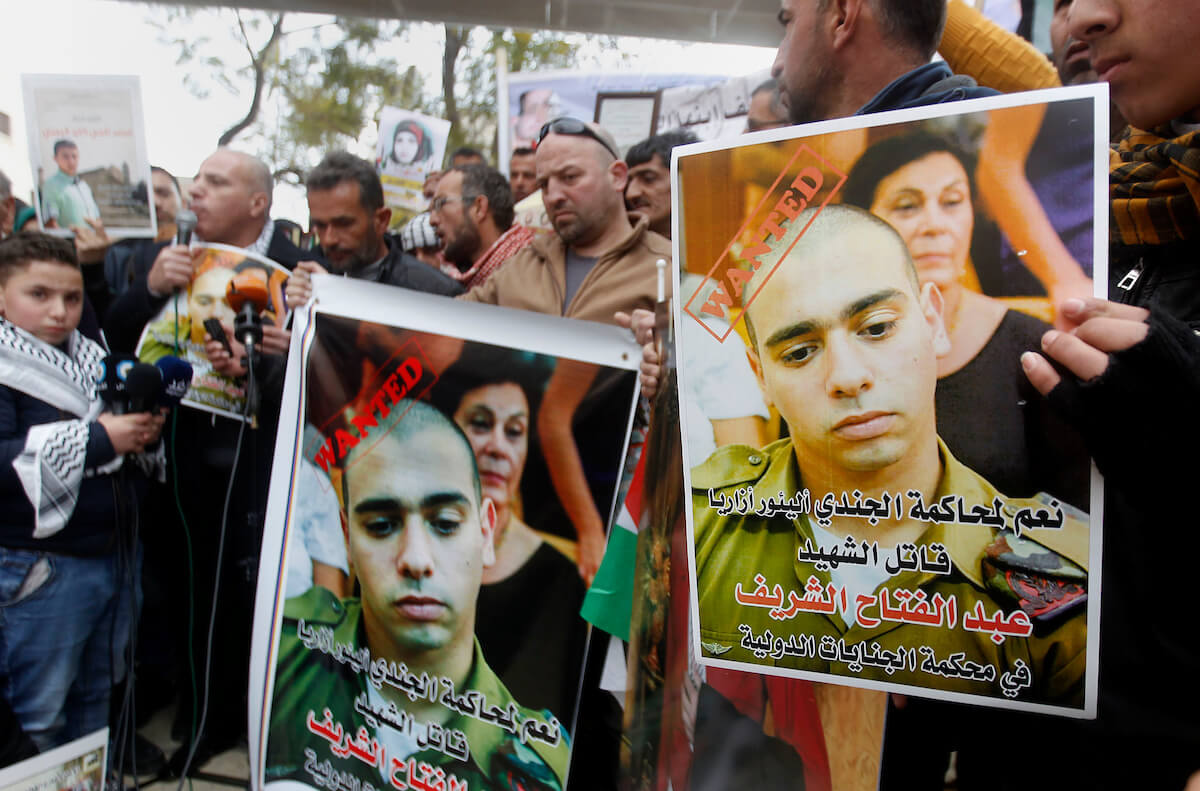
Elor Azarya had “endured a lot”, said an Israeli military spokesman, announcing Chief of Staff Gadi Eisenkot’s decision to cut four months off the soldier-medic’s already lenient 18-month sentence for killing a wounded, immobile Palestinian alleged attacker by a bullet to the head at point blank on the street in Hebron in 2016.
Are the moves by Fatah and Hamas towards new elections and a unity government a genuine push for strengthened Palestinian governance, or simply a strategy by faltering politicians to stay in power?
Israeli forces placed the West Bank village of Beit Surik under a military lockdown on Tuesday following a deadly shooting attack carried out by a village resident, with all entrances to the village blockaded by the Israeli army. Nimr Mahmoud Ahmed Jamal, 37, of Beit Surik, killed three at the nearby illegal Israeli settlement of Har Adar before being shot dead, Israeli officials said.
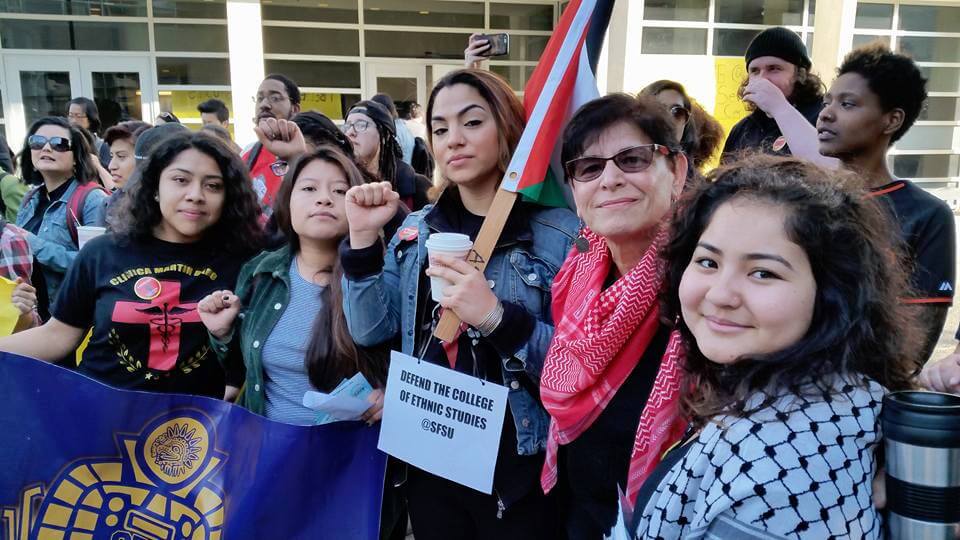
Read and sign a statement from Jewish supporters of Professor Rabab Abdulhadi, who is currently under attack by an organization identifying itself as “the legal arm of the pro-Israel community.”
The UN is sending letters to 150 companies around the world warning them that they could be added to a database of complicit companies doing business in illegal Israeli settlements. U.S. companies that received letters include Caterpillar, Priceline.com, TripAdvisor, and Airbnb. Omar Barghouti, co-founder of the BDS movement, says, “this UN database of companies that are complicit in some of Israel’s human rights violations may augur the beginning of the end of Israel’s criminal impunity.”
The New York Times headline is, “Palestinian Kills 3 Israelis, Shattering Tranquillity at West Bank Crossing.” The definition of “tranquillity” employed by the Times is one-sided; it can only apply to the Israeli point of view, inside a bubble, oblivious to Palestinian suffering.
Once again The New York Times defers to supporters of Israel. It gives the pro-Israel peace processor Dennis Ross a platform on the op-ed page to talk about anti-Semitism in the State Department back in the 80s and 90s. And Ross leaves out his marching orders to a Jewish audience, “We need to be advocates for Israel,” not for Palestinians.
At NYU, Rashid Khalidi says four Arab countries have been destroyed and ISIS would cut the throats of a quarter of the Syrian population, so he can’t blame Arabs for worrying about other issues more than Palestine. The historian also says that Palestinians faced a unique colonial problem because Zionism had 3 sources of support, international legitimacy at a time of decolonization, British backing, and a “river” of money from international Zionist movement.
Author Samuel Freedman is blind to Palestinian conditions in an article in the Forward celebrating the U.S. Jewish “love affair” with “the Jewish state.” And meantime he decries the “ideology of white supremacy” in the New York Times and praises the civil rights movement for ending Jim Crow. After 50 years of occupation and apartheid in Palestine, you can’t have it both ways.
Former Algerian female fighter Zohra Drif writes in her new memoir, “Perhaps the reader of today expects me to regret having placed bombs in public places frequented by European civilians. I do not. To do so would be to obscure the central problem of settler colonialism by trying to pass off the European civilians of the day for (at best) mere tourists visiting Algeria or (at worst) the ‘natural’ inheritors of our land in place of its legitimate children.”