


Religion has shaped Lebanon since it gained independence from France in 1943. In this multicultural country of Muslims, Christians and Druze – a medieval faith derived from Islam – religion defines membership and belonging. It is woven into Lebanon’s economic, political and social fabric.
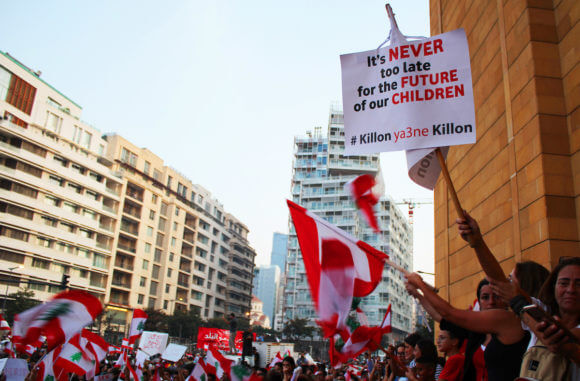
The mass protests that began in mid-October over a proposal to tax WhatsApp calls are challenging that tradition. Over a million Lebanese from all faiths have joined together in these leaderless and nationwide anti-government demonstrations, in which the agenda has now expanded from avoiding taxes to regime change.
“All of them means all of them,” protesters nationwide chant, demanding the ouster of Lebanon’s entire ruling class.
Protesters blame Lebanon’s Christian president, Shiite parliament speaker and Sunni Muslim prime minister for rampant corruption, a wrecked economy and a ravaged environment. They are demanding fair elections, a stronger judiciary and more government accountability.
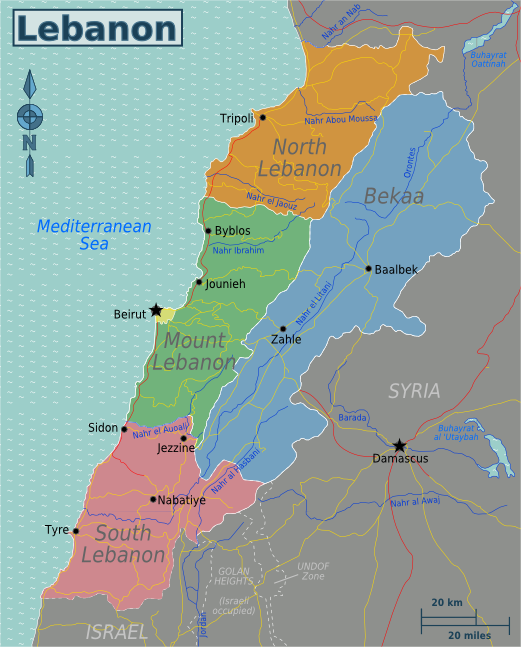
On Oct. 27, tens of thousands of Lebanese joined hands to form a 105-mile-long human chain running from the southern city of Tyre through the cosmopolitan capital of Beirut and into Sunni-dominated Tripoli – a repudiation of the idea that religious allegiance comes before national unity.
‘Hunger has no religion’
With 18 recognized sects – including the Maronite Christians; Sunni, Shiite and Alawite Muslims; and the Druze – Lebanon is one of the most religiously diverse countries in the Middle East.
When a class struggle broke out there in the mid-1970s, it quickly devolved into a civil war between right-wing Christian and left-wing Muslim militias.
To end Lebanon’s conflict, the 1989 Taif Accords required all factions to relinquish their weapons and distributed government positions to politicians of different faiths.
This power-sharing agreement has kept the peace in Lebanon. But it has also given it a political order built on religious factionalism.

Patronage networks run by the “za’eem,” as Lebanon’s powerful sectarian leaders are called, protect the interests of their religious communities, doling out favors both legal and illegal. All faiths have their own za’eem.
Religiously based governance has given Lebanon both extreme national debt and staggering inequality. According to the World Inequality Database, the richest 1% of Lebanese own approximately a quarter of the nation’s wealth. Lebanon’s infrastructure is crumbling. Power outages are a chronic problem even in urban middle-class neighborhoods.
Widespread human rights violations – including domestic violence, child labor and abuse of Syrian refugees – are rarely punished.
But, according to the political scientist Bassel Salloukh, Lebanon’s rulers “use sectarian mobilization to camouflage intra-sectarian socioeconomic disparities” – a divide-and-conquer strategy meant to stop class solidarity from emerging.
The beneficiaries of this system argue that Lebanon’s stability hinges on this sectarian balance. And, indeed, sectarianism has been remarkably effective in forestalling dissent for the past 30 years.
It has also instilled a deep distrust in government. A recent poll shows that 96% of Lebanese think political corruption is endemic.
The sectarian construct
As a literary historian, I study the stories a nation tells itself about belonging, allegiance and identity. In Lebanon, my home country, I recognize sectarianism as a social construct.
Social constructs, like civility or money, are concepts that only mean something because humans agree they do. Often, social constructs benefit the powerful.
By drawing the boundaries of inclusion along religious lines, Lebanese sectarianism has impeded the rise of more unifying ideologies like nationalism or secularism.


“Sectarianism has been depicted as a monolithic force, unchanging in the face of history,” historian Ussama Makdisi wrote in his 2000 book “The Culture of Sectarianism. But, he continues, “sectarianism was produced. Therefore it can be changed.”
Since the civil war, Lebanese have been raised to see religion as the only marker of kinship and rivalry, but the Lebanese share many things: a multilingual literary heritage, for example, and a love of Fairuz, one of the Arab world’s most admired singers.
Lebanese of different faiths suffer together, too. As one protester told Foreign Policy, hunger has no religion.
Sectarian politics have been dismantled before. Two decades after Northern Ireland’s Good Friday Agreement, the divide between Catholics and Protestants there remains. But it is official government policy to foster peace-building, human rights and religious freedom.
Like protesters in both Tunisia and, more recently, Sudan – who pushed out religiously divisive leaders in hopes of nurturing a more secular democracy – Lebanon’s protests challenge a tired western stereotype that the Middle East is an intolerant, naturally authoritarian place.
Hezbollah is no exception
In recent days, demonstrators who support Hezbollah have protested the inclusion of their leader, Hassan Nasrallah, in the movement’s calls for regime change. They say accusations of corruption against this powerful Lebanese political and social force are evidence of a conspiracy by Saudi Arabia, Israel and the United States.
Still, the uprising continues to grow. Efforts to break up protests using violence have failed, as have offers from the government to cut lawmakers’ salaries by half and tax banks to relieve national debt.
The current grassroots protests build on the momentum of a 2015 uprising called the #YouStink movement. Those protests began when Lebanon’s main landfill was shut down and mounds of trash filled the streets of Beirut, but they came to embody numerous other causes: Children marched for climate action. Feminists defended the rights of domestic workers.
In 2018, women ran for office in Lebanon record numbers.

Rebuilding a nation
There is an academic theory I like about how nations are built, called “cultural intimacy.”
It holds that communal acts like breaking bread together, say, or self-deprecating humor play a crucial role in creating a shared citizenry.
The 1.5 million Lebanese Sunnis, Shias and Christians who have for weeks been walking side by side, holding hands and raging against the system are not merely protesting. They’re building a society that works for them.
This article is republished from The Conversation under a Creative Commons license. Read the original article. [ Deep knowledge, daily. Sign up for The Conversation’s newsletter. ]
Thank you for this very interesting article. I really appreciated these words:
“The 1.5 million Lebanese Sunnis, Shias and Christians who have for weeks been walking side by side, holding hands and raging against the system are not merely protesting. They’re building a society that works for them.”
I wish only the best.
Hezbollah has sent some of its men to beat up protesters. But nary a word against the fascists of Hezbollah to be heard around here. They’re a thorn to Israel, therefore they are above criticism.
I’ve been here for the past week. There is no evidence that Hezbollah sent anyone into any crowd and beat them up. The evidence seems to be in the fantasies of zionists like the one posting.
There has been very little violence, as hard as outside forces have tried. Demonstrations are run by young people, with huge numbers if them women.
If you talk to them (and I have), their overwhelming answer to who is demonstrating is “We are Lebanese first.” I have great hope for this revolution to be successful
Mmmmmm. Tempting as it might be to wish all the hopeful, young protesters in the Lebanon well and to empathise with their desire to see an end to corruption, sectarian power games and the beginning of a process of renewal, I fear one might have to delve a little deeper to divine what’s presently going on in each of Lebanon and Iraq where, since the beginning of the month, not dissimilar protests have led to that government’s finding its position more precarious than previously and brought political opportunists like Moqtada al-Sadr onto the streets in the hope of being swept into positions of power by the popular tide calling for reforms. The phenomena in both countries have more the feeling of “colour revolutions” – for one thing, they’re too damned well-organised and have grown too large, too fast to be genuinely “grass roots”. I’m not suggesting that many grievances being expressed are not genuine; or are not felt genuinely by those participating. I’d counsel, however, looking closely at who might be obscured in the shadows at the edges of these apparently spontaneous crowds (or even be somewhere else altogether, yet actors); and then ask the question, “Cui bono?”
Who benefits from a multiplicity of possible outcomes? Who benefits if the result is the installation of new régimes more to their liking than Hariri’s/Abdul-Mahdi’s? Who, equally, benefits if the result transpires to be chaos and the disappearance of any semblance of a national government, to be replaced merely by competing militias of sectional, sectarian gangsters and a protracted period of “failed statehood”? Clue: one’s nearby; one’s in the region; one’s an ocean-and-a-sea away. All have “previous” for similar.
Is Lebanon mutlicultural, or just multi-religious?