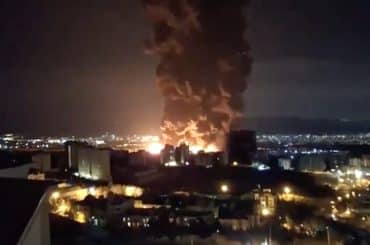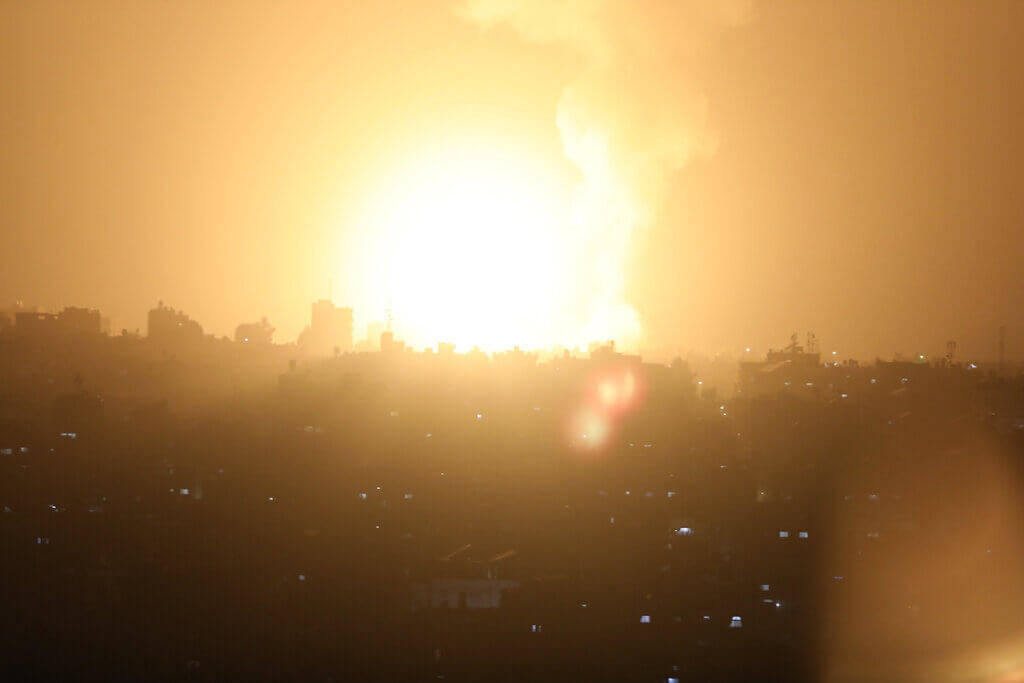
Flames rise during Israeli air strikes in the southern Gaza Strip, April 19, 2022. (Photo: Ashraf Amra/APA Images)
Mothers checked on their sons and told them to stay home Monday night in Gaza as the sound of Israeli warplanes spread terror across the sky.
After the warplanes arrived so did photos on Facebook showing people protecting their windows from breaking from the sound of bombs, as others started telling their friends the safety steps to take during wars. In Gaza, we link the holy month of Ramadan with the two devastating wars that have happened during that month. Even when nothing happens every valuable and pleasurable moment is scarred by the memories of recent years.
Hours before the sun set, and the warplanes struck fears among people, men got their plastic chairs and gathered on the pavement, as usually happens on warm weather days, so they could spend some time discussing current events until it was time to break their fast.
I found a group of seven hungry people surrounding a huge tree and their voices were rising, inflamed by news coming over a radio with the latest from Al-Aqsa mosque. Each one of them had a point of view of the events, however they all are believers that, “there is no such power that can defeat the Palestinians in their homeland,” according to Abu Maher, 77, who sat holding his chin.
The news of Israeli forces storming Al-Aqsa Mosque and attacking worshipers has dominated people’s attention in the besieged Gaza strip, as has Al-Aqsa’s Palestinian defenders who always prevent Israel from controlling the Mosque. Videos and news across social media show Palestinians of all ages in occupied East Jerusalem defending their holy mosque. The scenes captivate people in Gaza but at the same time they also put them on alert for an escalation and a possible return to war in Gaza. Two previous wars in 2014 and 2021 began with a similar chain of events when Palestinian defenders called upon Gaza from Al-Aqsa yard to intervene in defending our land, which then turned to a bloody war against Gaza.
The men gathered on the street remember that history, but speak proudly about the Palestinians engaged in Jerusalem. “I saw some videos of them inside Al-Aqsa, I wished I could be among them,” says Khaled, 33, a young man standing next to the older men who are seated. “Why?” I ask him. “There were thousands in the yard in the second most holy place on the earth. They were all hosted and supported by Allah, that’s why Israel can’t defeat them,” he answers.
Khaled believes that those unarmed Palestinians who defend Al-Aqsa are stronger because they defend their holy mosque, so their belief moves them, unlike the Israeli forces who are following orders.
This group is sitting in the Al-Shuja’iyya neighborhood, one of the largest and most crowded places in Gaza. It is located next to the Israeli borders east of the city, and when there is war people in this area and their houses are most targeted. Still, the spirit among them is very high.
“You know if there was no borders and people could easily go to the Al-Aqsa, I swear people like Khaled and many others will go without a second thought to defend their belief,” Abu Ali, a man sitting among them said. Khaled listens and confirms by saying “if only” and continues, “Imagine as if all Palestinians from all the world could cross the borders and come, we will definitely take our home back.”
“See!” Abu Ali says with pleasure. “It is the people themselves, like Khaled, who are defending Al-Aqsa, nothing can stop them!”
While these actions in Jerusalem almost activate people’s sense of freedom in Gaza, there is also the concern of it turning into a war. War is bloody in Gaza when it comes, and unfortunately it comes often. The last war in May brought the death of 66 children in the most horror-filled 11 days many people have lived, so they observe the news with worry.
Hamza Abu Al-Tarabeesh is a journalist and activist, and he is keeping an eye on the actions at Al-Aqsa and posting his revolutionary feelings on social media. He believes that this time is different, with broader support and that the people are speaking on their own.
“It has been a wise decision to not escalate the military confrontation. The decision makers in Gaza understand that the destiny of people is in people’s control themselves,” Hamza thinks.
“When it comes from the people, the people win,” Hamza says. “Now people are defending the holy mosque of Al-Aqsa. Only the defenders are facing the occupation, and that is beyond the political level.”
Hamza thinks there is no better defender for Al-Aqsa than the original people of the city. They know the Israelis face-to-face, and they have experience with Israeli violence against them, including home demolitions and imprisonment. “They are the best to defend the mosque, and will absolutely protect it one generation after another.”
It is a weird circle of life people in Gaza are living. Events in any place in the world may affect their daily life. The majority of people hopefully expect to spend the holy month of Ramadan safely with no escalation or war, but those who are on the front lines spend their time watching, waiting, and thinking of a quick way to evacuate their families if war does arise.