
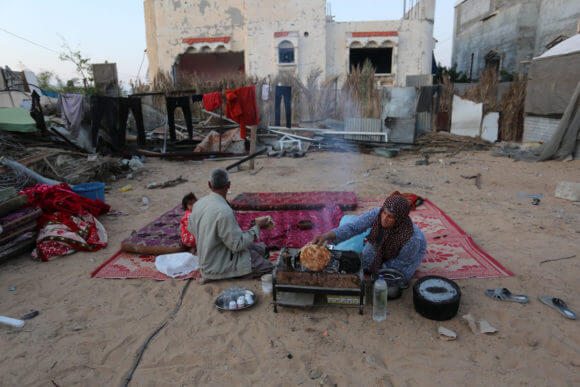
Every year, lots of effort goes into preparing for the month of blessings, Ramadan. I decorate the house, hang decorative strings on the walls, place flower pots in the corners of the house, clean the furniture and perfume it with the scent of incense.
One of the most important rituals for Muslim families in the month of Ramadan is the family gathering at the dining table for the sunset meal to break our fasts, iftar. In our family, we have our iftars and pray together on the balcony, surrounded by flowerbeds, and bunches of fragrant mint, and basil.
With the help of my husband, I hung lights on the roof of the balcony, and decorated it with strings and a new tablecloth to match the walls and floors. Before the blessed month began, I did everything I could in the house to ensure my happiness and the happiness of my family to welcome the month of Ramadan.
Despite everything I did, however, I still found myself feeling frustrated as my husband, due to the pressure of his work as a journalist, was leaving me alone at the table with my kids.
While I understood his work circumstances, it was still a sad feeling in Ramadan to sit at the table for iftar, the most beautiful hour for Muslim families during the month, alone with my kids.
Some may think that I am a stubborn person, but I think that many women will feel my pain. We spend a lot of time preparing to make our families happy at the iftar table, so when it comes time to break our fasts and my husband is not there, it is annoying to say the least.
As I thought about my circumstances, and the frustrations I was feeling, I was suddenly faced with a realization: that this year was the first Ramadan since the May 2021 aggression on Gaza, that hundreds of Gazan families were sitting down for iftar with incomplete tables, after losing loved ones to Israeli airstrikes last year. I realized that their dining tables will never be complete. An empty or lifeless table.
And I then felt that I was somewhat naïve; or perhaps very naïve.
Marwa the Widow
My husband, in any case, may compensate us by sitting with us the next day, or he might come back in the middle of the night to apologize to us for missing iftar.
But there are many wives, like 23-year-old Marwa Othman, who is spending this month alone at her home. Her husband Youssef al-Mansi, 24, who was killed last year, will never return home to her. She prepares food alone, eats alone, and searches through her memories alone. Instead of laughing with her husband at the dining table alone, she cries alone.
At the beginning of Ramadan in 2021, Marwa did what most young married women in Gaza would do. She decorated her house and prepared a special place for eating iftar with her husband Youssef, and their young son Qusai, who is now about a year and a half old.
“It was the most beautiful month of my life. Youssef had bought a special dining chair for our child, and the three of us were sitting at the table. I was waiting for this moment my whole life. I don’t remember once that he didn’t help me prepare food in the month of Ramadan,” Marwa remembered, of their first Ramadan together as a married couple.
Israel’s bombardment of Gaza began in the last two days of Ramadan 2021. The bombing was intense, and targeted residential areas across the Gaza Strip.
The army used what is known as the “fire belt” strategy, which is to carry out more than 150 air strikes in a specific area in less than three minutes. Even though we have experienced four wars since 2009, this density of rockets was new to us.
The purpose of this unprecedented attack was, according to Israel, to destroy Hamas’s military infrastructure and network of underground tunnels.
Among the “fire belt” strikes by the Israeli army, was one strike in the vicinity of the Qalibo mosque, east of the Jabalia refugee camp in northern Gaza, in the vicinity of the home of the extended Mansi family, Marwa’s husband’s family.
In the middle of the night on May 14, 2021, that is, on the fifth day of the aggression that lasted for 11 days, the Israeli warplanes launched about 50 missiles in the vicinity of the mosque, about 150 meters away from Marwa and Youssef’s house.
Marwa says about that moment: “I didn’t do anything. I hugged Qusai and we turned into one body. I couldn’t move or speak a word. Youssef then jumped out of his place and went down to the ground floor.”
Youssef, who worked as a traffic policeman, heard the screams of a neighbor, so he went out to help with his brother, Ahmed, and while running about 30 meters from the gate of their house, Israeli planes targeted them directly, and immediately killed Youssef, his older brother, Ahmed, and a neighbor.
A tragic video of Youssef and Ahmad’s brother Mohammed finding their bodies at a hospital while reporting on the airstrikes was spread widely on Palestinian social media.
Unfortunately, Marwa declined my invitation to join us for breakfast, as it turned out that she had promised herself that throughout this month she would practice the same rituals that she practiced with Youssef when he was alive. But this time instead of Youssef sitting on the other end of the table across from Marwa and Qusai, sat a photo of him that Marwa had printed.
Marwa continues in a broken voice: “The month of Ramadan, that I got to spend with my husband, cannot be compared to this month. I am a widow, do you understand that? I prepare food by myself and eat alone. My husband is now looking down at me from the sky, when he used to sit here next to me.”
As Marwa held back tears, she tended to Qusai, who she now focuses all her energy on. “Qusai, now I see Youssef in him. He looks exactly like his father. I will try hard to raise him like his father, who was elegant in appearance and kind-hearted.”
Alone at the table
Marwa’s story is unfortunately not unique. There are hundreds of families in Gaza who lost part of their families last year.
Israel succeeded in turning this blessed month, which all Muslim families wait for, into a house of mourning, particularly the moment of iftar, in the most beautiful hour, when the whole family gathers around the table.
Hundreds of families, instead of laughing with each other, break their fast these days with tears for their loved ones.
Alaa’ Abu Hatab, 36, lost his wife and four children last year, when they were killed by an Israeli airstrike on May 15th . Now, all he has left is his 5-year-old daughter, Maria.
The Israeli army destroyed his three-story family home in the Shati refugee camp with five missiles, turning his home into a large pile of rubble.
He says succinctly with a pale face: “Whenever the time for breaking the fast comes, I go into a state of severe depression, as the month of Ramadan in the past in my life was the most beautiful of my days. Today I feel like I am living in a funeral home during this month. Last year my family was complete, today I am alone with my little girl.”
Alaa’ tries to be the mother, father, brother and sister to his daughter during Ramadan. He tries to make up for everything that Maria is missing. “Israel destroyed my life, and it destroyed everything I used to enjoy before, even religious rituals like Ramadan. I miss its taste as I lost my children and my wife.”
Meeting these families was very painful, yet made me appreciate every single moment I spent with my family. I stopped arguing with my husband if he is not attending an iftar. At least, I know that by the end of the day, he will be back again.
Palestinians: Bust of 4500-yr.-old Goddess Anat found in Gaza “attests the Depth of Ancient Palestinian Civilization” (juancole.com)
“Palestinians: Bust of 4500-yr.-old Goddess Anat found in Gaza ‘attests the Depth of Ancient Palestinian Civilization’” Informed Comment, by Juan Cole, April 30/22EXCERPT: ‘A farmer plowing his land in Khan Younis, the Gaza Strip, recently found the head of a statuette of the ancient Levantine goddess Anat from 4,500 years ago, AFP reports.
“Everything in Israel/Palestine is political, including, and maybe especially, archeology.
“In 2500 BCE the ancient Levantine civilization, sometimes called ‘proto-Canaanite,’ was in full flourish. Several small kingdoms ruled over what is now Lebanon, Syria, Jordan, Palestine and Israel. The Canaanite or West Semitic (a linguistic, not a racial term) languages predominated. It was the early bronze age. A people referred to as Ken’an, Canaanites in English, had come to dominate Jerusalem and its hinterlands. There was no Israel, or any Israelites. That would be a development, out of the Canaanite or ancient Levantine peoples, of perhaps 1,700 years later.
“And that is where politics comes in, since the Palestinians in Gaza can claim that their forebears lived there 4500 years ago before there were any Israelis. Pro-Palestinian writers increasingly appropriate the Canaanites as their ancestors, even describing them as ancient Arabs.
“Of the discovery of the Anat bust, Naser al-Yafawi wrote, ‘Based on the foregoing, we see that the series of modern archeological discoveries confirms the depth of the ancient Palestinian civilization, and has sent a message that we are the owners of the land and history and refutes the falsehood of the Zionists.”