
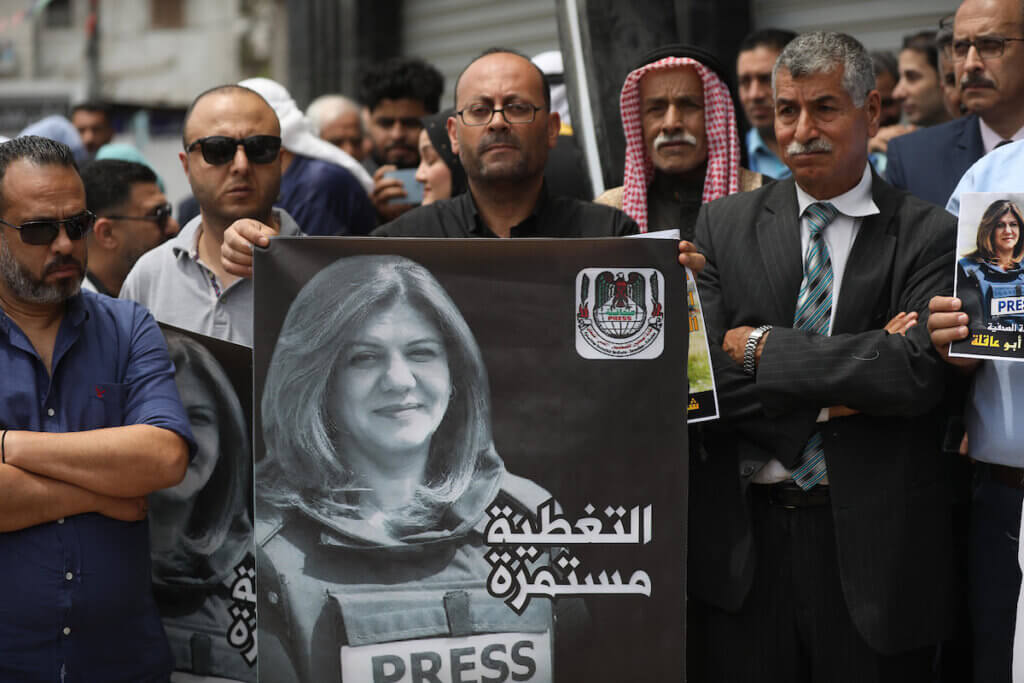
It’s been three weeks since Israeli forces killed Shireen Abu Akleh.
The sequence of events that unfolded following her killing were, like most of Israel’s responses to the Palestinians it kills, both shocking but unsurprising.
The Israeli propaganda machine kicked into gear, working overtime to discredit the accounts of eyewitnesses, many of them journalists, as to what happened. With every new eyewitness testimony came more statements from Israeli military and government officials, who sought to deflect and reassign blame.
Unsurprisingly, the mainstream media played along. The picture they painted of Shireen’s killing often aligned with the state’s narrative, and explicitly put into question the accounts of the journalists.
Those journalists, however, did not waver in their testimony, despite what seemed like the weight of the world working against them, and the fact that their colleague had been killed right in front of their eyes.
There were five other journalists with Shireen that day: Shatha Hanysha, Mujahed al-Saadi, Ali Samoudi, Majdi Bannoura, and Muhannad Nayroukh. All except Shatha and Mujahed worked with Shireen at Al Jazeera.
Of the group of six, four came under fire from Israeli bullets: Shatha, Mujahed, Ali, and Shireen. Majdi and the Muhannad were right behind them, with their cameras rolling.
Shireen was fatally shot in the head, right below her ear, and Samoudi was wounded in the back.
Shatha, who was right next to Shireen when she was gunned down, managed to take cover behind a tree. She told journalists later that day that the tree saved her life, as it was the only thing shielding her from the bullets coming her way.
And she continued to talk to journalists, for hours, days, and weeks following the shooting. Most recently, her eyewitness testimony was used in the CNN investigation that revealed what Shatha and her colleagues had been saying all along: it was the Israeli soldiers who shot at them, not Palestinian gunmen.
Just moments after he was hospitalized for a gunshot wound to the back, Ali was talking to reporters about what happened. He was telling them that the group came under fire by Israeli snipers stationed just down the road from where they were. He gave these accounts while he was in a wheelchair, still wearing his hospital gown.
In the weeks after Shireen was killed, and in the face of countless efforts to discredit them, their experience, and their testimonies, Shatha, Ali, Mujahid, Majdi, and Muhannad persevered. Amidst all the trauma and grief they were experiencing, from losing a hero and friend, they chose to speak up, and continued telling the truth.
Their service to journalism, to Palestine, and to Shireen’s legacy is invaluable. And without them, the struggle to achieve justice for Shireen would be that much more difficult.
Every year, Israel kills hundreds of Palestinians. Over the years, plenty of journalists have made that list. The vast majority of the Palestinians killed by Israeli forces goes unnoticed. Their stories remain untold to the world outside Palestine, or simply get swept under the rug.
For hundreds of Palestinian victims of Israel’s occupations and their families, justice is but a mere dream; something they would never dream of achieving for the loved ones they lost.
But because of the bravery and heroism of these journalists, and their refusal to let Shireen’s story die, Israel’s efforts to impede justice have so far proven futile. So long as the truth continues to be told, there is hope that some semblance of justice may be within reach.

