
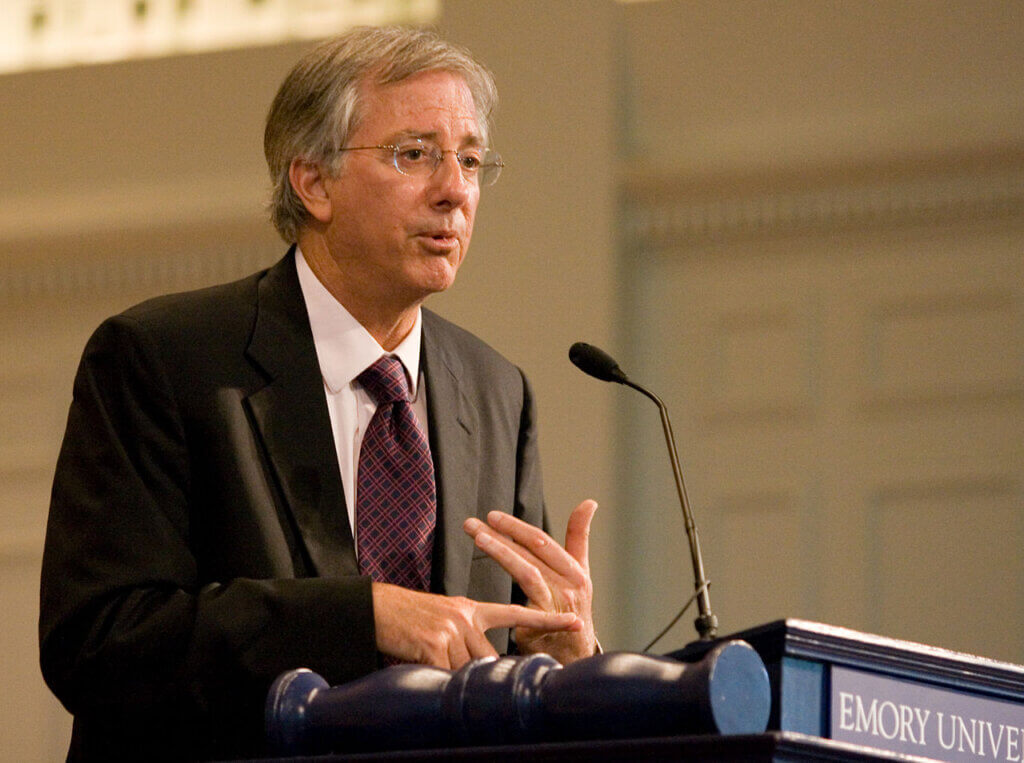
Dennis Ross, “Israel’s lawyer” who played key roles in crafting many of the agreements and political alignments that have defined Israeli rule over the Palestinians for the past three decades, suggested in The Atlantic last week that Russia’s invasion of Ukraine has a sharp lesson for the Biden Administration’s Middle East policy.
Ross says the United States must build a coalition in the Middle East that will counter Russia and its regional partner, Iran. And, while he never specifically mentions the so-called Abraham Accords, which normalized relations between Israel, on one hand, and the United Arab Emirates, Bahrain, and Morocco on the other, he leaves no room for doubt that this is the foundation he wants the United States to build upon.
While Ross pays some lip service to “concerns about human rights,” he is unequivocal in the pursuit of “our interests” as the priority. He focuses on the need to bring Saudi Arabia into a coalition built around confronting Iran, which, he says without irony, “has no interest in accepting the norms that the West believes should guide international behavior.” The implication that Saudi Arabia, the UAE, Egypt, Bahrain, Israel, et al have an interest in what might be thought of as democratic norms and respect for human rights would be laughable if it were not so dangerous.
Confronting Iran
It’s no coincidence that Ross published this piece mere days after a reported discussion between the staff at the White House and that of the Israeli Prime Minister’s Office about arranging a summit of regional leaders, including Israel and Arab countries, during Joe Biden’s planned visit to Israel at the end of June.
The content of that visit has not yet been determined, but Ross is eager to see it include cementing and expanding the regional military alliance that is the essence of the Abraham Accords. Despite claims of the Accords being a “peace agreement” or being focused on economic issues, Jared Kushner’s own description of the Accords stated bluntly, that they “serve to constrain shared threats from the Islamic Republic of Iran.”
Ross makes no secret of his desire to see an alliance of Israel and those Arab states willing to normalize relations with it confront Iran. “Thankfully, a growing coalition that includes the Saudis, Emiratis, Egyptians, Jordanians, Moroccans, Bahrainis, and Israelis is already cooperating to counter Iranian plans for the region,” he wrote.
Ross refers to people—Saudis, Israelis, Emiratis, etc.—rather than countries because Saudi Arabia has not yet agreed to normalize its relations with Israel. But this is a small detail, as Saudi-Israeli cooperation has been an open secret for many years. Still, Ross is eager to see the relationship brought into the open, to make joint operations easier.
He needs to press Biden on this point because the President has found himself caught between his rhetoric and his inclinations.
The politics of embracing a Mideast NATO
Saudi Arabia was never very popular among the U.S. public, and the murder of journalist Jamal Khashoggi as well as its devastating war in Yemen have made it even less so. Biden capitalized on this during his 2020 presidential run, vowing to “reassess” the U.S.-Saudi relationship. But he’s allowed the Khashoggi murder to fade from the agenda, and has, for the most part, continued to sell arms to the Saudis for use in Yemen.
Now, with the rise in global fuel prices due to Russia’s invasion and magnified by oil companies taking advantage of the price hike to gouge consumers, the Biden administration went to the Saudis hat in hand, begging for them to increase production so the price of oil, and the concomitant political heat on Biden and Democrats ahead of November’s midterm elections, would come down.
Biden was flatly refused. Ross, correctly, attributes that refusal to the cooling relationship between Saudi Arabia and the U.S. and Saudi uncertainty of U.S. commitment to its military needs and desires.
Beyond Biden’s immediate political considerations, he has another, broader political conundrum. Despite being criticized for what has been incorrectly perceived as “lukewarm” support for the Abraham Accords, Biden has been very supportive of pursuing more partnerships between Israel and Arab states that are willing to abandon even rhetorical support for the Palestinians in exchange for normal relations with Israel.
The problem for Biden is that the Accords are Donald Trump’s project, through his son-in-law, Jared Kushner, and promoting them enhances a political win for Trump and Republicans among Israel’s supporters across the U.S. political spectrum, one of Biden’s favorite audiences. So, he has tried to promote the widening of Israel’s relationships with Arab states more quietly, hoping to distance that progress from Trump.
Biden had hoped that he would be able to secure more commitments from Sudan toward Israel. Sudan did sign on to the Abraham Accords but has done little to act on them due to internal dissent. But the deepening political crisis in Sudan pushed those plans back. Instead, in the wake of the summit between the United States, Bahrain, Egypt, Israel, Morocco and the United Arab Emirates in late March and the increasing contacts last week, the process is moving forward with other countries, albeit slowly.
Competition for the Accords
Ross is aware of the political dilemmas that Biden is facing and is trying to push him past them. He also knows that Saudi Arabia is the big prize in an Israeli-led, anti-Iranian “Middle East NATO.” Saudi money allied with Israeli relationships in DC would mean a significant increase in the already tidal flow of U.S. arms to the region and would greatly increase the entire alliance’s ability to threaten Iran and its allies both in the Persian Gulf and throughout the Middle East.
Ross is also aware of the competition that the Abraham Accords and its vision of a regional faces. That competition is the dialogue between Iran, the UAE and Saudi Arabia that is taking place in Baghdad. Those talks, rarely reported on in the United States, have been going on since 2019, spurred, ironically, by Donald Trump’s refusal to take military action against Iran after an attack on Saudi oil fields.
The Baghdad dialogue is the other side of Saudi and Emirati concern about the support it can expect from Washington. It has spurred them to consider the possibility of a working relationship with Iran and at least explore that possibility even as it also works in Washington to enhance its military capabilities for a potential confrontation with the Islamic Republic. As one reporter in the Israeli daily Haaretz put it, “If the negotiations between the House of Saud and the Islamic Republic of Iran do result in an agreement and normalization, this will be the final chapter of the anti-Iranian coalition.” It would also envision peace in the Gulf region, rather than the permanent state of tension that Israel and the U.S. are promoting.
So, Ross makes the case for the United States to leave all considerations aside and mend ties with the Saudis. Never mind Khashoggi or Yemen. Forget the opportunity to accelerate the move to renewable energy so desperately needed to combat climate change. Embrace instead the Saudi dictatorship and its oil.
This is how Ross can say, without irony, that “Lebanon, Syria, Yemen, and Iraq are testaments to what awaits states where Iran exercises its influence,” completely ignoring the massive role the United States and Israel played, whether through action or inaction, in the horrifying destruction wreaked on all those countries.
It is also how he can make his policy case with no mention whatsoever of the Palestinians. Because the Abraham Accords and its vision of a Middle East cold war that is shared by Ross and the Biden administration are all about maintaining, not resolving, tension in the region. And, not incidentally, that regional cold war is also aimed at obliterating even the meager support Arab rulers, in contrast to their populations, have given to the Palestinians.


Ah yes, Dennis Ross, the pro-Zionist con artist. I am reminded of his role during the 2000 Camp David Summit:
Working in tandem, Barak and Clinton tried to shove a very bad deal down Arafat’s throat. It could only be rejected. To quote Shlomo Ben-Ami, Israel’s lead negotiator at Camp David 2000: ‘Camp David was not the missed opportunity for the Palestinians, and if I were a Palestinian I would have rejected Camp David, as well.’
Dennis Ross (then an executive with the Washington Institute for Near East Policy, a pro-Israel ‘think tank,’ and subsequently its director and chairman of the Policy Planning Institute for the Jewish People headquartered in Jerusalem), he repeatedly intervened during negotiations on Israel’s behalf.
What happened to CENTO?