
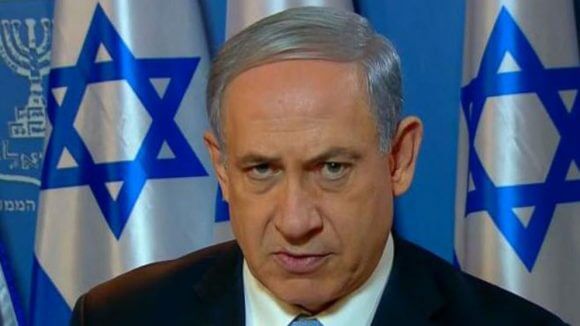
On November 1, Israeli citizens will go to the polls once again to elect a new government. As always, only a small percentage of Palestinians under Israeli rule—those with Israeli citizenship—will be able to vote in the election. But most Palestinians who have no say in the government that controls their lives and futures will be attacked by a sitting Israeli government that wants to prove it’s as tough as the farthest right-wing one would be.
As things stand now, Netanyahu and his likely coalition partners are just a tiny margin short of the support they would need to form the next Israeli government. But their opponents, be they led by Yair Lapid or Benny Gantz, are farther away from a majority because of their refusal to work with the largely Arab Hadash-Ta’al coalition. Only a very shocking result in the election or a defection from the pro-Netanyahu camp, which seems very unlikely right now, would keep Netanyahu in the opposition.
But it is not Palestinians who are concerned about a return of Benjamin Netanyahu to the prime minister’s office in Israel. Nor are they the ones fretting about a Netanyahu government which will undoubtedly feature even more explicit racists such as Itamar Ben-Gvir and Bezalel Smotrich.
No, the hand-wringing over a major right wing victory in Israel next week is largely coming from Israel’s centrist and liberal supporters in the United States.
The most obvious sign of concern came from no less a figure than Senator Bob Menendez (D-NJ). Axios reported that when he was in Israel in September, Menendez cautioned Netanyahu that “if he forms a government after the Nov. 1 elections that includes right-wing extremists, it could harm U.S.-Israel bilateral relations.” According to Axios, “Menendez told Netanyahu he has ‘serious concerns’ over a possible partnership with ‘extremist and polarizing individuals like Ben Gvir’ in a potential future government,” and didn’t back down when Netanyahu clearly got angry with the senator.
That’s no small event. Menendez is one of the most zealous pro-Israel Democrats in all of Congress. Another, Rep. Brad Sherman (D-CA) expressed his support for Menendez, adding, “I urge Israeli political leaders from all sides of the political spectrum to ostracize extremists like Itamar Ben-Gvir whose outrageous views run contrary to Israel’s core principles of a democratic and Jewish state.”
Some of the most prominent pro-Israel groups are just keeping their heads down. AIPAC, the American Jewish Committee, the Conference of Presidents of Major Jewish Organizations, and the Jewish Council for Public Affairs all say they won’t comment on the inclusion of Ben-Gvir, or on the Israeli elections in general, although they all publicly urged Netanyahu to stay away from Ben-Gvir in 2019. The Anti-Defamation League put out a much tamer statement than they did in 2019 as well.
One exception was the Democratic Majority for Israel, which exclusively targets the growing support for Palestinian rights within the Democratic Party. According to DMFI’s board co-chairs Ann Lewis and Todd Richman, DMFI believes “that the party led by Kahanist Itamar Ben-Gvir and Bezalel Smotrich should have no place in Israel’s governing coalition. Most Israelis find the views of these men abhorrent as they conflict with the country’s founding principles and the shared values that undergird the U.S.-Israel relationship.”
We can quickly dispense with the idea that these groups, much less members of Congress—none of whom support equal rights for Palestinians—are concerned about principles of democracy. But Ben-Gvir worries them and even aside from him, Netanyahu’s return itself is causing real consternation among those groups. So what is motivating that concern?
Ties to the Trumpian global right
The concern for pro-Israel groups in the United States is rooted in their connections to the Democratic Party. Even AIPAC, whose support for election deniers has strained their relationship with Democrats, recognizes that a coalition that includes Ben-Gvir and is led by Netanyahu is going to complicate matters with Democrats in Congress, and will provide an opening for more progress for advocates for Palestinian rights in the United States.
Specifically, it will widen the opportunities for rights-based, equality-centered advocates to expose the apartheid nature of Israel. That’s good news for the Palestine solidarity movement, especially the parts that have abandoned or never supported the two-state solution. But it is challenging for liberal Zionist groups that seek to maintain Israel’s status as a Jewish state while ending its occupation of the Palestinians, a goal which can only be achieved through two states.
Netanyahu’s close affinity with the global far right was very visible in his last few years in office. And while his sometimes close relationship with Donald Trump is now frayed, his deep ties to the Republican Party were laid bare over the course of his premiership. From his 2015 speech to Congress attacking President Barack Obama to his strong relationship with ultra-conservative Christian Zionist groups, Netanyahu has not only become strongly identified with Republicans, but is seen as a political nemesis by most Democrats. With the exception of a few extremists, like the racist television host Bill Maher, Netanyahu raises real concerns among Democrats.
As the Republican Party and the broader Conservative movement in the United States has fully and passionately embraced the European far right leader Viktor Orban, they are following Netanyahu’ lead. The problems a Netanyahu government in Israel—that country which so many Democrats endlessly remind us is our “true friend” and with whom we have an “unbreakable bond”—presents for Democrats are obvious. Any hope that they can continue to pretend that Israel is anything other than the apartheid state it has been shown to be by so many is severely compromised by the presence of so unsubtle a racist as Itamar Ben-Gvir.
Indelicate racism
Like his ideological mentor, Meir Kahane, Ben-Gvir is a very loud racist. He is less inclined toward subtle racist digs like Netanyahu’s infamous call to right wingers that “Arab voters are coming out in droves” in 2015, and more likely to point guns at and call for attacks on Palestinians, and to draw attention to himself by riling up extremist crowds.
Actions like that have been argued away, however disingenuously, as atypical of Israel, presented as the acts of a radical anti-Palestinian activist. But when the person doing those things is not just a Member of the Knesset, but a minister in the Israeli government, as Ben-Gvir is almost certain to be in the event Netanyahu forms the next government, it’s impossible to claim that he does not represent a legitimate part of both Israeli politics and culture.
DMFI’s claim that “most Israelis” are appalled by Ben-Gvir is undermined by the fact that the Religious Zionist coalition, headed by Bezalel Smotrich and including Ben-Gvir’s Jewish Power party, is currently projected to win 13-14 seats in the next Knesset. An August poll about a bill Ben-Gvir has proposed to deport any Israeli found to be “disloyal” to the state found “64 percent of Israelis approve of the legislation, rising to 80 percent among supporters of the right-leaning Netanyahu bloc. 47 percent of the centrist and center-left Lapid bloc voters also supported the measure.”

While that’s not necessarily a referendum on Ben-Gvir himself, it is about his signature legislation and therefore reflects the fact that whatever the precise amount of support he has may be, he is not outside the mainstream in Israel.
“Ben-Gvir is Kahane in the age of Twitter and his hatred and racism should have no place in any Israeli government,” Americans for Peace Now CEO Hadar Susskind said.
But Kahane’s Kach party, which was officially banned in 1994, usually failed to win any seats in the Knesset, and only ever held one at any time. The Israel of 2022 is a different place. The apartheid nature of the state has deepened over more than a quarter century, and more and more Israelis see Kahane’s racist ideology—which Ben-Gvir is unabashedly carrying on—as an acceptable norm, one which should not have to be talked about in hushed tones. This is reflected in the support not only for the parties of the Religious Zionism coalition but also in the attitude of Yair Lapid, who once kicked off a campaign with a rally in the West Bank settlement of Ariel and in the words of fellow “centrist” Benny Gantz, who once bragged about the massive number of “Arabs” he’d killed.
Given the prominence of these men, it’s impossible to argue that Ben-Gvir is much of an outlier. Certainly, he is less thoughtful, more bull-headed and reckless, and more of a racist rabble-rouser than the others who would confine their violent pursuits to orders given to police and soldiers. But if his views are more radical than those of Netanyahu, Gantz, and Lapid, it is not by anything like the orders of magnitude that some would like to portray it as.
Netanyahu’s return, with Ben-Gvir proudly at his side, is very much Israel 2022.

“complicate matters” means complicate their deception efforts. In reality, the Neo-cons (Neo-colonialists) all agree on their ethnic cleansing agenda. They think their story from 20 centuries ago gives them that right. Especially with so much gas and oil at stake. (Not to mention ruling the world from Jerusalem.)
From 2013 in the Atlantic, but nothing’s changed ( remove Atlantic cookies to get access ), italics mine:
https://www.theatlantic.com/international/archive/2013/11/bibi-netanyahu-the-non-negotiator/281893/
What needs to be understood about Bibi Netanyahu, who may prove in coming months to be the chief obstacle to a longer-term rapprochement between the U.S. and Iran, is that non-negotiation has been an article of faith with him for his entire political career. It is an attitude that goes back to his first term as prime minister in the late 1990s, when he privately boasted that he had “de facto put an end to the Oslo Accords.”…Netanyahu’s obstructionism has a long history. A videotape of him speaking to a gathering of right-wing settlers in 2001 is as revealing of his true feelings about the Palestinians as his good friend Mitt Romney’s infamous “47 percent” videotape was of the former Republican candidate’s beliefs about the American electorate. In Netanyahu’s first term, he appeared to negotiate at Wye River in 1998 and praised President Clinton for his efforts to come to an interim deal, but he later revealed to the settlers that he’d only been gaming the president. Netanyahu allowed that he had said he would honor the Oslo Accords, but then described how he had undermined them by eliciting American agreement to let him define security zones that Israel could maintain. Then he effectively defined the “entire Jordan Valley” as a military zone. “From that moment on, I de facto put an end to the Oslo Accords,” he said.
I thought Netanyahu was still under inditement. No surprise that he can still be elected in Israel. The further right the world moves the more Israel should be worried. The are already considered an apartheid nation by most of the world and the UN and others. The US staunchly still supports them. Moving further right endangers that support. It will take a lot to get them out of US politics, but this may be a start. Wake up world! This rightward worldly trend also ushers in governments akin to Germany prior to WWII.
1 of 2
Excerpts: Bibi, the huckster:
https://www.youtube.com/watch?v=JrtuBas3Ipw
Videos: July 17, 2010
https://www.youtube.com/watch?v=l9dLTOd3V-Y
https://www.youtube.com/watch?v=JrtuBas3Ipw
Bibi:…”The Arabs are currently focusing on a war of terror & they think it will break us. The main thing, first of all, is to hit them. Not just one blow, but blows that are so painful that the price will be too heavy to be borne. The price is not too heavy to be borne, now. A broad attack on the Palestinian Authority. To bring them to the point of being afraid that everything is collapsing…”
“Woman: Wait a moment, but then the world will say ‘how come you’re conquering again?’
Netanyahu: “The world won’t say a thing. The world will say we’re defending.”
Woman: “Aren’t you afraid of the world, Bibi?”
Netanyahu: “Especially today, with America. I know what America is. America is something that can easily be moved. Moved to the right direction.”
Child: “They say they’re for us, but, it’s like…”
Netanyahu: “They won’t get in our way. They won’t get in our way.”
Child: “On the other hand, if we do something, then they…”
Netanyahu: “So let’s say they say something. So they said it! They said it! 80% of the Americans support us. It’s absurd. We have that kind of support & we say ‘what will we do with the…’ Look. That administration [Clinton] was extremely pro-Palestinian. I wasn’t afraid to maneuver there. I was not afraid to clash with Clinton. I was not afraid to clash with the United Nations. I was paying the price anyway, I preferred to receive the value. Value for the price.”
In the following segment, Bibi boasts about how he emptied the Oslo Accords of meaning by an interpretation that made a mockery of them: Woman: “The Oslo Accords are a disaster.”
Netanyahu: “Yes. You know that and I knew that…The people [nation] has to know…” (cont’d)
2 of 2
“What were the Oslo Accords? The Oslo Accords, which the Knesset signed, I was asked, before the elections: ‘Will you act according to them?’ I answered: ‘yes, subject to mutuality & limiting the retreats.’ “But how do you intend to limit the retreats?” “I’ll give such interpretation to the Accords that will make it possible for me to stop this galloping to the ’67 [armistice] lines. How did we do it?”
Narrator: “The Oslo Accords stated at the time that Israel would gradually hand over territories to the Palestinians in three different pulses, unless the territories in question had settlements or military sites. This is where Netanyahu found a loophole.”
Netanyahu: “No one said what defined military sites. Defined military sites, I said, were security zones. As far as I’m concerned, the Jordan Valley is a defined military site.”
Woman: “Right [laughs]… The Beit She’an Valley.”
Netanyahu: “How can you tell.? But then the question came up of just who would define what Defined Military Sites were. I received a letter to me & Arafat, at the same time — which said that Israel, & only Israel, would be the one to define what those are, the location of those military sites & their size. Now, they did not want to give me that letter, so I did not give the Hebron Agreement. I stopped the government meeting, I said: ‘I’m not signing.’ Only when the letter came, in the course of the meeting, to me & to Arafat, only then did I sign the Hebron Agreement. Or rather, ratify it, it had already been signed. Why does this matter? Because at that moment I stopped the Oslo Accord.”
Woman: “And despite that, one of our own people, excuse me, who knew it was a swindle, & that we were going to commit suicide with the Oslo Accord, gives them — for example — Hebron…” Netanyahu: “Indeed, Hebron hurts. It hurts. It’s the thing that hurts. One of the famous rabbis, whom I very much respect, a rabbi of Eretz Yisrael, he said to me: ‘What would your father say?’ I went to my father. Do you know a little about my father’s position?”
“He’s not exactly a lily-white dove, as they say. So my father heard the question & said: ‘Tell the rabbi that your grandfather, Rabbi Natan Milikowski, was a smart Jew. Tell him it would be better to give two percent than to give a hundred percent. And that’s the choice here. You gave two percent & in that way stopped the withdrawal.’”