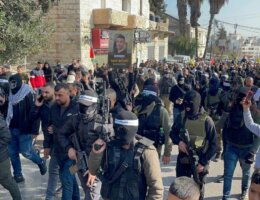
Palestinian political prisoner Nasser Abu Hmeid, 50, died in Israeli custody on Tuesday morning, following a bout with cancer and months of “medical negligence” on part of Israeli authorities, according to his family and Palestinian prisoners groups.
Today I see some hope in the American discussion of Palestine. I believe the politics of Palestine are changing in irreversible ways; we can take some credit for that change and look forward to the great shift we have long yearned and prayed for.
Despite the continuation of resistance, Palestinian deaths dropped in comparison to the Israeli onslaught of the previous weeks. This means one thing: the decision to kill is political.
As Mondoweiss has continued to point out, this signals the revival of the decades-old Israeli policy of “liquidation,” an attempt to restore Israeli deterrence through the obscene practice of raising the Palestinian body count.
The New York Times appears to be tired of cheerleading for Israel, witness two opinion pieces this weekend: a long report by Thomas Friedman in which the columnist admitted at the start that “the prospect for a two-state solution has all but vanished;” then, a full page offering by the entire Editorial Board headlined that says that Benjamin Netanyahu’s likely next coalition government “is a significant threat to the future of Israel.” Neither article mentions apartheid.
Human rights defender and lawyer Salah Hammouri was deported from his homeland on December 18, after the Israeli government revoked his Jerusalem residency under the Israeli “breach of loyalty” law.
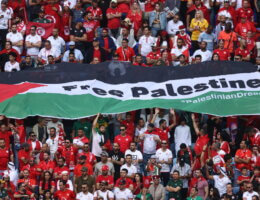
As Qatar witnessed, Palestinians are engaged in a great and historic struggle. Which side are you on?
Fida Jiriyis’s memoir is the product of her unique and multilayered experience of the different fragments of Palestinian existence — as an exile, in the diaspora, as a Palestinian citizen inside Israel, and in Occupied Palestine.
The book offers more than just a personal glimpse into each of these very distinct realities. It viscerally evokes the flavor of each modality, each moment, wedding the historical facts to the writer’s own impassioned feelings and unfettered impressions.
Our video on the unprecedented levels of Palestine solidarity at the tournament has garnered over 1.2 million views across our social media platforms. Can you make a generous gift today to produce video journalism from Palestine in 2023?
The kind of power that supports the Palestinians manifests slowly, but not gradually. It takes a long time to get to a tipping point, and before it does, nothing really changes. Apartheid goes on, settlers continue to rampage, Congress continues to flood Israel with money and the Palestinians with condescending criticism, Gaza continues to be a giant open-air prison.
But fortunately for the Palestinians, the U.S. is not the key to Palestinian liberation. The Palestinian people are.
Members of the Palestinian national team never just played to win. They played to bring Palestine to the world, and the world into Palestine.
But the new generation of aspiring footballers want to bring the World Cup home. If Morocco’s historic victories this year have taught us anything, it is that nothing is impossible.